By Will Lerner, Communications Manager for Portland Japanese Garden & Japan Institute
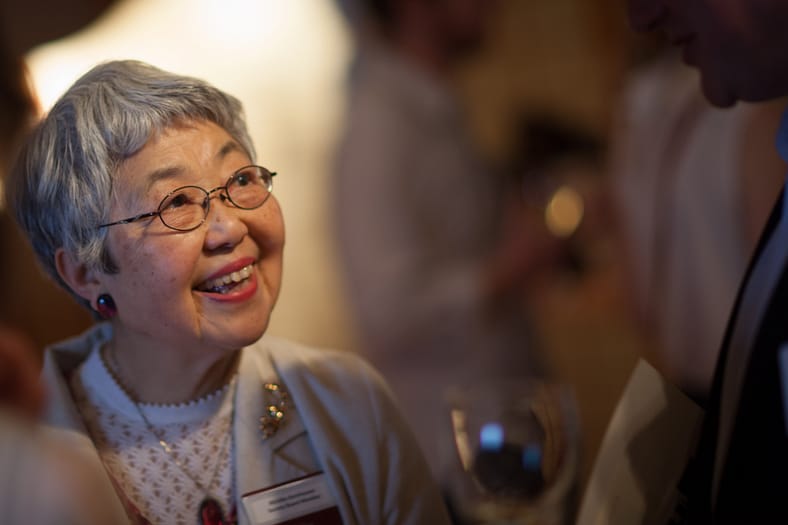
Portland Japanese Garden has been and always will be a community effort. Founded by civic leaders in government, business, and cultural organizations in 1963, it has been a place of nature, beauty, and cultural understanding for more than 60 years. And while it has relied on every single person who has worked for it, volunteered for it, joined it as a member, or even just visited once to make it the acclaimed world class organization it’s known as today, there are certain individuals who stand out as having made exceptional contributions to it. One such person is former Trustee and Garden Resource Committee Member Michiko Kornhauser. It is our pleasure to present this profile on an individual who has helped elevate the Garden as an institution.
The irony of war is that regardless of how many bombs are assembled or bullets are cast, these tragic conflicts almost always end with people talking to one another—no violence is ever enough to cease hostilities. The key, then, to avoiding the wanton destruction of lives and homes and futures, is to create and maintain the spaces where we can foster dialogue. Otherwise, we’re figures on other side of the canyon, too distant to see one another’s human features. But if we can bridge the divide, we can come closer and recognize that perhaps our differences aren’t that numerous and there can even be appreciation in those that do exist.
This has been the case for Michiko Kornhauser, a longtime supporter and former Board Trustee of Portland Japanese Garden. As a child, she witnessed firsthand the brutality of warfare when her home in Japan was quite literally destroyed around her during World War II. Despite experiencing a series of traumatic events, she refused bitterness and declined to hate the American people. She instead moved to the United States, met as many people from as many places as she could, recognizing that our only planet’s diverse output of humanity is a remarkable gift. This summer, Kornhauser sat down with staff from the Garden to talk about her life and connections to the organization.
Raised Amidst Warfare
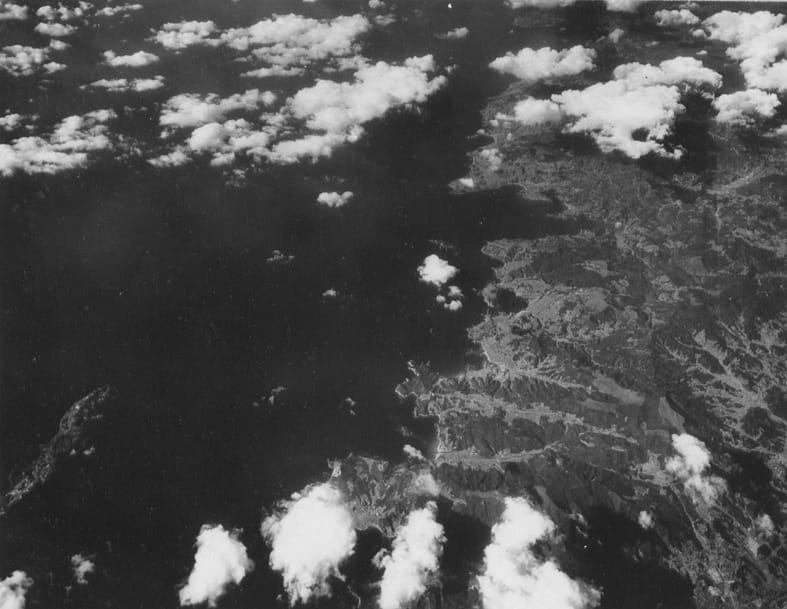
Michiko Kornhauser was born in 1936 on a naval base in Sasebo, Nagasaki, her father being an officer in the Japanese Navy. Because of her father’s profession and the family’s frequent moves, she claims no city as her hometown. For a time, they settled in Kamakura, once a medieval seat of power in Japan south of Tokyo. As the winds of war began to gain velocity, the young Kornhauser was still able to enjoy aspects of the area’s rich cultural heritage.
“I would go to Koraku-en, one of the three greatest gardens in Japan,” she recalls. “I was so lucky, it was wonderful. I became familiar with how people can care for the land and really enjoy it—it’s the same enjoyment I had when I came here to Portland.”
However, an idyllic life of luxuriating in elegantly composed landscapes was short lived for Kornhauser. “I remember walking on the beach when we heard the Pearl Harbor attack occurred and how furious my father was,” Kornhauser shares. “He felt the Emperor was wrong to declare war against the United States—we didn’t have the natural resources to go against the United States. My mother was so concerned that the military police would be everywhere. After that, the government reorganized the Japanese Navy and split the country into two as far as support and supply systems were concerned. My father became a leader in Western Japan and was headquartered in Okayama.”
So many of us today have been fortunate to not have been raised in the middle of a war—it is something that resides in the text and images on a glowing screen or in print, far enough away that we can’t feel the grasp of conflict’s agonizing touch. Kornhauser would not find this comfort until later in life. As a child, she saw the worst impulses of humanity cause havoc.
Related: Dr. Calvin Tanabe Recounts His Youth in an American Concentration Camp During WWII
In 2003, she spoke with Stephan Gilchrist for an interview with the Japanese American Museum of Oregon about living through the bombing of Okayama. “I lost 25 percent of my classmates on the 29th of June, 1945, when 138 B-29’s came and drop 15,000 firebombs on us,” she told Gilchrist. “When that happened, …my best friend was gone. And I played with her and said, ‘See you tomorrow,’ and tomorrow never came. When I think about those things as a little child, and I said to myself, ‘I have to live for those people who died… not just for myself.’ That really kept me going in many ways, I think.”
The devastation of World War II would not cease simply because Japan surrendered. Soon after, the nation entered a time of stark poverty. Kornhauser recounted the vicious tragedies she experienced after the war ended on August 15, 1945 to Gilchrist in 2003. “And then I think the 10th or 11th of September, my youngest brother Seigo starved to death. I still remember the night before, I was able to find only about five, six grapes, and I remember squeezing juice and then feeding him, and that was not enough for him to survive. And next morning, my mother woke me up and said, ‘Michiko, Seigo is gone.’ And then I woke up and I looked at Seigo’s face and was all white, and he was gone, and I remember crying a lot and then telling myself that I was going to live for him too. And then that really stayed with me throughout my life that I don’t have time for small things. Every time I felt sad, and then I thought about my brother that he didn’t have a chance, then I was able to get up and go. And then also that I never treated other people in a mean way. It’s because of that experience.”
It would have been understandable if Kornhauser had developed a hatred of the United States with her community destroyed and her father killed in action in New Guinea. And yet, despite it all, she avoided animosity to the once enemy and future longtime home. “In the 1880s, my grandfather went to the University of Illinois, so I was always interested in going to the U.S.,” Kornhauser says. “Hating other nations never occurred to me because we have so much to learn from each other.”
Related: The Story of Oregon’s Nikkei
After high school, Kornhauser noted in 2003 to Gilchrist that she became one of the first woman to enter the Department of Agriculture at the University of Okayama. She would wind up working and studying in a few of the university’s departments until an opportunity arose to do graduate work at the University of Hawai’i’s new East-West Center. The Center was “was established by the United States Congress in 1960 as a national educational institution to foster better relations and understanding among the peoples of the United States, Asia, and the Pacific islands through programs of cooperative study, training, and research.”
The East-West Center was a wonderful opportunity to enlarge my view,” Kornhauser shared. “I got to know Chinese and Korean people and learn how they suffered under Japan.”
From there, Kornhauser would eventually leave for the continental U.S., experiencing the joys of meeting new people from different places and working for places like the Communicable Disease Center (now named the Centers for Disease Control and Prevention in Atlanta) and studying subjects like marine biology at the University of Washington. Eventually Kornhauser would back up at the East-West Center. Here she would meet and marry David Kornhauser. The two would eventually retire in Oregon in the mid-1980s. This is when her relationship with Portland Japanese Garden began.
Helping the Garden Prosper
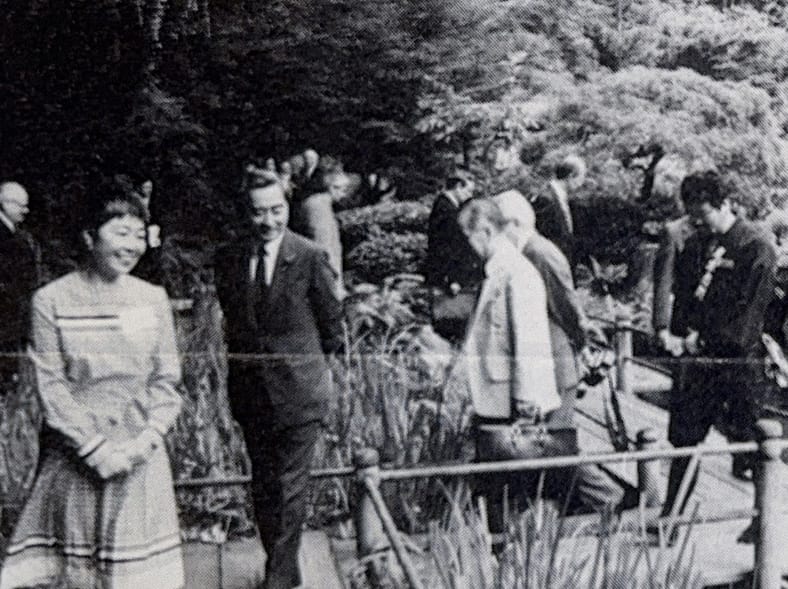
“The first time I came to the Garden, I went to the gate,” Kornhauser says, referring to the organization’s original entrance before its expansion in 2017. “I said, ‘I’m from Japan, maybe I can help you.’ They asked, ‘Will you become a volunteer guide?’ And that’s the way I got involved, it was right away. I took lessons on the Garden and how to be a guide. I gave tours in English and Japanese. When Japanese people were visiting, the Garden would call me. I wanted to help the Garden prosper. At that time, they needed the help.”
Kornhauser notes that as she has gotten older the number of things she can recall from her nearly 30-year relationship with the Garden have begun to fade, only remembering scant details such as serving as an unofficial interpreter for Toru Tanaka, who served as Garden Director from 1988 to 1991. Fortunately, archival issues of The Garden Path, the organization’s member magazine, can provide more details about the breadth and depth of her generosity. Kornhauser’s extensive history of fostering connections between cultures and fluency in both Japanese and English was quickly realized to be an invaluable resource.
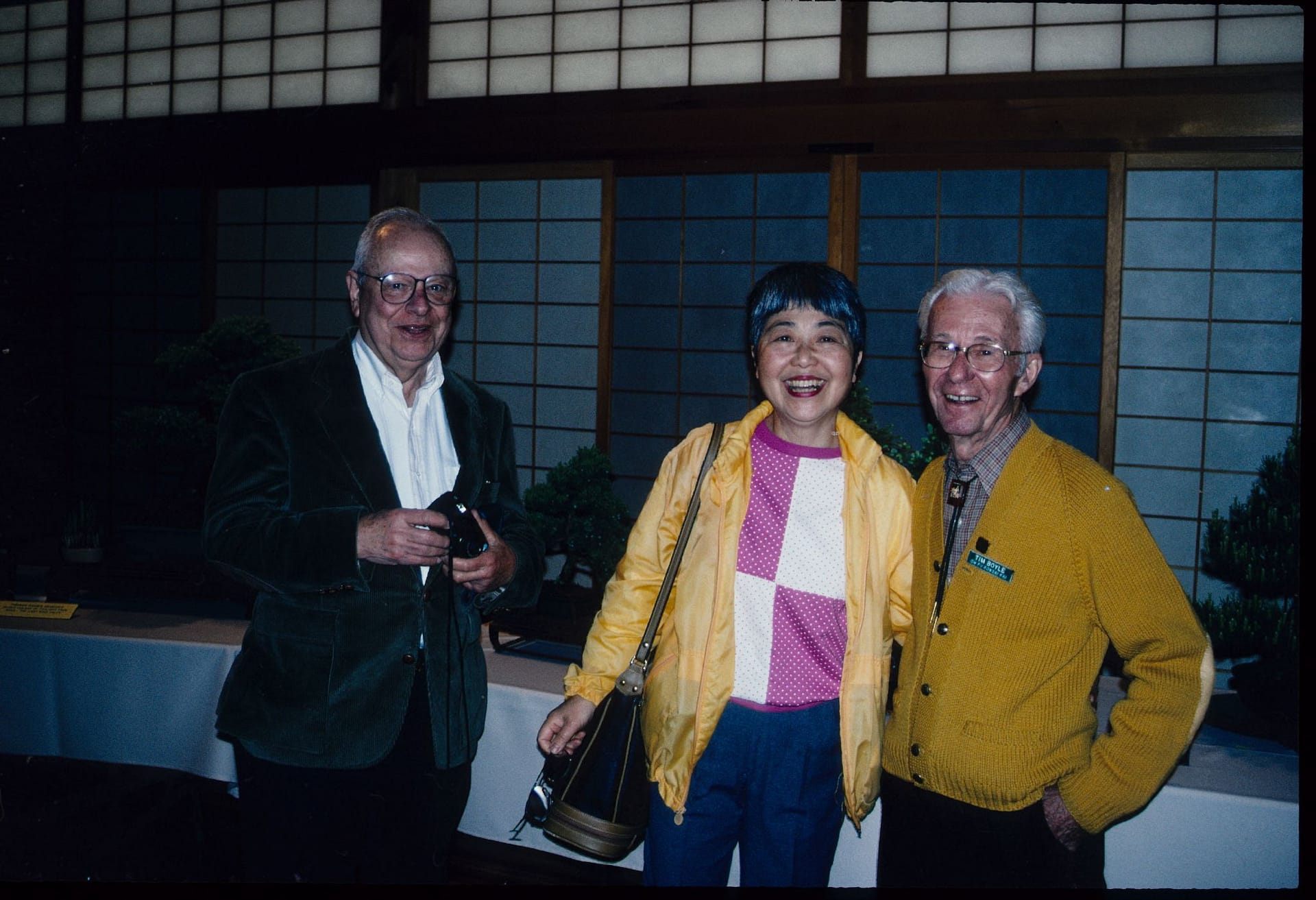
Within two years of being a volunteer guide, Kornhauser was tapped to help lead tours with visiting Japanese dignitaries. Notably she was there to help receive His Excellency, Nobuo Matsunaga, Ambassador of Japan to the United States (1985-89) when the diplomat visited the Garden during its 25th anniversary in 1988. Ambassador Matsunaga’s declaration that Portland Japanese Garden is the most beautiful and authentic Japanese garden outside of Japan was a seminal moment for the attraction and gave it early footing as a leader in its field. Kornhauser would once again take on the responsibility of welcoming an important representative of Japan in His Excellency, Yasuhiro Nakasone, former Prime Minister (1982-87) on a late summer day in 1990. Prime Minister Nakasone would exclaim the beauty of the Garden.
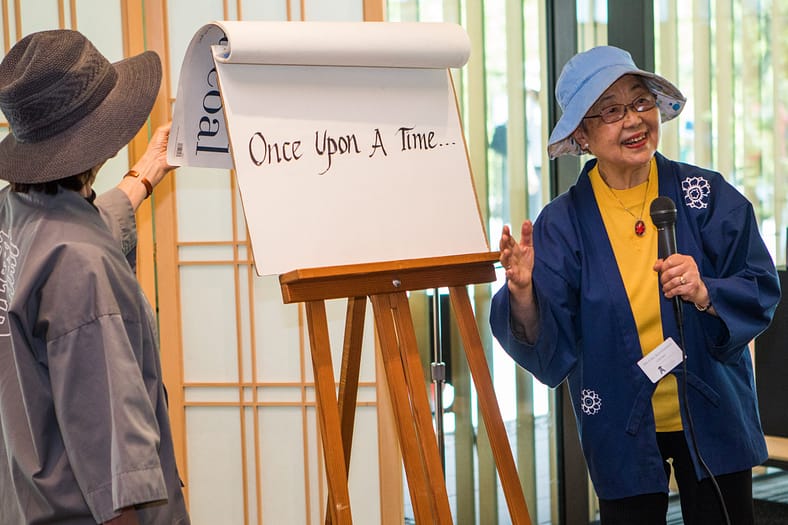
Her gifts would not be limited to strolls along the Garden’s pathways, however. In 2002 it was noted that Kornhauser was flying to Los Angeles to receive an “outstanding calligraphy award to be presented at the Japanese American Cultural Community Center.” This issue of The Garden Path went on to share, “She would have received this award in Japan, but her schedule did not permit her to fly there at this time. Michiko says of the award, ‘I still think there is some kind of mistake because I do not think I am that good yet.’”
Occasionally giving lectures on facets of Japanese culture, such as kokeshi dolls, Kornhauser was also a regular participant in the Garden’s Tanabata (Star Festival) celebration, performing storytelling of the Chinese folk legend of two stars that were in love but banished to opposite ends of the Milky Way—Hikoboshi, the Cowherder Star (Altair), and his lover, Princess Orihime, the Weaver Star (Vega).
A Positive Life
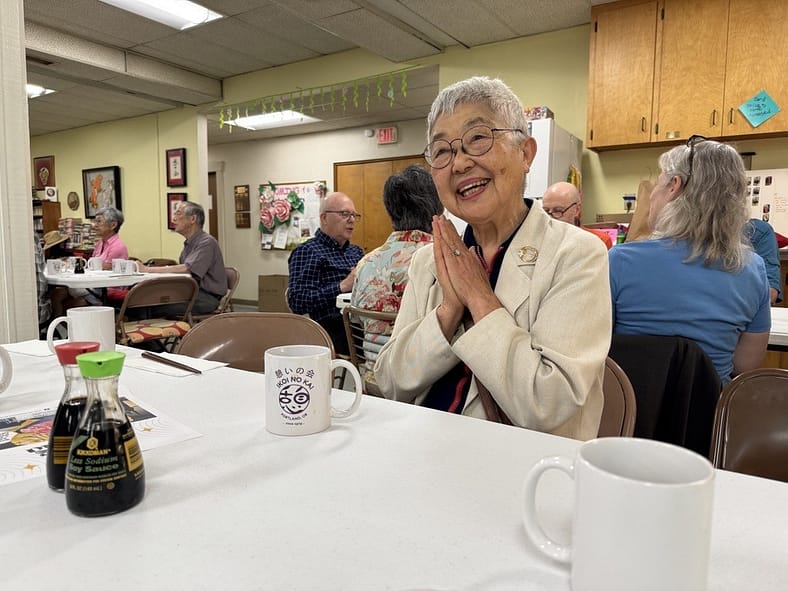
Now 89 years old, Kornhauser is still enthusiastic and social. She wakes up every morning and takes long walks in her neighborhood and most weekdays spends time with her friends at Ikoi no Kai, a Nikkei (Japanese diaspora) lunch and cultural program that was founded by the Japanese Ancestral Society in 1979. There she enjoys healthy meals, sings in a chorus, and participates in activities like tai chi and haiku writing. Once a month she takes calligraphy courses at the Oregon Buddhist Temple. It is an excellent life, brimming with joy.
“As I got older, I realized that I have 24 hours a day and I should occupy that time in as useful a way as possible,” Kornhauser shares. “Instead of crying for being alone or thinking about my [late] husband I started working. I like to think positively about life.”
She still has a guiding touch with Portland Japanese Garden, still lending her expertise and experience when approached, providing the organization with advice as it fosters its grounds and programming.
“It’s such a nice place, I want people to go there and grow up with a nice atmosphere like that,” Kornhauser concludes. “The Garden broadens the scope of peoples’ way of thinking about the world. I want school children to visit the Garden and enlarge their scope so World War II will never happen again. The more young people learn about different cultures, the more peaceful the world will become.”