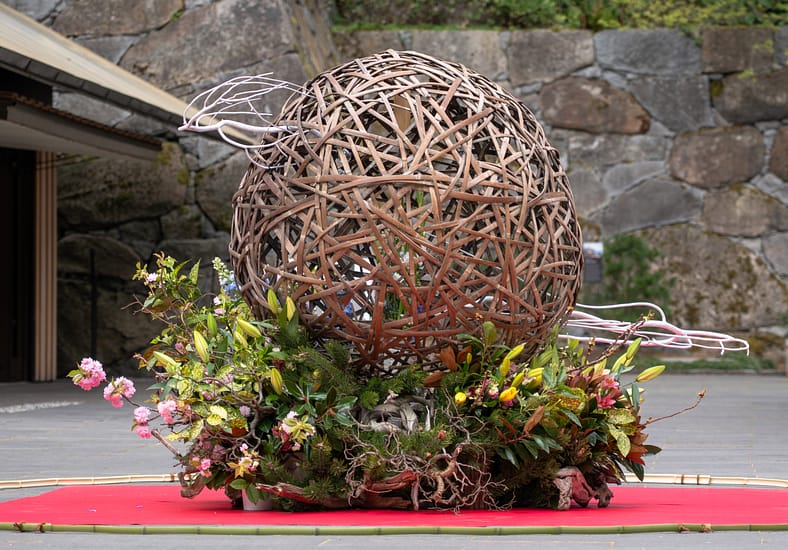
Shakamuni Buddha’s birthday is commemorated on the eighth day of the fourth month. In Japan, this celebration is called Hana Matsuri. Saga Goryu North America Chapter will offer an ikebana installation for Hana Matsuri at Portland Japanese Garden from April 8 through 11. Members and guests who pay admission can enjoy this special display in the Atsuhiko and Ina Goodwin Tateuchi Foundation Courtyard.
The theme of this year’s ikebana installation is akari, or “bright,” which was inspired by the Imperial New Year’s Poetry Reading.
His Majesty the Emperor composed the following waka poem for the event:
Watching the morning star
Shining high in the sky
I pray sincerely for
Peace in the new year
Ikebana, the Japanese art of flower arranging, has been translated as “living flowers” or “giving life to flowers.” It dates to the sixth century when China and Korea introduced Buddhism to Japan. Floral offerings, known as kuge, were placed on the altar of temples.
Akari (明): Reflected Light, Perception, and Presence
Akari (明) is often translated as “light” or “brightness,” but the meaning is more nuanced within a Japanese aesthetic and philosophical context. The character 明 is composed of the elements for sun (日) and moon (月), suggesting light that arises through relationship rather than from a single source. In this sense, akari is not simply illumination, but the experience of light as it emerges within darkness—made perceptible through contrast, shadow, and the conditions that allow it to be seen.
In this ikebana installation, light is approached indirectly. Rather than presenting light as a dominant force, the work explores how light is received, reflected, and perceived, revealing a sensibility in which subtlety and suggestion invite deeper attention.
A bamboo sphere representing the moon rests at the center of the arrangement. Created by bamboo artist Jiro Yonezawa and donated by the late Ken Pincus, the sphere recalls a celestial body that does not produce its own light, but reflects the light of the sun. In an outdoor setting, this relationship becomes immediate as the sphere receives and reflects natural light, shifting with time and atmosphere. In doing so, it transforms a distant source into something softer and more contemplative.
The sphere is elevated on driftwood, creating the impression of suspension. Shaped by water and time, the driftwood introduces a sense of natural process and impermanence.
Weeping mulberry is placed horizontally, offering a quiet suggestion of clouds and gently framing the moon. Its lateral movement establishes a soft horizon and gives form to ma (間)—the meaningful space between elements—where light is partially obscured and revealed again.
Suspended from the bamboo sphere are crystal prisms and a wind chime, suggesting the gogyō (五行), or Five Elements: Wood, Fire, Earth, Metal, and Water. These are understood as dynamic processes describing how phenomena arise, interact, and change. The prisms refract light into shifting patterns as their sparkle catches the viewer’s eye, revealing the fleeting nature of light. The wind chime responds to air, introducing subtle sound and movement. Together, these elements are experienced through interaction—light, sound, material, and space in relationship.
The arrangement invites a moment of stillness. Light shifts, sound appears and fades, and forms seem both present and suspended. Within this space, viewers are encouraged to slow down and notice how light emerges, how it changes, and how meaning arises through perception. Akari is not only something we see, but something we experience: a quiet awareness of light within darkness, and of presence within the space we share.
More About the Saga Goryu School of Ikebana
The Saga Goryu School, started by Emperor Saga, founder of Daikakuji Temple in Kyoto, aims to introduce visual and spiritual pleasure into daily life. To do this, the School teaches techniques of floral decoration, and the skills to recognize the delicate beauty of flowers and their artistic value. According to Saga Goryu, ikebana is more than a classical art of ancient origin to be appreciated by an exclusive group of specialists. It is an art form that is still relevant today.
Portland Japanese Garden would like to thank James F. and Marion L. The Miller Foundation, Oregon Arts Commission, and Toshiba International Foundation for their support of arts and culture programming.