
By Will Lerner
Portland Japanese Garden’s Phoenix Legacy Society recognizes and stewards individuals who want to support the organization through their estate. Working alongside our Development Department, those in the Society make a commitment to support the Garden with a planned gift, ensuring that the end result aligns with their philanthropic interests. Joining the Phoenix Legacy Society is an incredibly generous and thoughtful way to honor the Garden and help ensure it remains able to pursue its mission of Inspiring Harmony and Peace for generations to come. We recently sat down with two members of the Society, Scott Shiigi and Bill Melcher, about why they decided to make this meaningful gesture.
One Short Personal Ad, One Long Shared Life

Shiigi and Melcher, a retired couple and residents of Portland for decades, first met in Hawai’i. Shiigi, Sansei (third-generation Japanese American), was born there and raised among a vivid tableau of colors but it would be in plain black and white through which he met Melcher, a Pennsylvanian transplant.
“I was in the Army,” recalls Melcher, who served as a physician. “People weren’t getting tossed out of the military [for being openly gay] so I decided that it was time to come out and start dating men. I put a personal ad in the newspaper because the internet didn’t exist. Scott answered the ad and we’ve been together ever since.”
“We saved the ad and have it in a photo album,” Shiigi, a retired landscape architect, adds.
After two years together in Hawai’i, Melcher wanted to explore other career opportunities. Shiigi, who thought he might spend his entire life there, agreed to move to the continent with the stipulation that it had to be on the West Coast. After considering places like Seattle and San Francisco, they settled on Portland. Shiigi had been familiar with the area, having been a student at the University of Oregon before finishing his undergraduate studies in Southern California. It was through this time in Eugene that he also first became aware of Portland Japanese Garden, making the occasional trip up north to check it out.
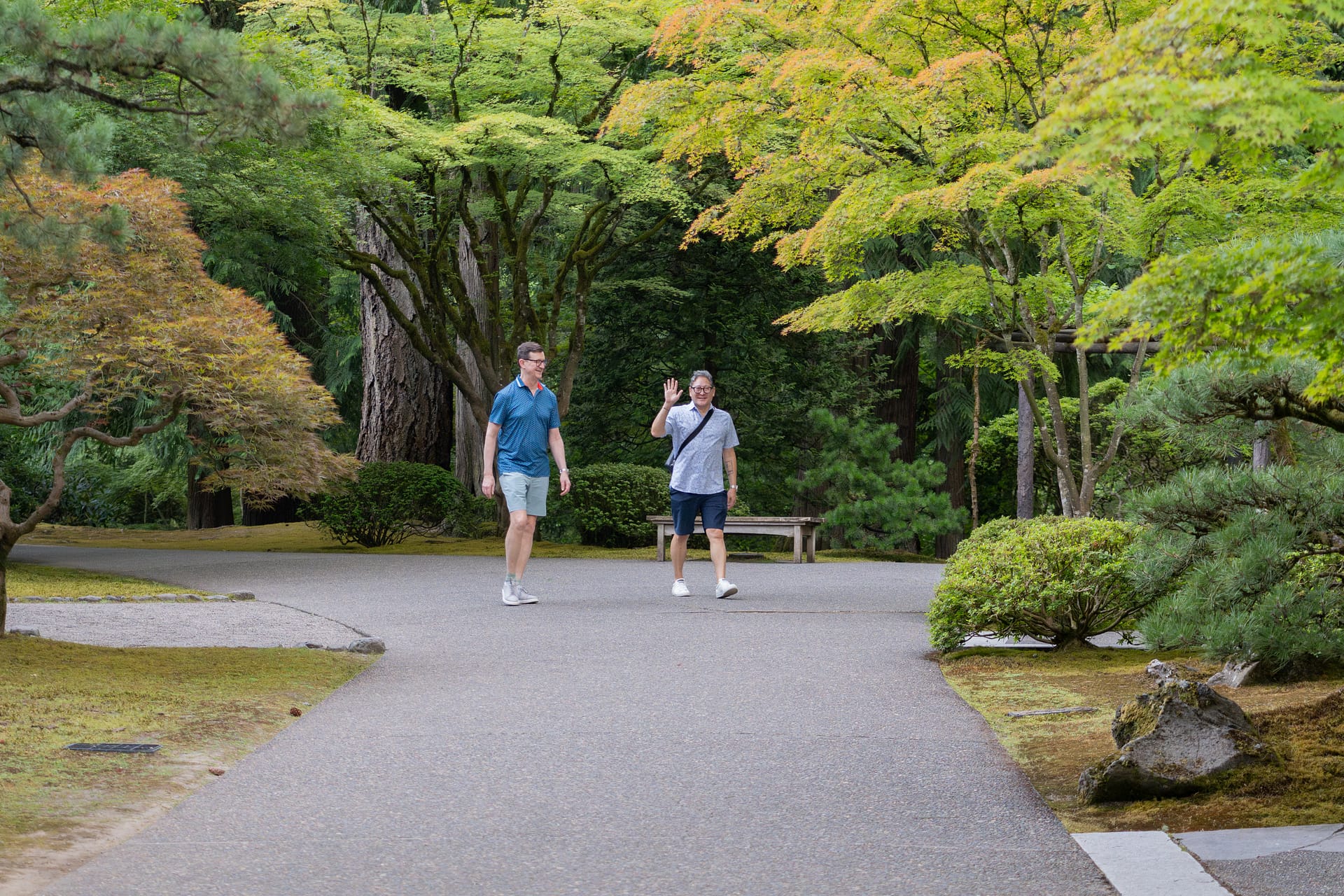
After moving to the area in 1995, the Garden became one of their regular haunts. “I think of this hill as our Portland happy place,” shares Melcher.
“I like the procession up the hill, the way you transition out of the city,” Shiigi says. “You’re walking under trees, enjoying nice smells and hearing the crunch of gravel under your feet. It’s a nice way to calm down. And then when you’re up top, the spaces are unique and there are a variety of experiences that I really enjoy. I think it’s wonderful. Every time we come up here, and we come up here a lot, I feel like there are so many new things to see. The dynamic is always changing there’s something different to appreciate. It keeps it exciting and interesting.
“You’re always discovering something new,” Melcher agrees.
Creating and Fostering Connections to Japan
As those who visit the Garden know, beyond the beauty and restorative qualities of the landscape, it is also a site of authentic cultural immersion. For some, it’s an introduction to Japan—its customs, its artforms, its perspectives. For others, it’s a means to better understand their own background, as is the case for Shiigi.
“My grandparents were originally from Japan,” Shiigi notes. “When I was 17, I went to Japan for the first time and I spent two weeks, seeing everything, including gardens. It was wonderful, but I don’t think I fully appreciated the experience. As I got older and my parents passed, I began to appreciate my personal history more. It wasn’t that I hadn’t cared before, it’s just that I was distracted by other things. As I matured, my connection to my ancestry became more important.”
“I moved from Honolulu, a very multicultural place, to attend the University of Oregon, but there was a huge Hawai’ian population there so I felt a bit insulated,” Shiigi continues. “Moving to Portland was different—Bill and I first lived in West Linn, which has a predominantly white population. I didn’t feel isolated, but when I would stop and think about it, I’d go, ‘Oh yeah, I’m the only [person of Asian ancestry here].’ It’s nice to come to a place that makes you feel proud—seeing the beauty and people appreciating it. It’s a comforting place.”
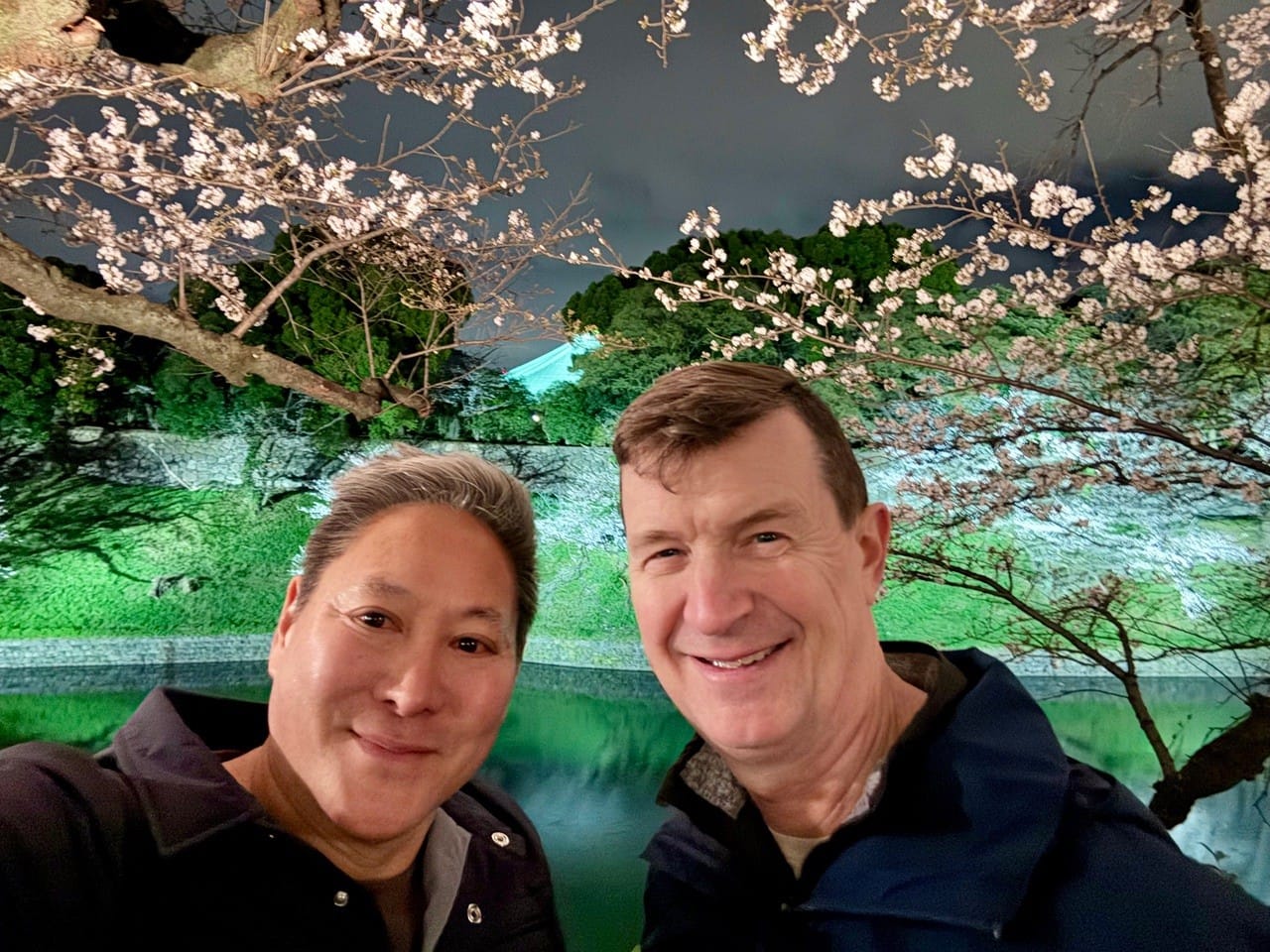
Meanwhile, for Melcher, it’s immersion in a culture that interests him as well the opportunity to learn more about the background of the man he loves. “Thanks to Scott and his family and the interest they have in their heritage, we’ve been fortunate to get to Japan a few times. We went to see the sakura (cherry blossoms) last year. I think we’re fortunate that the Garden brings Japanese culture here. I’ve learned more about the history of Japanese gardens, ikebana, sake, and Tea Ceremony. The Garden is spectacularly educational.”
A Bridge to the Future
Gardens, by their very nature, are a multigenerational form of expression. The vision of Professor Takuma Tono from Tokyo Agricultural University, our original designer, would be for naught absent the stewards who followed. This place is a continuum. We hope to only know the first point of the line and strive to do what we can to make sure the final point is never discovered. The Phoenix Legacy Society is the clearest and among the most resonant ways to do this because it acknowledges that our mortality is finite but our care need not be. Melcher and Shiigi want others, folks they’ll never meet or know, to experience Portland Japanese Garden.
“This truly is a happy place,” Melcher shares. “When you come here and walk around, your mind clears up. I think this is the best place to come for harmony and peace. If you want to be a more fulfilled person, do as much as you can with Portland Japanese Garden. I feel like it has enriched me so much. This organization is helping change the world. Of all the places we’re thinking about leaving money to, the Garden has maybe the most earth-changing potential. We want to make a difference, and this organization is making a difference.”
“My parents have given my brother and me lives that we could not have imagined,” Shiigi adds. “I feel that honoring and remembering their legacy is important. Including Portland Japanese Garden as part of this feels natural for me. Everyone’s situation is unique but for us, thinking of our legacy, it’s great because the contributions we make here will endure beyond our lifespan and help future generations.”

The news of today, so often punctuated by conflict, can sometimes feel like a specter that haunts every conversation and quiet moment. But it is not the first time substantial challenges have arisen—we’re not even a century past World War II, an event that would eventually inspire the establishment of Portland Japanese Garden. In hopes of preventing future generations of Portlanders perceiving those of Japanese ancestry as the enemy, the city’s civic leaders created a space of beauty and cross-cultural understanding. These founders overcame hostility and now more than 60 years later, a Japanese garden has become a crown jewel of the region. It goes to show how gardens grow more than plants and that resonates with Shiigi and Melcher.
“My father served in World War II for the 442nd Infantry and he was wounded by a mortar shell in Italy,” Shiigi shares. “He was just a kid—it’s difficult for me to comprehend how terrifying it must have been. The Garden being borne out of the healing that was needed after the war is especially important to me, personally. The story here is especially critical in our current climate. And as a minority in many ways, promoting peace over hate and division is critical. We don’t want to repeat the past.”
“The Garden puts on so much here and that takes a lot of hard work and support,” Melcher concludes. “My hope would be that continue to do everything you’re doing. The Garden has a world class landscape, art shows, and educational experiences. There are so many different and varied experiences—it’ll help gather new audiences here.”

For more information about Phoenix Legacy Society, contact Claire Eisenfeld, Director of Development, at ceisenfeld@japanesegarden.org or (503) 542-0281.
Will Lerner serves as Marketing and Communications Manager for Portland Japanese Garden and Japan Institute.