By Will Lerner
On January 31, Living Traditions returned for a new installment in what has become an anticipated annual tradition of conversations and talks exploring the most iconic facets of Japanese culture and traditions. Launched in 2020 as a joint project of Japan Institute of Portland Japanese Garden and Japan Society, 2026 was the third year of a Portland-based, in-person gathering, once again returning to Cheatham Hall at the World Forestry Center in Washington Park.
This year, the afternoon gathering was titled “Visions of Water: Revitalizing Cities, Landscapes, and Community Life” and was centered around water as a bridge between heritage and innovation. Featuring historic examples such as Kyoto’s sophisticated networks of rivers, canals, and springs alongside contemporary architectural responses shaped by climate, community, and place, this year’s program brought together an insightful panel discussion of global leaders in landscape design, architecture, and urban culture:
- Balázs Bognár, Partner & Executive Vice President, Kengo Kuma & Associates
- Kathryn Gustafson, Founding Partner, Gustafson Porter + Bowman
- Shunsaku Miyagi, Founding Partner, PLACEMEDIA Landscape Architects Collaborative & Visiting Professor in Landscape Architecture, Harvard Graduate School of Design
“There is a special kind of magic in bringing together voices so compelling that even a single word like water becomes a world,” shares Aki Nakanishi, who in addition to his roles of Co-Chief Executive Officer and Arlene Schnitzer Curator of Art, Culture, and Education at Portland Japanese Garden, served as emcee and moderator. “Our speakers kept us leaning forward the entire time. I remain in awe of the opportunity to engage in conversation alongside these three remarkable thinkers and makers.
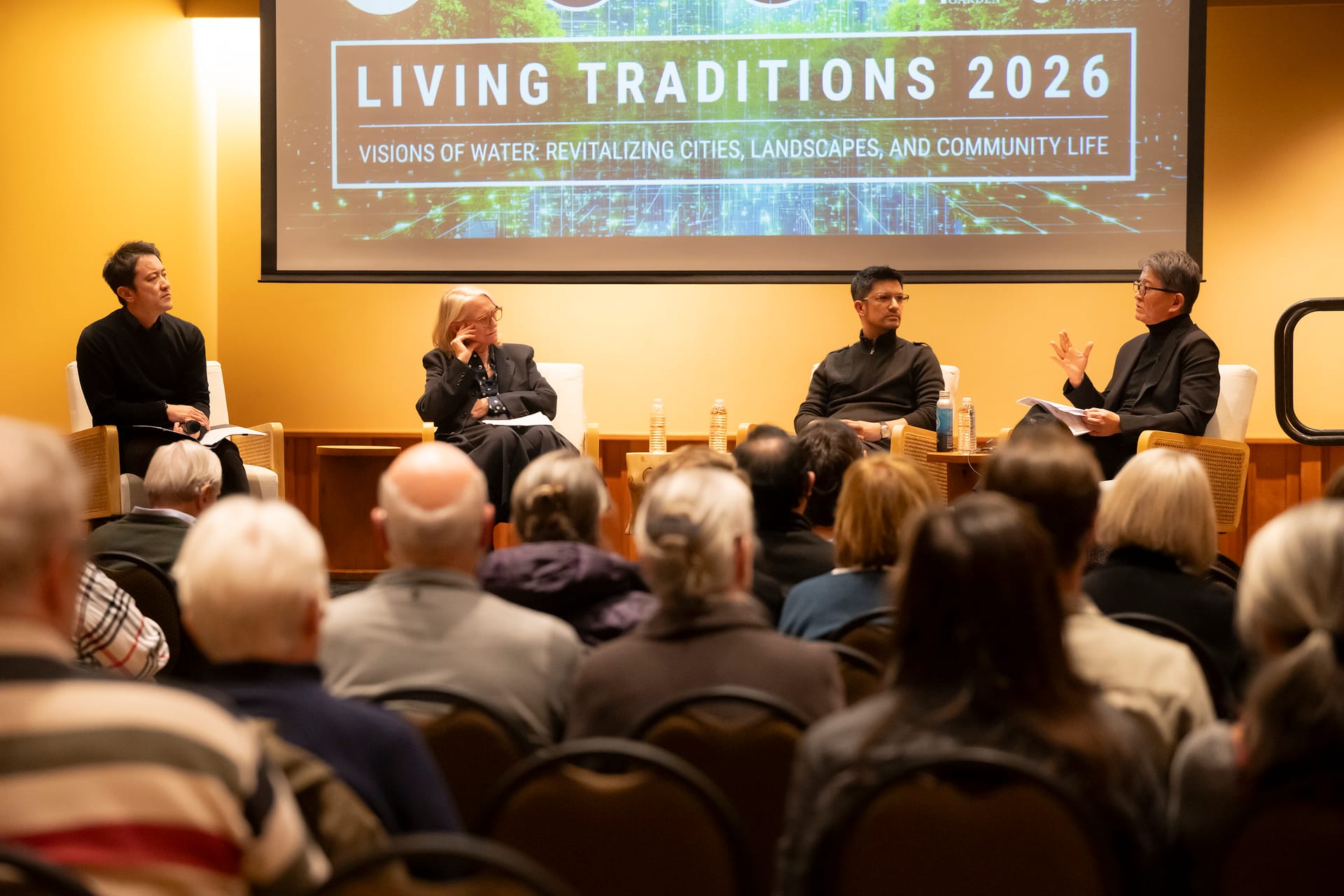
Below are some moments captured from the speakers, but they do not capture the entirety of their talks. The video shared above and also here contains the entire contents of all three speakers plus their panel discussion that concluded the afternoon.
Stepping the Architecture Back
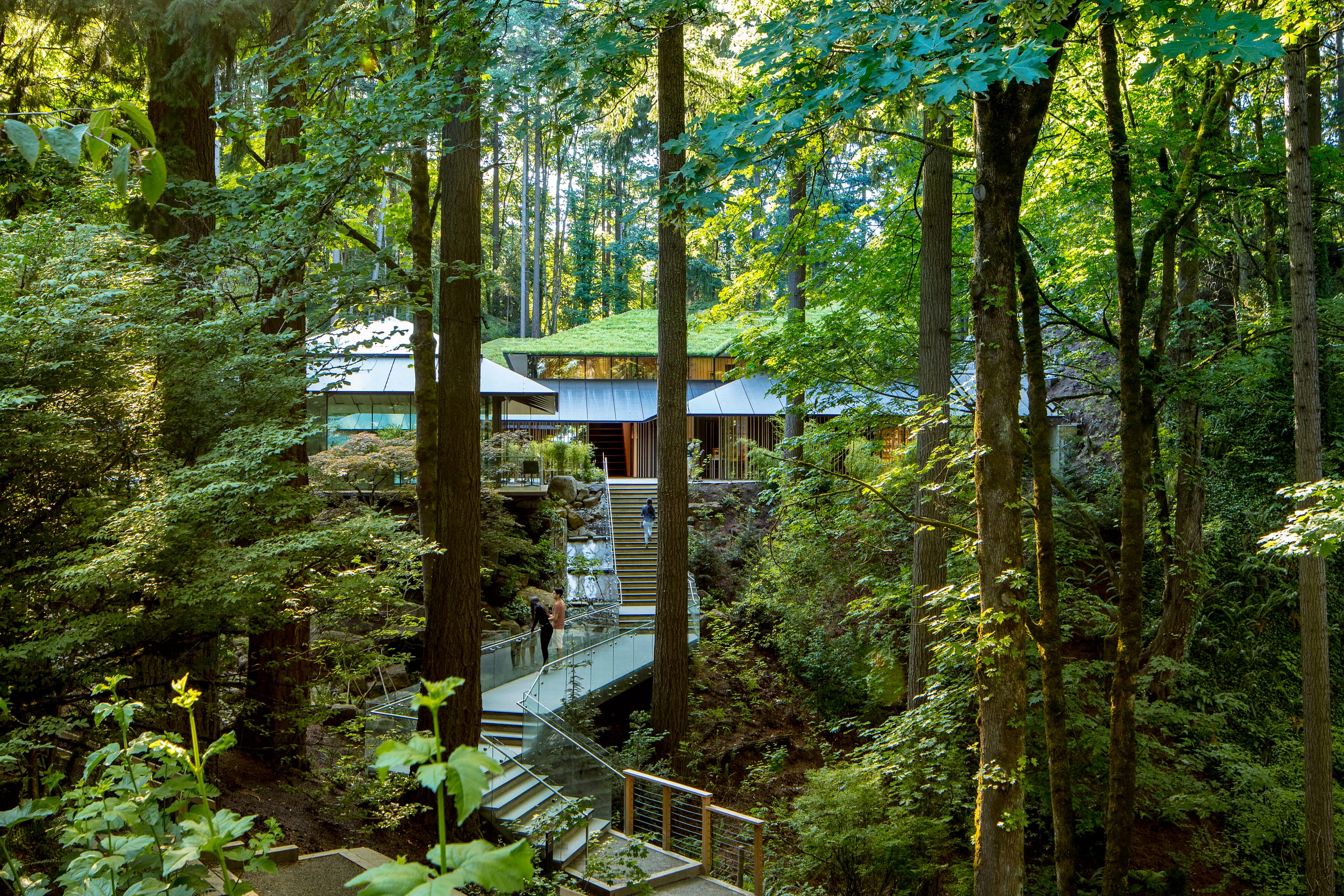
Among the elements that render Japanese landscape architecture distinct from other traditions and cultures is the role of buildings. Whereas other cultures may consider the building first and landscape second, Japanese gardens instead seek to blend a building within. The Tea House in Portland Japanese Garden’s Tea Garden, subdued, rustic, and sheltered by trees and the hillside, is an example of this.
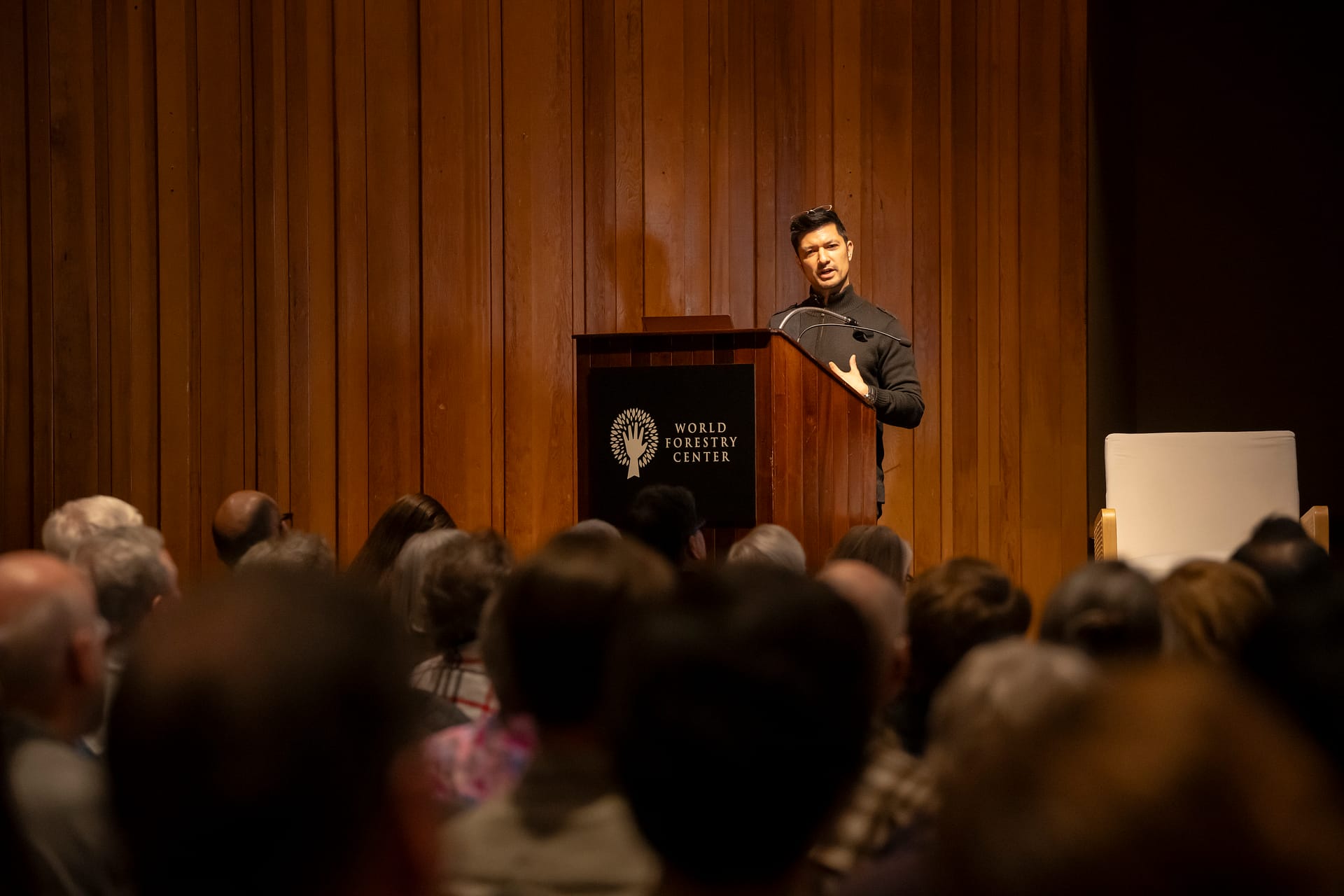
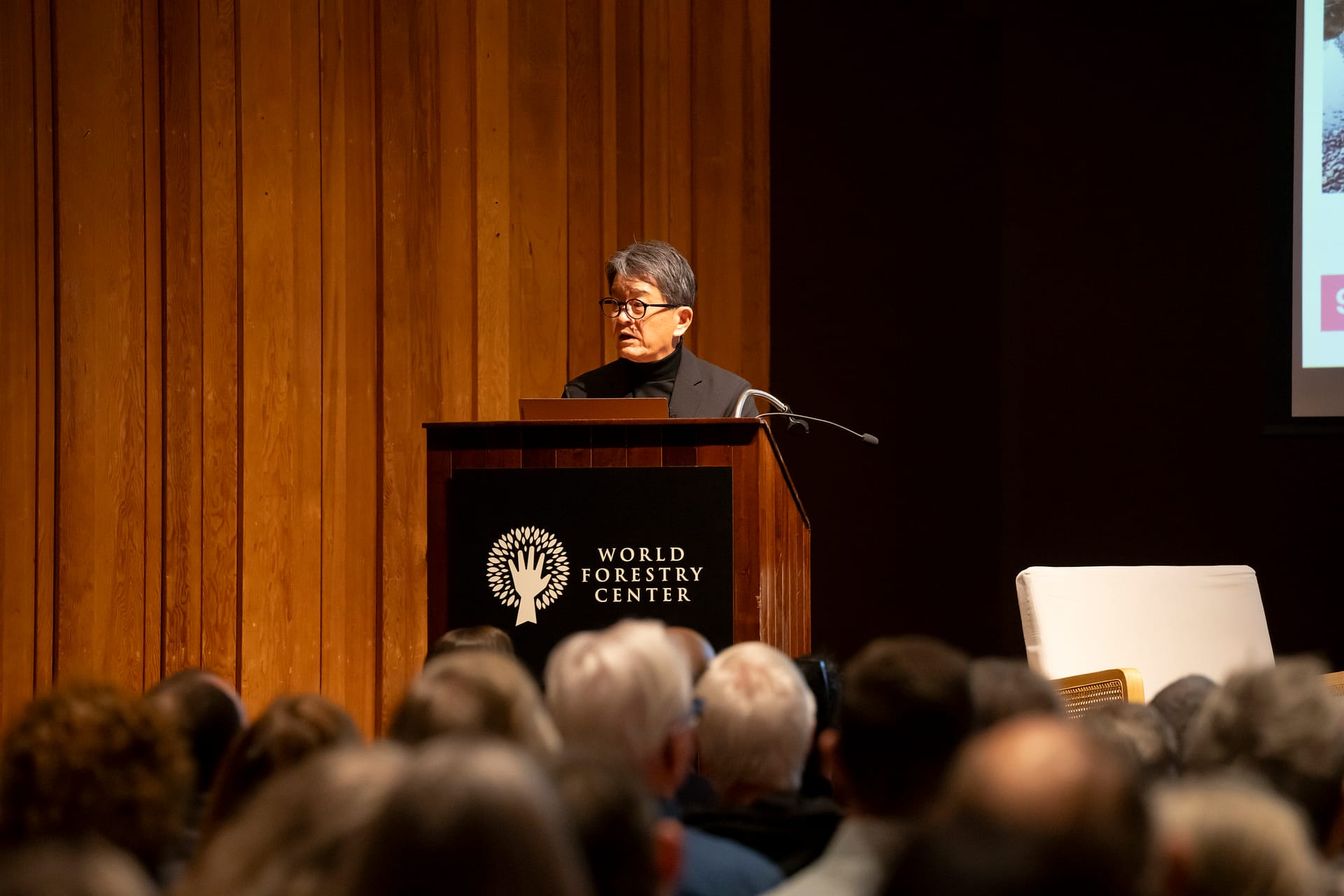
The first speaker of the afternoon, Balázs Bognár, spoke to how the work he has done with his colleagues at Kengo Kuma & Associates aligns with this philosophy, which is among the many reasons why his firm was an extraordinary fit to design the Garden’s Cultural Village. Bognár started his presentation with an image of the moon viewing platform at Katsura Imperial Villa in Kyoto.
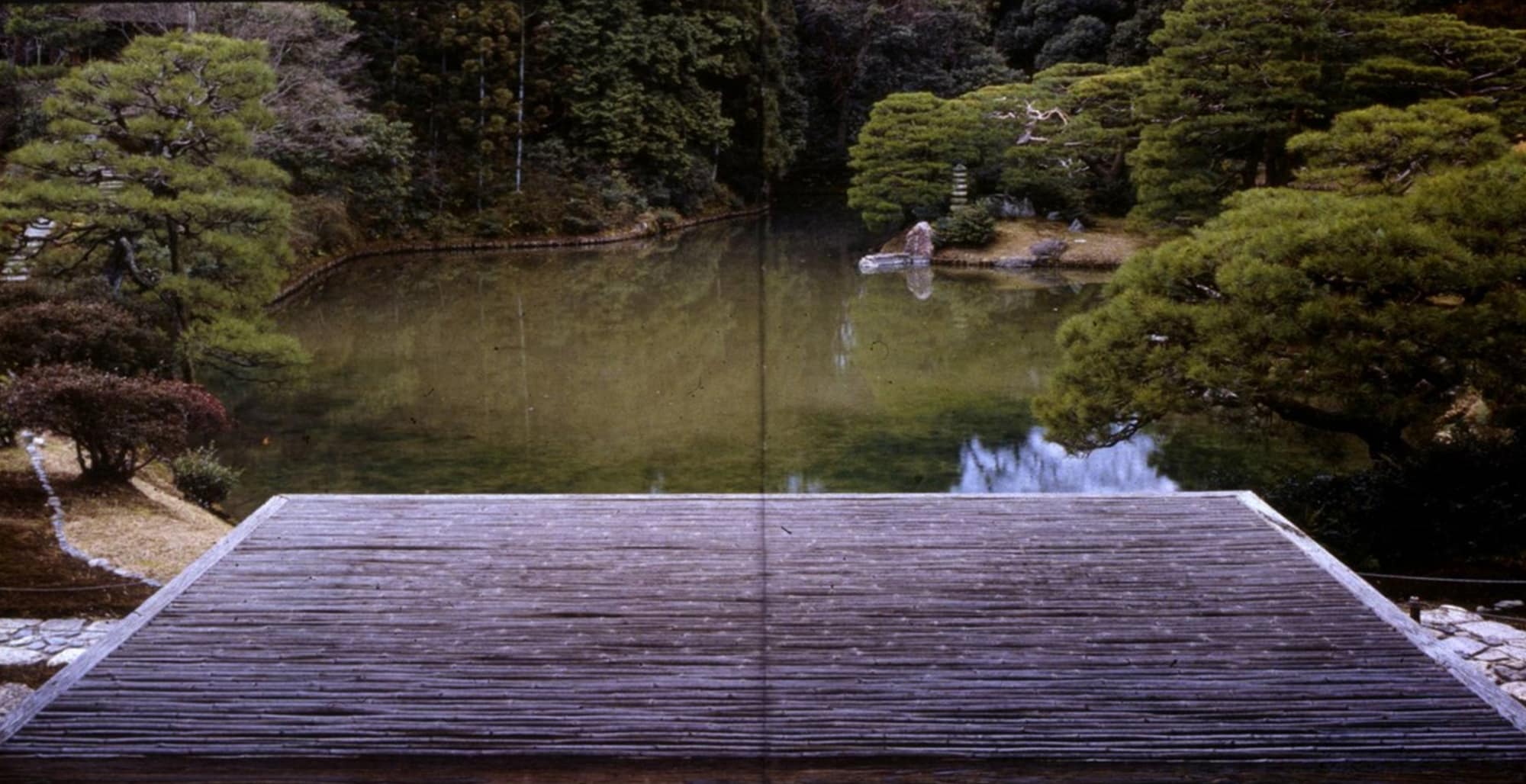
“It’s our favorite photograph of architecture,” Bognár shared. “It’s only floor and roof. The rest is nature and the rest is how we relate to that scene beyond us. … It’s how we recognize contexts, our surroundings, and our understanding of our place in the cosmos. This framing helps us to tell shared stories and to remember and to think through together. By stepping the architecture back, it is our hope that we see more and gain deeper insights, not just about ourselves, but about each other.”
“Portland Garden Village underlines the notion that the garden has a house in it and not the other way around as in the western paradigm,” he shared. “From moment to moment, water creates an undercurrent of continuity, and indeed you’re greeted by water at the very outset. It’s immediately a sensory presence from the start of this journey from bottom to top with rippling light and burbling acoustics. And this changes with the weather, the time of day, seasons, and from year to year.”
The idea of not attempting to use architecture to dominate the nature around it, but rather complement it has been present in several of Kengo Kuma & Associates’ works around the world, waterways very much being a part of this. An example of this was seen in the Kitakami Canal Museum in Miyagi Prefecture northeast of Tokyo. “Our effort is to minimize that architecture so that really what’s on display is the water of the canal,” he said. “The whole thing is submerged. It’s a game of hide and go seek. The building is almost not there.”
The Representation of Water
Another layer of complexity when it comes to the relationship between Japanese landscape architecture and water is how water is depicted within the built environment. While many of Japan’s historic gardens were designed to take advantage of the natural hydrological features of Kyoto, today’s spaces across the world may not be able to rely on what is provided by the earth. Instead they must create waterways where none existed. This is seen in Portland Japanese Garden, particularly in the Strolling Pond Garden, where the ponds, streams, and waterfalls were all formed by human hands.
The idea of taking inspiration from nature and deploying it in the garden was a key element of the talk provided by the afternoon’s second speaker, Shunsaku Miyagi, Founding Partner of PLACEMEDIA Landscape Architects Collaborative and Visiting Professor in Landscape Architecture at the Harvard Graduate School of Design. Miyagi noted how the idea of immersing the built environment inside the natural one can be traced back to the oldest known extant manual on garden building, the Sakuteiki (11th century).
“’Contemplate the famous place of various regions,’” Miyagi recited. “’Incorporate the charming elements of each place, make them your own, and then create a gentle pattern by softening its form. Depending on the topography and the shape of the pond, add your own touch to each of the areas that arise, and while considering the natural landscape generated a form while imagining what it was like there.’”
“In this way, one of the most important design methods in traditional gardening in Japan was to make a visual quotation of nature and its landscape and in [all] cases the presence of water remains a central feature,” he then followed in his own words.
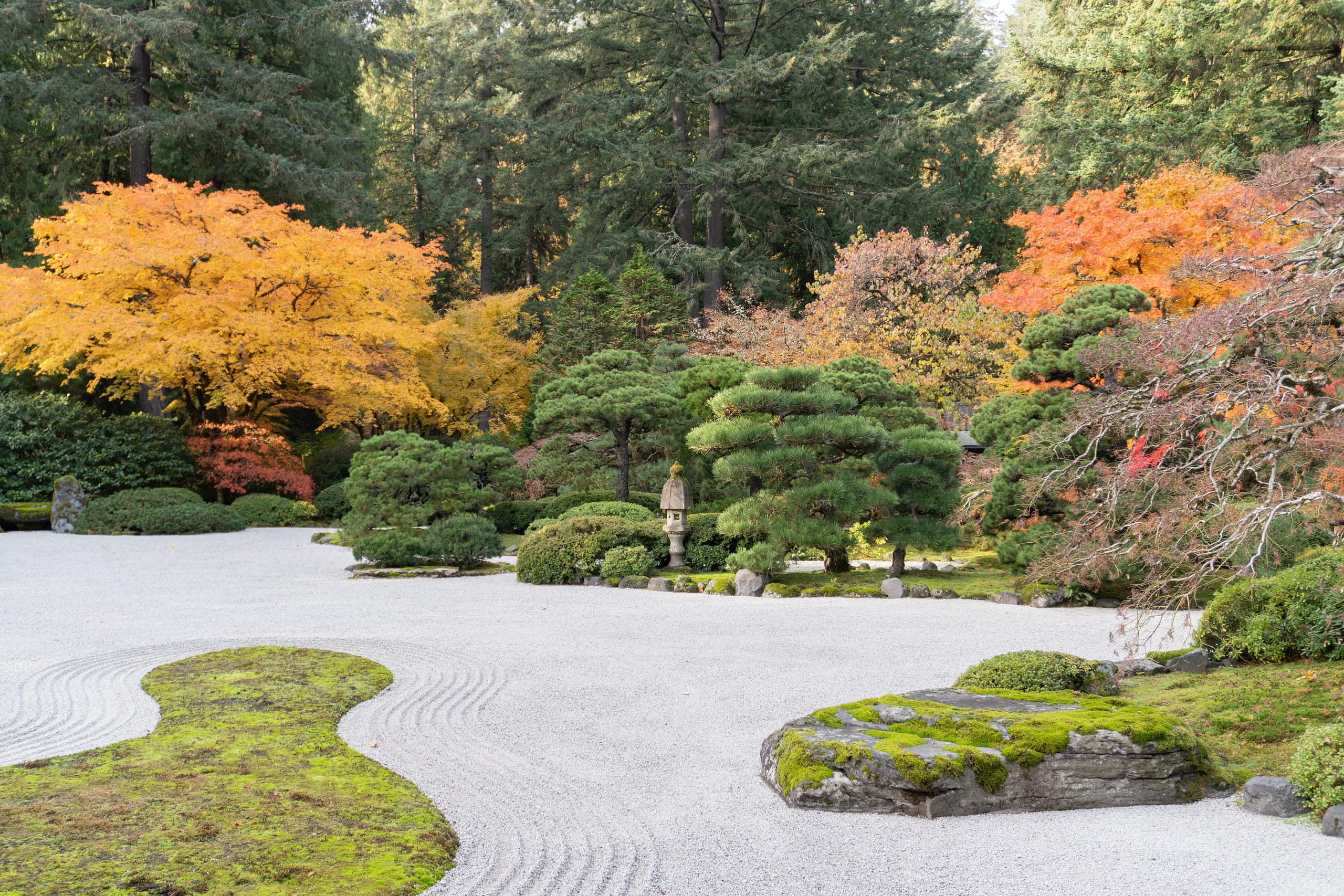
“The reason why this design method of visually referencing specific elements in natural landscapes without scale references has become so widely applied is because of a theory concept very quite unique to Japan,” he continued. “That is mitate. It is quite difficult to find an English word to accurately convey the concept or meaning of mitate, but metaphoric representation would be one of the possible translations. It refers to the poetic act or mindset to seeing one thing as another by transforming natural figures and materials into symbolic representation.” While the professor would go on to demonstrate examples of this with gardens in Japan, it can also be seen quite clearly in Portland Japanese Garden. If one peers into the raked gravel of the Flat Garden, they’ll see ripples appearing alongside the mossy islands in its middle. Here we see water symbolized. However, sometimes the allusion to natural waterways is more subtle, such as how the edges of the ponds in the Strolling Pond Garden are rough hewn in the way a coastline might appear.
Related: Learn More About Mitate and Other Design Principles That Go Into Making Japanese Gardens
A significant portion of Miyagi’s presentation also included his theory on the levels of scale seen in a landscape, noting that the composition of mountains, valley, and water running throughout that make up the entirety of the Kyoto Basin can be perceived on six levels of scale. In addition to the video, more on that can be read in this summary of Japan Institute’s 2025 TEIEN FORUM in Tokyo.
Artistic Composition of Water
As much as Portland Japanese Garden may attempt to evoke thoughts of nature by having architecture blend within it or by using visual quotations of the land outside its boundaries, it is still nonetheless an act of humankind. The landscape of the Garden was not much more than rocks and dirt before Professor Takuma Tono oversaw its transformation like a sculptor may do so with a block of clay.
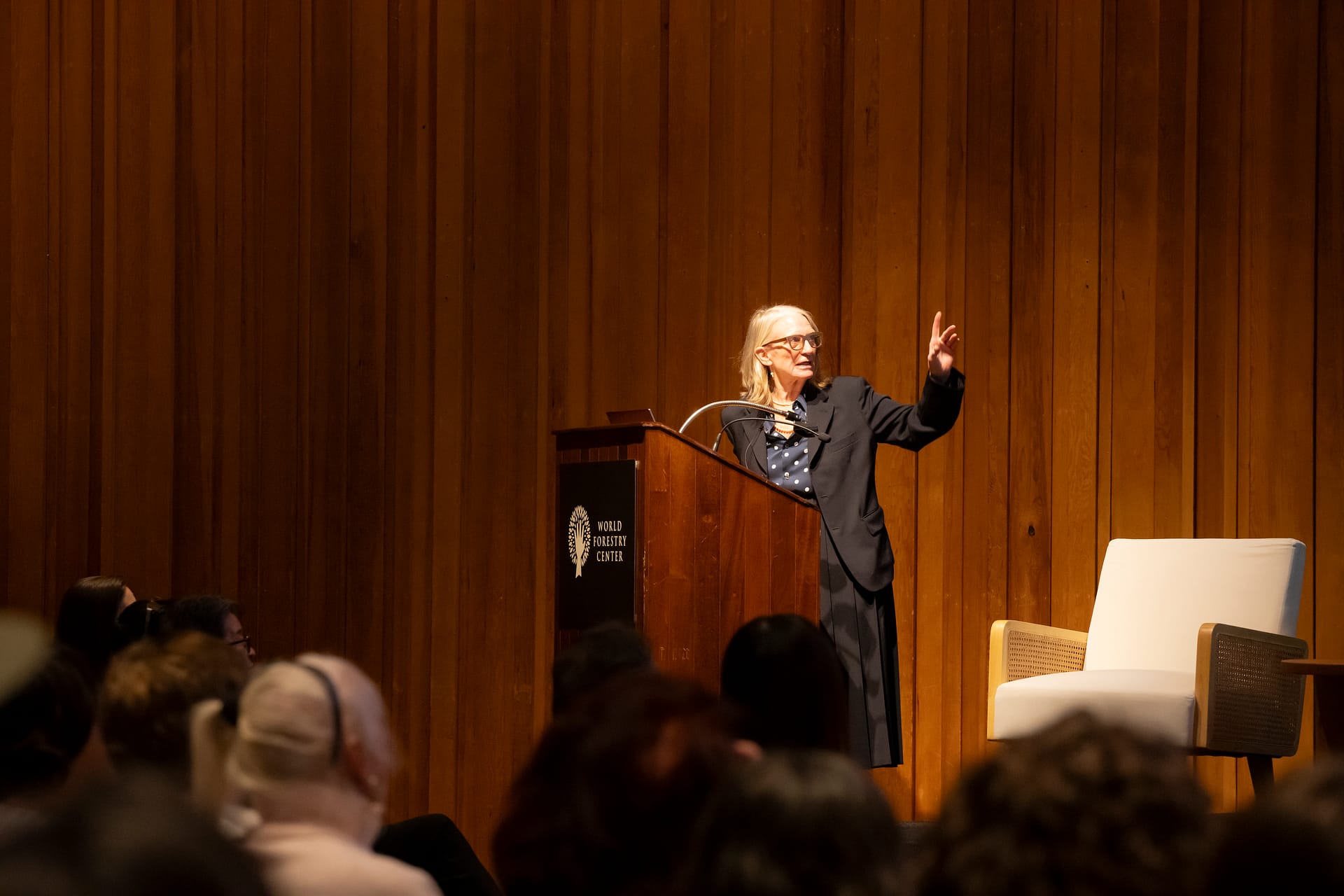
The third and final speaker of the afternoon was Kathryn Gustafson, a founding Partner at Gustafson Porter + Bowman, someone who has, like Tono, has worked landscapes into acres of artistic expression. Her career, approaching 50 years, has seen her work with water in a way that avoids ostentatious display that imposes itself on public spaces but rather reflects an intuitive approach that comes across as something nearly primordial, as though they are the lasting touches of a prior civilization more advanced than ours.
“My first project was stormwater management, and it was to drain the fields so that farmers in France could start getting their fields prepared and keep them from flooding. And it was my absolute first project. I went from fashion to landscape architecture because I wanted it to be an art form. Sculpture and sculpting the earth, became part of it. And through that I learned to understand plants, understand water, understand sustainability, understand engineering, and it has carried me through a marvelous journey to this day.”
Gustafson also discussed how her work with water can serve as a metaphoric reinterpretation of the people who shaped the land centuries prior, such as the work she did on Parque Central in Valencia, Spain. This green space built over old, buried train tracks was inspired by the Horta of Valencia, an important agricultural space. “The Moors were there in the 12th century and with irrigation, they brought water from the mountains into all the fields,” she noted. “And it’s the fruit basket of the food basket of all of Europe.”
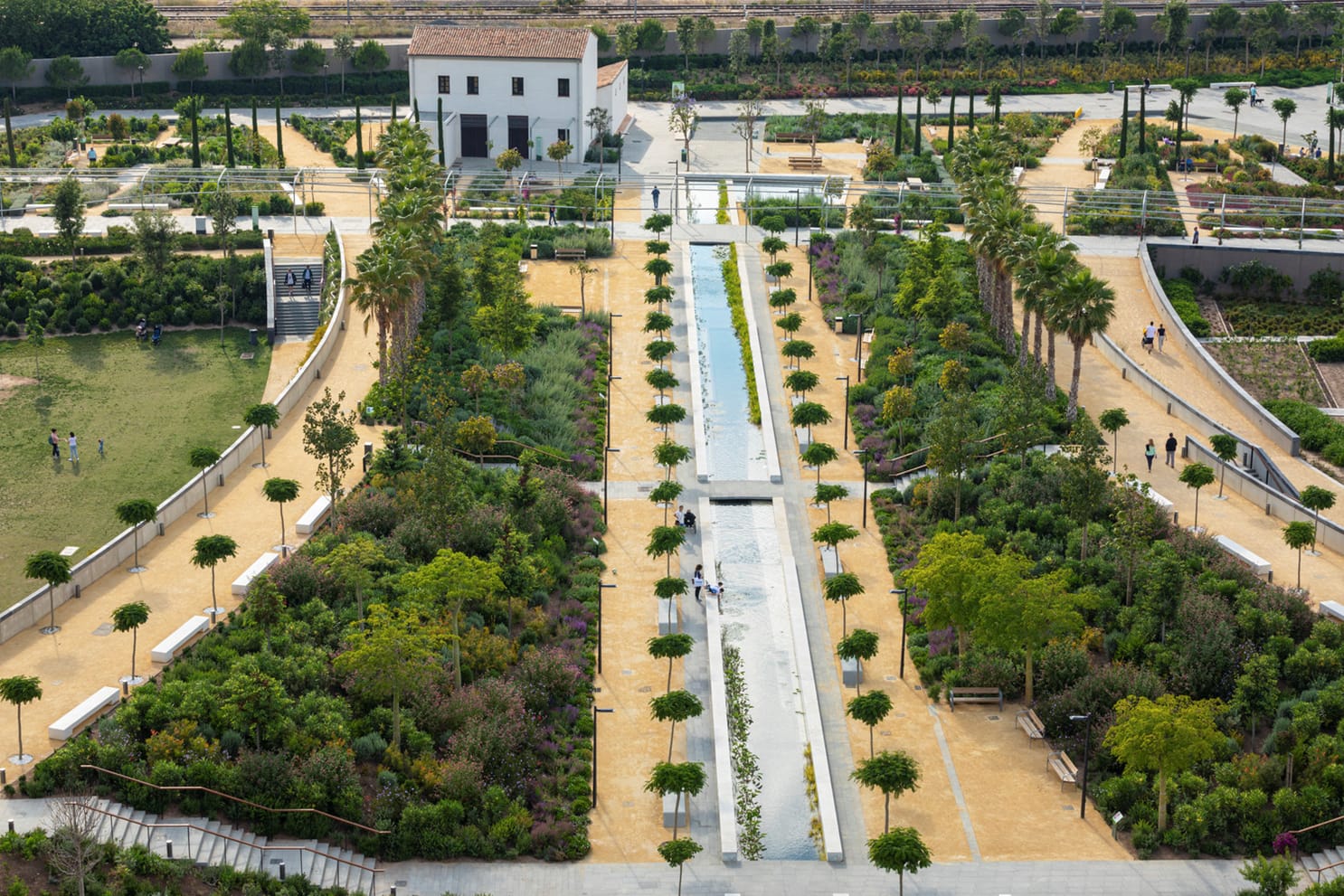
“I wanted to design a park that was about water and about the place. The first thing I discovered is that my site was a bowl. And then I went to the [Valencia History Museum] and the museum showed bowls people ate out of. It was a place of bowls and food and water…so we did a park of bowls…”
Gustafson ended her talk by demonstrating how water can soften something that is quite literally a barrier—ingeniously maintaining the safety that it might provide while rendering it into something more artistic and humanistic.
“These are bollards, these are foundations built down,” she said, referring to two massive safety structures on the site of one of her more recent projects at the Art Gallery of New South Wales in Australia. “I can’t even tell you how deep they will stop a truck [that may intend to cause damage by driving into the building]. … You have to make it look like they really aren’t there and it isn’t like you’re next to a barrier. Those two water features are 20 meters long, five meters wide and they actually reflect the building.”
When someone pointed out to her that in times of drought, the water might not be present to create the desired reflection, so she included in the barrier a surface of sculpted and polished black granite. “When you don’t have water, it reflects the sky and it becomes a sculpture.”
Gustafson’s work has taken her throughout the world (“I travel a bit and I like it,” she noted) and that work has also taken her to Japan. A project she highlighted there was the 11-acre Grand Green in Osaka, Japan. A massive and still ongoing undertaking, which saw the site of train station be combined with the similarly sized 11-acre Umekita Park, Gustafson and her colleagues took what had been a drab sight of concrete and metal into a vibrant natural space, where water once again was used in an artistic fashion. Referring to a pool of water near a large, 20-foot-tall oval curb they built, she noted “When the sun sets in the west, it is down the center of that water feature that you see from the top.”
Water’s Vast Terrain
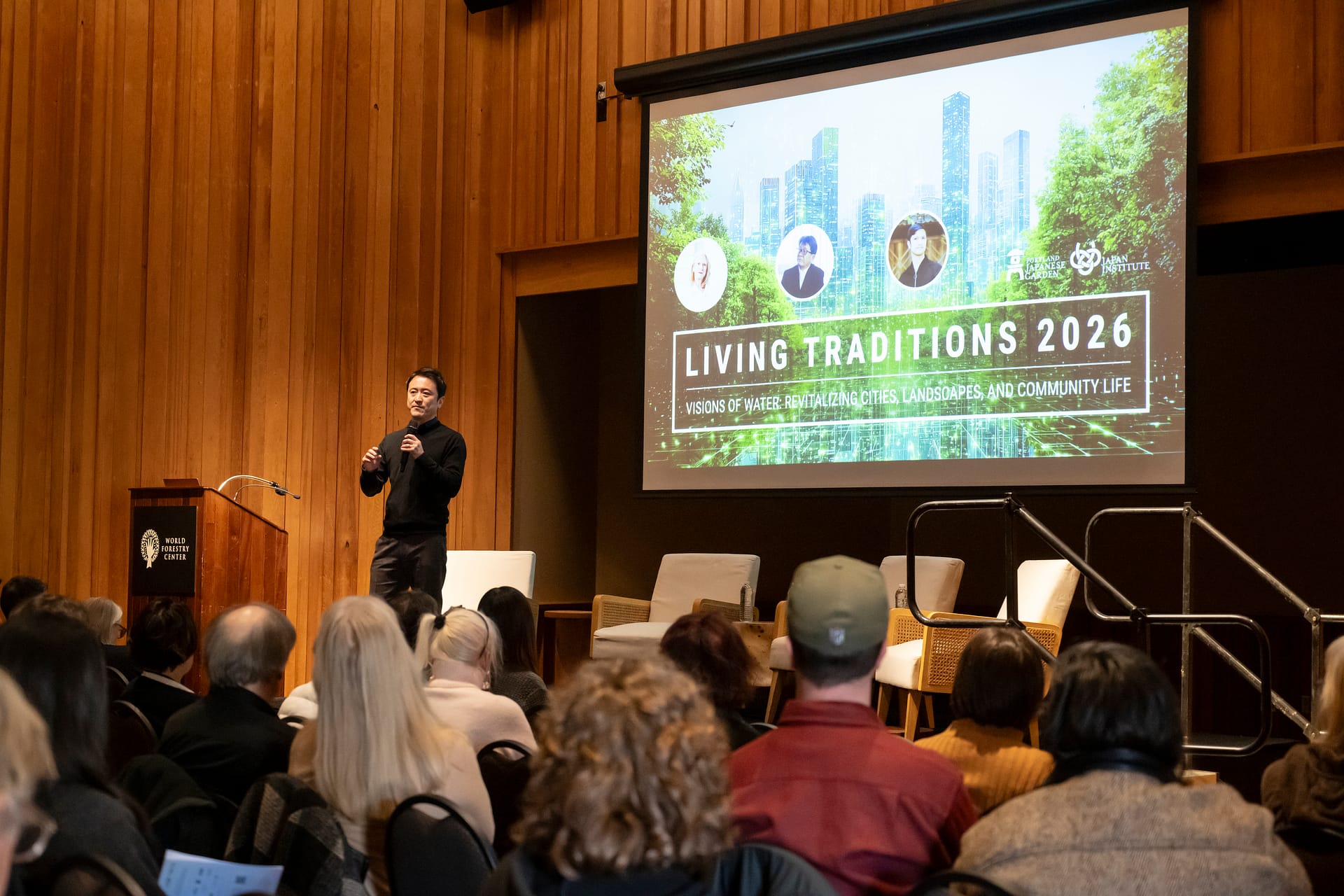
“I’d like to once again give my deepest thanks to our speakers for the vision, creativity, and insight they shared so generously, shaped by lived experience at the intersection of tradition and modernity,” Nakanishi concludes. “I also have the deepest gratitude as well to our full-house audience along with our partners at the Prime Minister’s Office of Japan and Japan Society New York. We will carry this moment with us for years, as we continue exploring water’s vast terrain, from poetics and sustainability to disaster recovery, philosophy, art, belonging, history, and AI.”
Written by Will Lerner, Marketing and Communications Manager for Portland Japanese Garden and Japan Institute.
More About Living Traditions
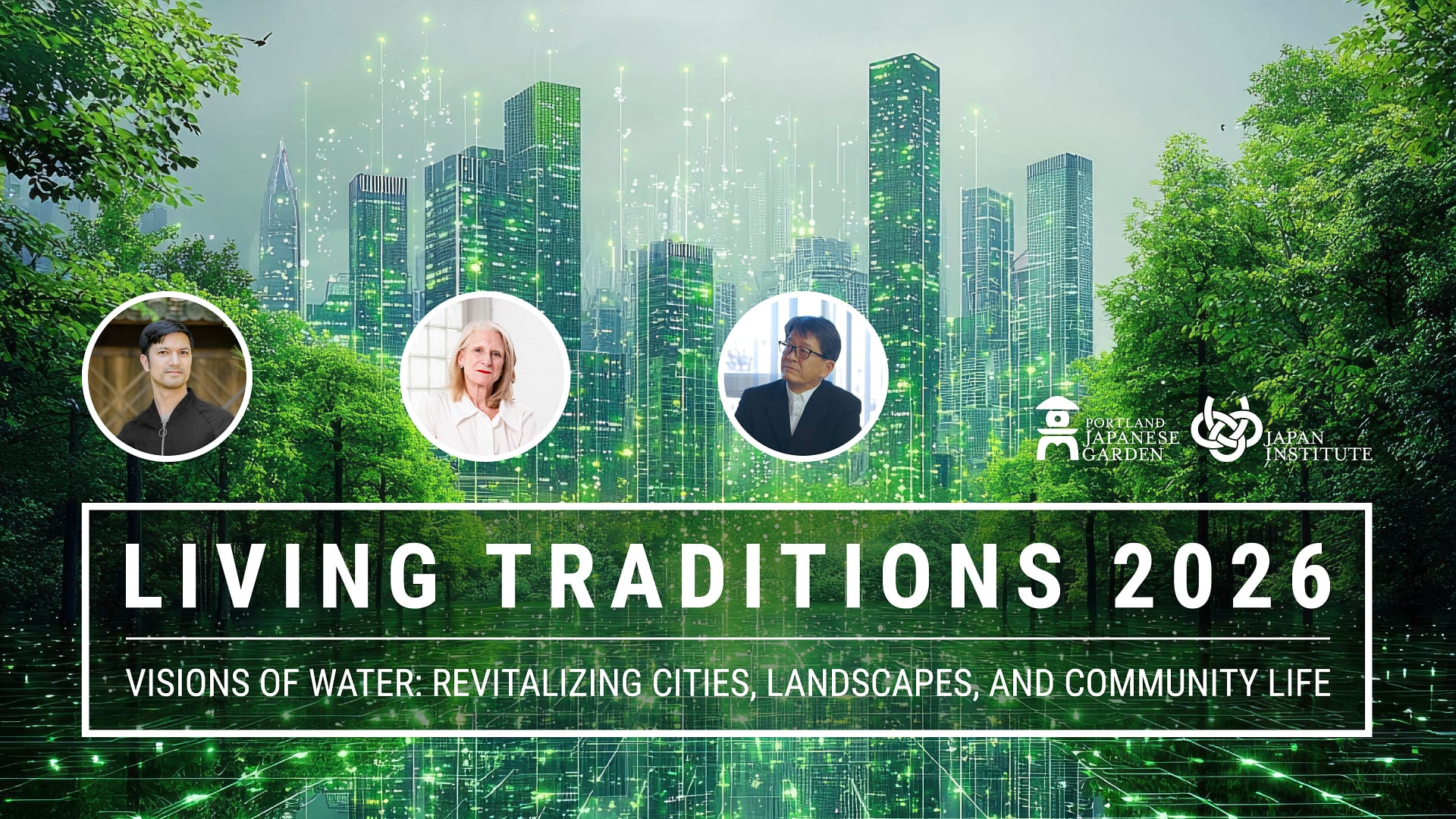
Many of today’s most popular and newest trends are rooted in ancient Japanese traditions going back centuries, if not millennia. Since its inception in 2020, the Living Traditions series has been unraveling the historical journeys of some of the most iconic facets of Japanese culture through conversations between thought-provoking experts and cultural stewards. Previously only available virtually, Living Traditions held its first in-person gathering in 2024. This third in-person installment continues the endeavor’s efforts to explore the ever-increasing significance of “Living in Harmony with Nature” at the intersection of architecture, landscape architecture, and art.
Living Traditions is presented by Japan Institute of Portland Japanese Garden in partnership with Japan Society (NY). The series is supported by the Government of Japan.
