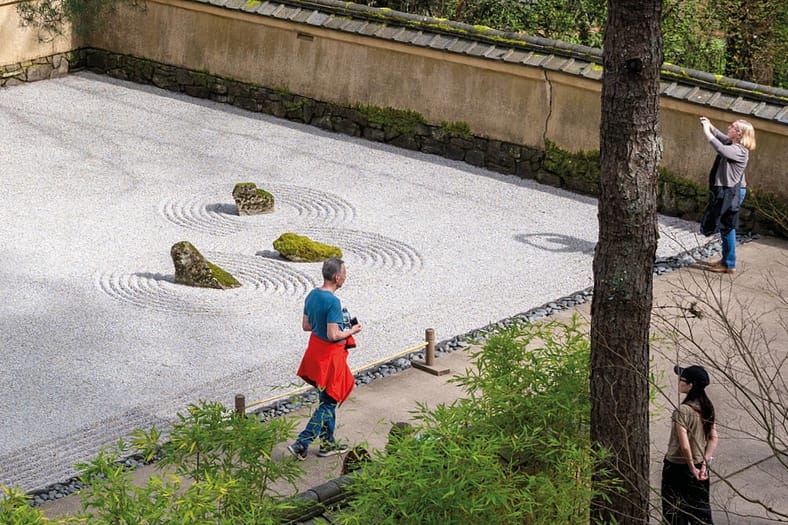
In 2025, Portland Japanese Garden was honored to be the featured cover story of the Niwaki Field Report. With permission from the author, we’re proud to share this article on our website. Copies of the entire issue can be purchased in the Garden’s Gift Shop or on Niwaki’s website.
By Alex Edouard
Watching the sun melt into the Pacific Ocean from the majestic Cannon Beach, 80 miles west of Portland, Oregon, it’s easy to imagine you’ve reached the edge of the world. To get here from the city of Portland, take Highway 26 west through the Tillamook Forest – glowing green with evening sun pouring through moss-laden old-growth trees – before emerging onto a wild and rugged coastline.
Between the imposing scale of the giant basalt monolith teeming with seabirds, the untouched wildness of the forests behind filled with thousand year old trees, and the tsunami warning signs reminding you of the ocean’s destructive power, the landscape evokes awe and wonder, with a little fear thrown in. It’s a bit like staring up into a starry night to contemplate your place in the big scheme of things.
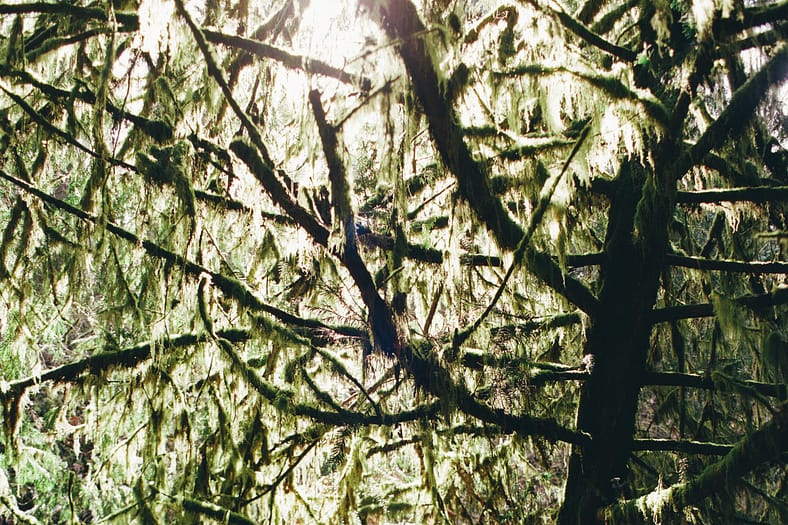
The main aim of my trip to the Pacific Northwest was to spend some time with the team at Portland Japanese Garden, but since I’d come all this way I couldn’t resist exploring the forests and beaches. Though different in many ways, Oregon (and nearby Washington State) and parts of Japan share oceanic climates, are both home to ancient forests, tsunami warnings, bears, volcanoes and a staggering amount of natural beauty.
Flat-earthers look away now: if you keep travelling in a straight line out across the ocean, following the 45th parallel (halfway between the equator and North Pole), in about 5,000 miles you’ll bump into Hokkaido, Japan.
I was following a hunch and looking for clues to how and why Portland Japanese Garden has come to be considered the finest Japanese garden outside of Japan, and perhaps even a rival to gardens in Japan.
“There are different Japanese gardens in Portland Japanese Garden and not even in Japan would you be able to see so many different types of Japanese gardens in one go. It is a museum of gardens. For people who want to study Japanese gardens, that’s the place to go. For people who want to feel those Japanese gardens, that’s the place to go. In Japan you would have one garden here, another garden there, but [at Portland Japanese Garden] it’s like a museum of gardens, as far as I can see. And they’re living. They’re living entities.” ~ Her Imperial Highness, Princess Takamado, speaking at the 60th anniversary celebrations for the Portland Japanese Garden, Tokyo 2023
The more you learn about Japan, the more you understand how reverence and respect for nature in all its moods – bountiful, beautiful, destructive and even deadly – are central to Japanese garden design and the aesthetics, philosophy, faith and cultural identity the gardens seek to express. If you found a place that had similarly striking natural features, perhaps a Japanese garden would make more sense in that place, both to the people visiting and the gardeners working there? Is it possible that factors outside the boundaries could contribute to the overall effect of the garden contained within? I needed to take a wide view.
Hunches are one thing, but what was really needed was time in the garden and to listen to the Portland Japanese Garden team, so I turned my back on the ocean and headed for the city to prepare for an early start.
Arranging my trip, I was ably assisted by Will Lerner, Communications Manager at Portland Japanese Garden. For various reasons, I didn’t have much choice but to come in late March, and I was worried that the weather and seasonal progress of the garden would be less than ideal. When I mentioned this, Will gently reminded me “that the garden has a distinct beauty in each season, none of which is inherently superior to the next”. As a fan of drizzly vistas, skeletal winter trees and all the other features that take priority in an out-of-season garden, I agreed in principle; but like any good tourist what I really wanted was to see the garden in one of its big moments. So I was very glad to drive through the upmarket streets surrounding Washington Park, of which the garden is a part, lined with magnolias in full bloom, soaking up the early morning spring sunshine with no sign of Portland’s famously rainy climate.
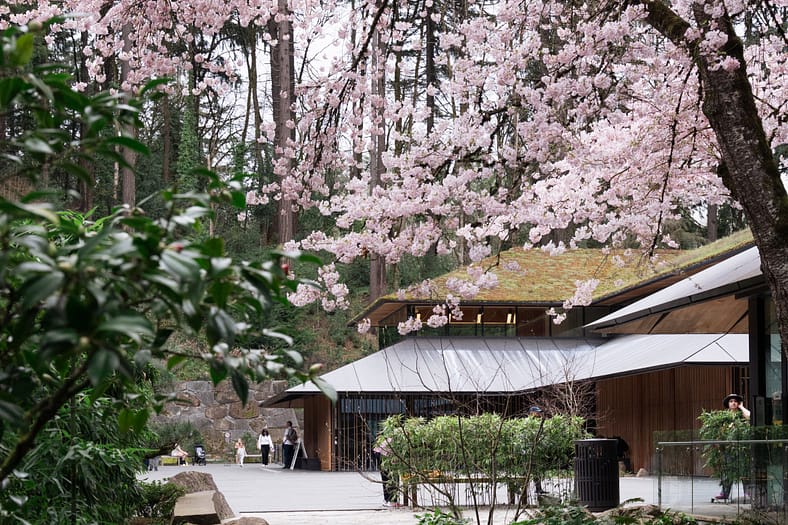
As I wound my way up the switchback path leading up from the car park, I was even more delighted to notice a shimmer of delicate pink growing larger with every step: fortuitously, the courtyard cherry tree had surprised everyone and exploded into blossom overnight. Even at this early hour, when only Portland Japanese Garden members are allowed in, it was already drawing a small crowd, and later that morning the local TV station would be down to report live from the scene.
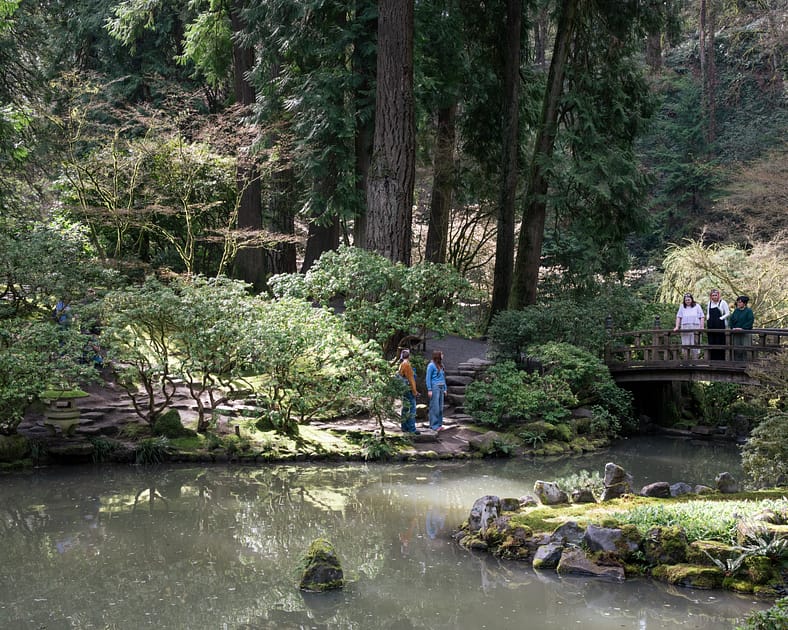
Leaving the cherry to one side for a moment, first impressions of the garden are dominated by its situation. The 12 and a bit acre site sits high up above the city in a natural amphitheatre of mature – and subsequently very tall – Douglas fir, hemlock and cedar. Besides the Portland Japanese Garden, Washington Park also contains the marvellous Hoyt Arboretum which boasts its own redwood grove. It’s a dendrophile’s dream destination. The whole park occupies the tip of the much larger Forest Park – a 5,000 acre forest made up of mostly second or third growth trees, but which still retains a few 1,000 year old specimens lucky enough to escape the 19th century timber boom (when the city earned the dubious nickname ‘Stumptown’).
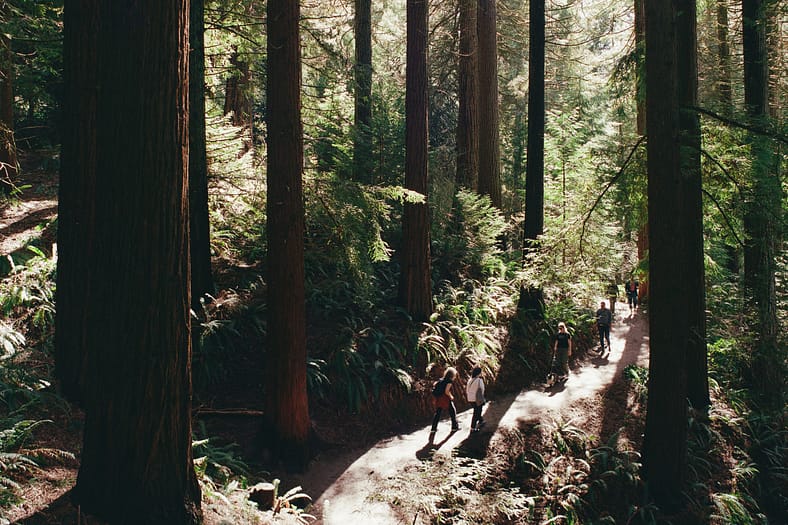
In its simplest form, any Japanese shrine or temple garden might begin as a clearing in the forest. I’m reminded of Tenryū-ji, a temple garden in Kyoto (designed by eminent 13th century Zen master Muso Soseki), which contrasts a cleared and arranged garden with the backdrop of Arashiyama’s forested mountainsides. Or the 2,000 year old Shinto shrine at Ise, established in a simple rectangular clearing in the forest, laid with gravel and containing wooden buildings of ancient design that are rebuilt every 20 years or so.
Portland Japanese Garden has natural elements to frame it, but in spite of appearances, much (though thankfully not all) of the forest clearing had already been done for the zoo that occupied this spot until the 1950s. The switch-back path leading to a stone zig-zag bridge encourages you to appreciate the setting, especially the towering trees, from different angles, but besides the cherry tree the garden itself remains hidden.
Before you enter the garden (or gardens), you’ll most likely linger a while in the Cultural Village – world-renowned architect Kengo Kuma’s 2017 contribution to the site – which adds three buildings and a wide, open courtyard to create a Monzenmachi (門前町) – literally “gate-front town” – a modern interpretation of the collection of buildings you might find at the entrance to any major shrine or temple in Japan, designed to welcome pilgrims and visitors.
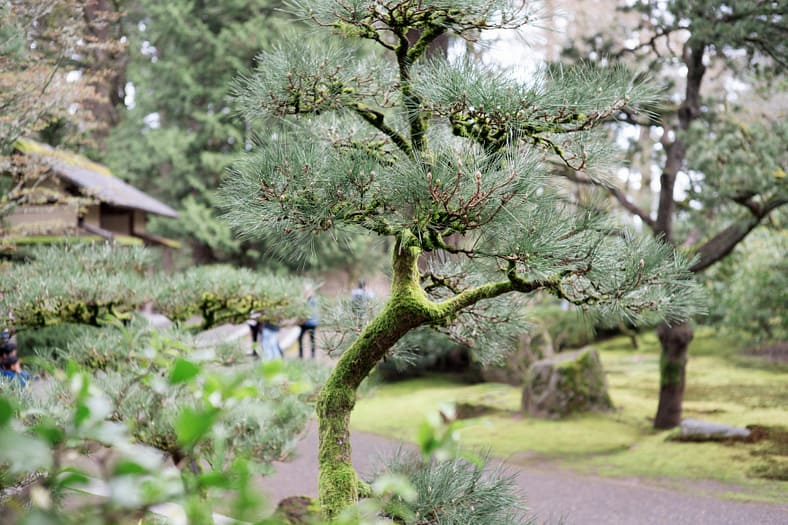
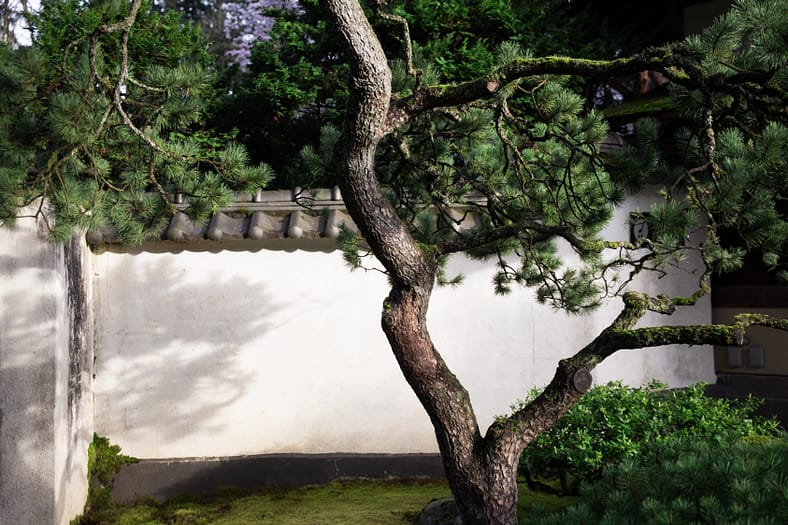
Despite being bright and airy inside, the structures appear to sit low, with their carefully angled roofs (some of which are alive with green growth) integrating the timber, glass and stone with the trees and hillside behind. The buildings occupy three sides of the courtyard, with the open fourth side leading past the blossoming cherry tree and a carefully shaped Japanese red pine (Pinus densiflora) to the Nezu Gate – the original entrance, which frames glimpses of the Flat Garden beyond.
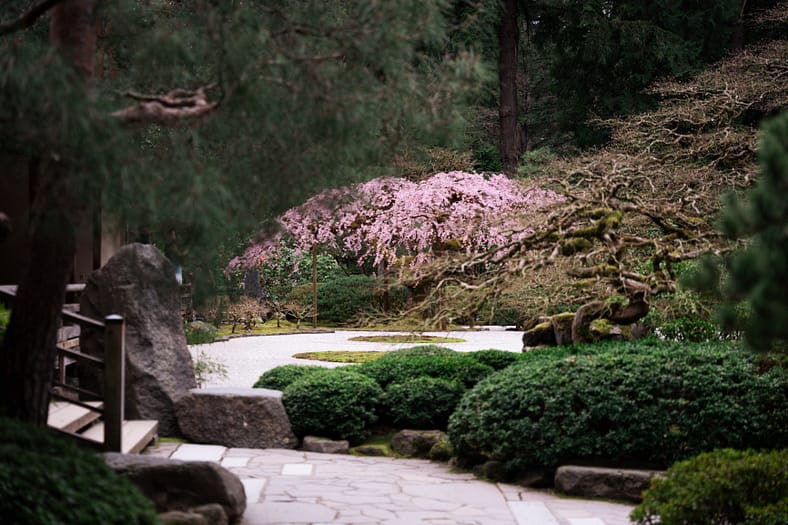
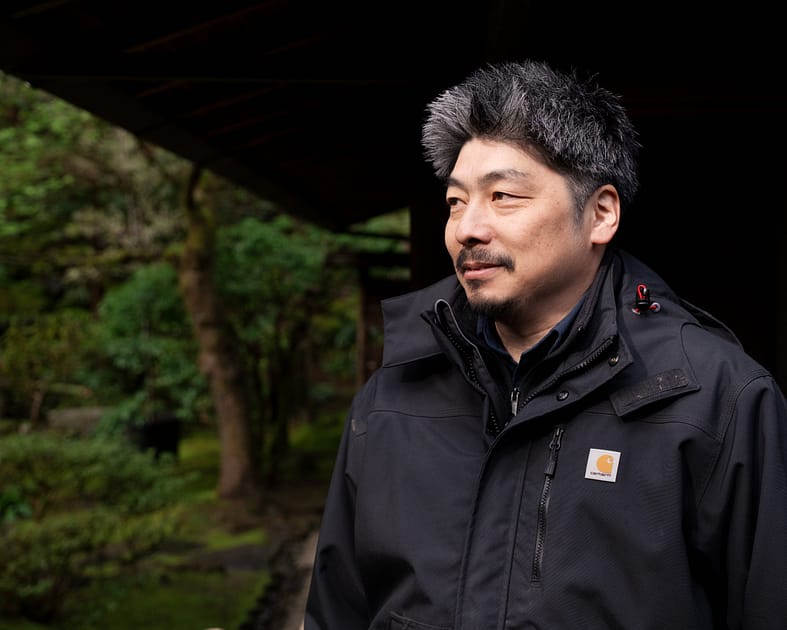
Already feeling a little overwhelmed, I was very grateful to have been offered the chance to spend time with key members of the team. Over the course of two days, in ascending order of seniority, I met with Lead Gardener Evan Cordes, Senior Gardener Jacob Knapp and Garden Curator Hugo Torii. I also met with Lisa Christy, Executive Director, and throughout my visit I was shepherded and chaperoned by Will Lerner (previously mentioned), who introduced me to Evan shortly after my arrival.
The first thing that struck me about Evan was the enviable authenticity of his workwear. Baggy Toraichi/Tobizubon work trousers tucked into tabi split-toed canvas boots, a tenugui head scarf and various other details would allow him to go deep undercover in any traditional temple garden team. As I would discover, all nine full-time gardeners have similar uniforms, which is not only practical but also, perhaps more importantly, a reflection of earnest and wholehearted commitment to the profession. Later, as I paused to photograph a gardener disappearing off the top of a tripod ladder and up into the canopy he was pruning, Hugo Torii expanded on this theme, noting, with satisfaction, that the gardener looked graceful and appropriately dressed to match the garden.
Evan’s commitment is unquestionable – he joined as a volunteer in 2017, and in the intervening years has established himself as a core member of the team. He speaks about the garden with insight and passion, and has accumulated an impressive range of skills, from crafting bamboo fences to helping to organise (with Bonsai Curator Michael Hagedorn) the display of seasonal bonsai, which will reappear in a designated area off the main courtyard as soon as the weather is a little more predictable. It was the variety of tasks and the number of new things to learn – an almost endless number, especially where horticulture is concerned – that attracted Evan to the job in the first place.
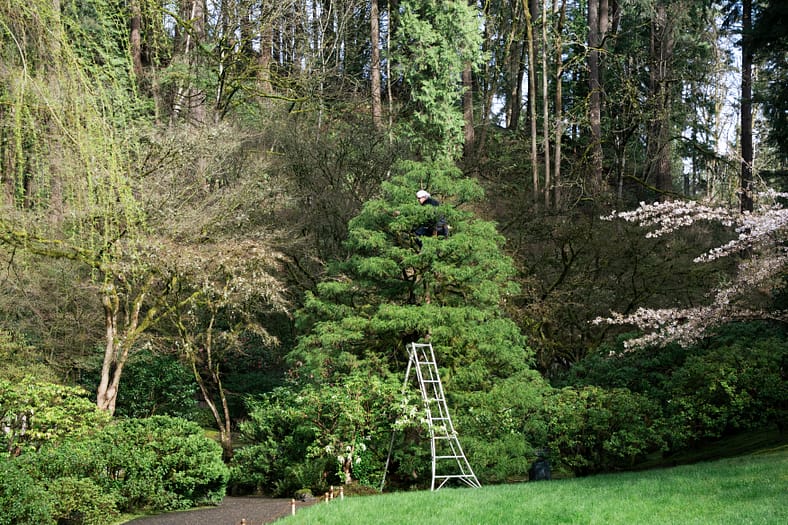
As we skirted the top edge of the Flat Garden, past intentionally pruned and placed human-scale black pines, camellias and maples, we paused under a brace of towering native Douglas firs – remnants of the original forest landscape. I asked Evan about the challenges of gardening in the shadow of these oversized trees, which are constantly dropping detritus large and small on the trees and moss below. For one thing, he explained, it creates a lot more clearing up for the team, but he doesn’t resent the work. Time spent in the garden is never wasted time, since it allows the opportunity to observe closely. In some ways, this makes slow, manual jobs (as so many of the jobs are) desirable. It reminds me of the four hour watering details meted out at Great Dixter, back in the UK, and how, for similar reasons, a visiting Japanese gardener had actually relished that job.
How different this garden would look without these huge trees dotted throughout and drawn like a curtain around the garden. You can hike up onto a trail in the hills above and look down to see how neatly the Japanese gardens sit in amongst the native environment, which creeps in from all sides. Later, Garden Curator Hugo Torii explained that the surrounding wild trees are a necessary foil to the control and order of the garden. The team have to remain watchful for potential falls and deal with damaged boughs before they cause too much trouble. Nature is forgiving but can also be merciless, he added, and we need to be reminded of this, even if we would rather not be.
With so many elements of Japanese garden design hinting at temporality you could say that Portland Japanese Garden’s situation helps to restate and amplify the themes expressed with intent in the garden. Take, for example, the symbolic nature of the cherry blossom, which, as well as creating an annual spectacle, also acts as a memento mori. Life and pleasure, like blossom, are fleeting.
Does the garden offer advice on how to respond to this lesson, I wondered? When Hugo talked about unwelcome reminders of human impotence, he did so with a smile on his face. There’s comfort in recognising that we can only have so much influence on the world: nature will do what it will. When things go wrong in the garden (or in life), in spite of our best efforts, this attitude permits us to forgive ourselves and move on.
Portland’s famously changeable weather had its say on the matter that very evening with a tornado (!) and hail storm forecast to hit the city, threatening to strip the cherry blossom almost as soon as it has appeared. I was delighted if a little surprised when Senior Gardener Jacob Knapp expressed genuine excitement at the prospect of a tornado: not something you’ll often hear from a gardener. Jacob elaborated: “There’s an action from gardeners in observing the destruction response of pine trees or any coastal tree that’s getting bombarded by tsunami, high winds, ice loads. These things give the trees their aesthetic value and we are only trying to recreate those destructive moments in the garden, albeit with a bit more grace. Nature is the best artist in that destruction.”
I was pleased to hear this for two reasons. There’s the useful reminder that observation is an active, integral part of the gardener’s job and, of course, there’s the encouragement to look to the natural world for aesthetic advice. When a freak ice storm hit the city in 2024, most people hunkered down at home. Jacob, on the other hand, couldn’t wait to trek up the treacherously icy entrance path to marvel and take note of the effects of the heavy rime ice on the trees.
Before we disappear completely into the garden, this would be a good moment to pause and talk about how and why there is a Japanese garden in Portland in the first place, with a bit of historical context to set the scene.
Japanese immigrants began arriving in Oregon and Washington State in the late 19th century, attracted by the booming timber industry and other employment opportunities. Long before WWII, the relationship between the longer established white immigrants and the Japanese was already strained, and at times openly hostile. Several laws were passed to limit Japanese immigration and even to restrict the newcomers’ right to own land.
Related: The Experience of Oregon’s Nikkei
In spite of this, in the first decades of the 20th century Portland boasted two Japantowns (ie predominantly Japanese areas of the city) and the Japanese population continued to grow. Following the attack on Pearl Harbour, the c.3,600 Japanese residents of Portland were rounded up to join the other c.120,000 ethnically Japanese citizens from across the country who were imprisoned at concentration camps for the duration of the war.
When the war ended and the camps eventually closed, the few Japanese-Americans who returned to Portland found their old neighbourhoods had disappeared – and xenophobic feelings were still running high. It’s surprising to think that only a decade later there were growing calls for a Japanese Garden to be established.
The official histories of the garden credit Portland Mayor Terry Schrunk as the driving force, but the more research that is undertaken, the more it appears that the wives of local community leaders played significant, if largely unheralded roles in helping to get the garden off (or in?) the ground. After all the destruction wrought by men, it makes a lot of sense for women to take on the healing role. Take for example Margueritte “Maggie” Drake who – uninvited but interested – attended the City’s very first Japanese garden committee meeting in 1963, subsequently joined the board and, in time, became the first female Board President (1993–95).
Whoever takes the credit, Portland was certainly a place in need of some healing, and the garden was going to be central to this. You might even say Portland needed this garden.
An appreciation for the natural world transcends so many cultural and social barriers, so to show how integral nature is to Japanese identity could, it was supposed, be a powerful tool in achieving some harmony. Portland Japanese Garden’s website states “Needing no translation, an American could experience firsthand Japanese ideals and values, communicated simply through nature.”
Executive Director Lisa Christy knows better than most the unique and subtle influence that a garden can have on a place and the people who visit it. Amongst many other responsibilities, Lisa helps to organise the Peace Symposium, and if there’s a better, more noble aim than peace – the absence of struggle and strife – I’m struggling to think what it could be.
In 1954, before the garden came into being, the city of Yokohama sent peace lanterns bearing the inscription “casting the light of everlasting peace” to Brooklyn in New York, Kew Gardens in London, Tokyo, Hiroshima, Nagasaki and … Portland. With no Japanese garden yet to call home, the lantern spent some time in another part of Washington Park, where it was subjected to anti-Japanese vandalism. Now, Lisa points out, it sits unmolested in the garden, where it is appreciated by hundreds of thousands of people a year: tangible progress!
Related: Casting the Light of Everlasting Peace, the Story of a Stone Lantern
That transformation alone should be enough to silence any cynics who question the potential of a garden to bring any sort of peace and reconciliation. And another thing: now they can see the garden and enjoy it, the community supports it. There are no funds from the government or council. It’s the people’s garden.
Was it hard to get westerners to understand this garden, I wondered? It’s sometimes said that Judeo-Christian cultures see themselves as set apart from nature. In Christianity, man is made in the image of God (a blessing not bestowed on the animals, and certainly not the plants) and given dominion and stewardship over nature. We ‘tame’ rivers, ‘conquer’ mountains and ‘civilise’ wildernesses. Do people see all the careful pruning and tidying of the Japanese garden as further attempts somehow to ‘conquer’ nature?
Lisa doesn’t think this is the case and has noticed that people seem to accept the physical acts required by this type of gardening in the spirit in which they are undertaken: as acts of reverence, care and attention. Indeed, everything about the gardeners I met or observed – from their choices of tools and clothing down to the way they think and talk about the garden – suggested that to be the case. Things are different in the garden.
Our conversation was interrupted by my phone pinging away with “screen time” requests from my 11 year old son, 5,000 miles away. Lisa and I compared notes on our parenting approach to appropriate screen use limits. It’s not such an irrelevant topic: one of the functions of the garden is to offer an analogue space where people can unwind and, with luck, switch off. They’ve discussed making visitors check their phones on entry, but there are lots of good reasons to stay connected and besides, people use their smart phones to take pictures: it would be cruel to deny them this pleasure when the garden looks this good.
In reality, Lisa explained, there’s no need to restrict phones: most people respond to the space by self-monitoring. It seems that when people are suitably stimulated by nature, they don’t crave the cheap dopamine hit of Instagram. Beauty here is a double-edged sword though, and sometimes it’s too beguiling. They had to add stickers to the glass doors of the gift shop because people kept walking straight into them, transfixed by the trees beyond.
On the whole, signposts and other visual noise are kept to a minimum. Instead, the garden has been designed to lead the visitor in subtle but very clever ways, using techniques that could be found in any traditional garden in Japan.
Take, for example, the zig-zag paths and bridges near the koi pond, encouraging you to observe the world around from multiple angles; and perhaps also to consider all sides of less tangible problems? In the Strolling Pond Garden, wide, smooth paths make for an easy-going, social environment where people can move and talk in groups; and perhaps also to listen, and find empathy in doing so?
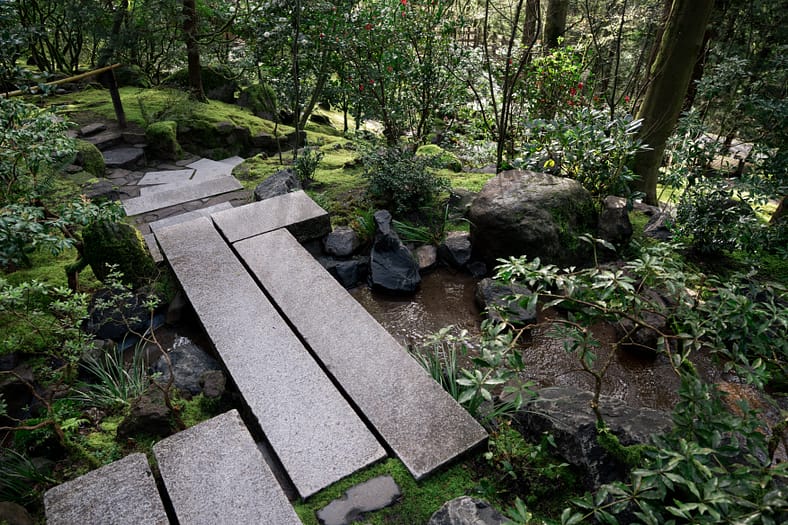
The Natural Garden demands more from the visitor, with uneven steps and wiggly paths forcing you to look down – both for your own safety and also to encourage you to notice the water, moss, stones, shadows and all the other details that bring this space to life. The paths are too narrow for you to walk side by side, encouraging quiet contemplation. Observing the early morning walkers soak up the garden’s unique air of tranquility you can see another type of peace has been achieved here.
My time with Lisa offered valuable insight into how the garden has expanded its positive influence beyond its modest acreage. More and more of her focus is on bringing the three pillars of the recently established Japan Institute – a sibling organisation for the Portland Japanese Garden – to life. Simply put, Japan Institute is the next step in realising the organisations’ shared mission to inspire harmony and peace. Through a programme of workshops, symposiums, exchanges and more, they aim to realise the bold vision of becoming a leading global voice for cultural understanding, in pursuit of a more peaceful, sustainable world. It all begins by fostering connections between people, growing steadily outwards from there.
Demand for the events is very high, with long waiting lists for their flagship training programme: Waza to Kokoro: Hands and Heart – a programme led by Hugo Torii himself. The course helps Japanese gardens outside of Japan find authentic, locally-appropriate solutions in design, construction, maintenance, and preservation, sharing the knowledge that has been accrued at Portland Japanese Garden.
The ambition – and the tangible steps towards achieving this ambition – are hugely inspiring. I returned to the garden with fresh eyes and a hunger to soak up as much as I could the following day.
It’s very quiet early in the morning, when only members are allowed in, so I took the opportunity to try something out for myself. Heading straight for the Heavenly Falls, I turned my back to it and closed my eyes. Will had told me a possibly apocryphal story about how, when the waterfall was first set out, Professor Takuma Tono – the man responsible for establishing the garden’s initial layout – would stand with his back to the falling water and listen as men positioned the stones. He wanted to make sure it sounded as well as looked the part, and was not satisfied until everything sounded how he wanted it to.
Related: The Thoughts of Professor Takuma Tono
You can imagine the grumbling from the soaking wet labourers, but to my untrained ear it sounded authentic, and I lingered to enjoy the sensations. I later discovered that the waterfall had to be refurbished (when they took the opportunity to extend its height by 15ft to make the 35ft tall spectacle we see today) so it’s not quite the original sonic vision. Either way, this experience brings us back to central idea that the garden is not a re-creation of nature, but a creation of the experience of nature. We can look at the waterfall and know it’s not a natural space, but at the same time we can experience the effect of being near a real waterfall (see Jake Hobson’s article on Taki Jinja to hear his thoughts on this).
I can’t ask Professor Tono if this is true, or what he was thinking when he positioned the original stones, but luckily for me there are more recent projects to discuss with the gardeners who helped conceive and create them. And regardless of their backgrounds – whether it’s Hugo Torii who grew up in Japan or Jacob Knapp who grew up in the American Midwest – these gardeners have come together to live and work in Oregon, not Japan.
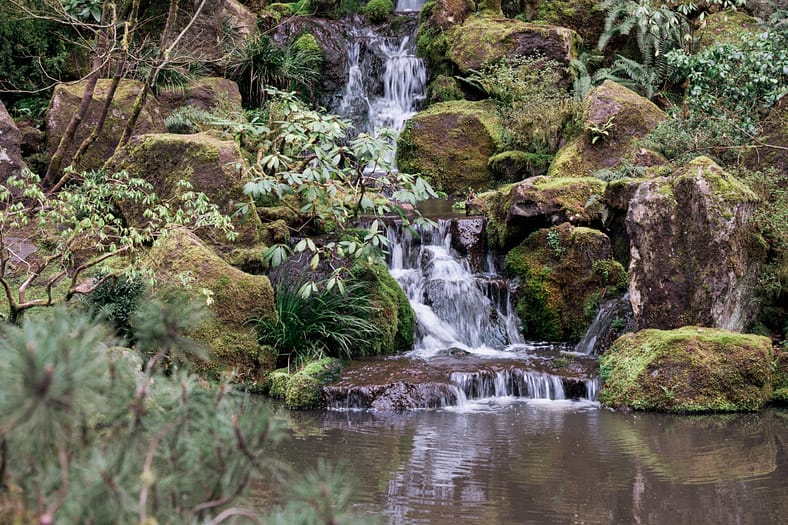
The fact that the garden is still evolving is a major draw for talented individuals in the world of Japanese garden care. It’s not so much that Professor Tono’s original vision needs revising, more that it is a relatively youthful space and they are still getting to grips with what works and what doesn’t. Since they’re working with plants, the garden team also need to adapt and respond to disease, weak growth, fluctuations in climate and many more factors besides. Shortly before my visit, failing Hinoki (Chamaecyparis obtusa) in front of the Tea House needed replacing. Hugo settled on Podocarpus as an alternative, but there were additional decisions to be made including whether this planting should screen or reveal the building behind it. Professor Tono would say “a closed book is nothing but a block” – a generous sentiment, giving the team licence to keep the spaces evolving.
One of the biggest changes to Professor Tono’s original plan, besides the recent construction of the Cultural Village, was the establishment of the Natural Garden, which took over a failing space originally known as the Moss Garden. It’s surprising to hear that moss could fail in Portland – it’s everywhere you look, and, in fact, removing it from the trees and shrubs is a never-ending job for the team. However, the slope where the Natural Garden now sits was a little too exposed to sustain the original vision, so the area was remodelled in the early 1970s by then Garden Director, Hachiro Sakakibara.
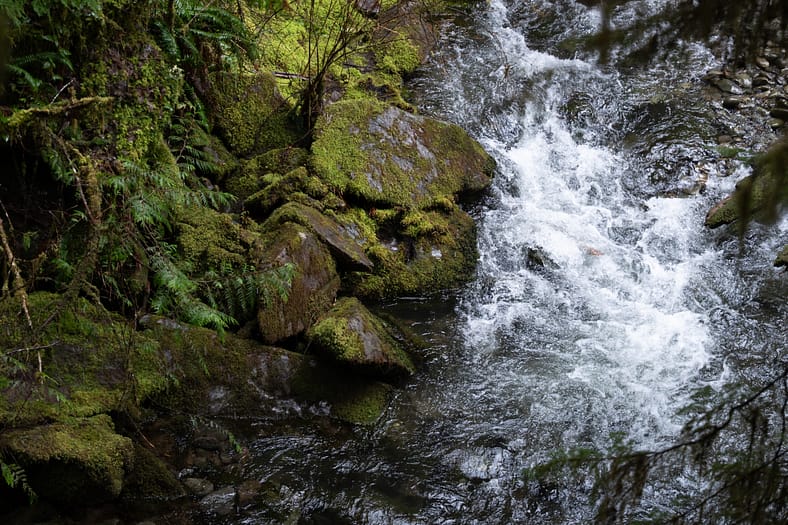
This style of garden – zoki no niwa – aims to give the visitor the feeling of walking in nature. Deciduous trees cast dappled shade over mossy rocks (moss still features in a big way, but it is not the primary focus). Uneven paths (previously mentioned) wind through camellia shrubs, and the whole length of the garden, which is built on a steep slope, follows the course of an artificial water feature designed to evoke the different stages of a mountain stream – from vigorous upland torrent all the way down to the limpid pools at the lower end of the space.
Related: The Zoki no Niwa of Portland Japanese Garden, a Uniquely Natural Feeling
At the top of the stream, the boulders are large and jagged; by mid-elevation they’re a little smoother and more rounded, and in the lower reaches significantly smoother. The casual visitor might not consciously register this attention to detail, but the effect is felt and understood. When the stream needed renovation work, Jacob drew inspiration not from Japan, but Gales Creek and Wilson River, both in the nearby Tillamook Forest.
For two months he hiked the waterways every weekend, exploring deeper and deeper upstream to observe how nature sculpts and populates at different stages. He noted how rocks transition into the water and observed which plants thrived at the water’s edge, or in the spray from a small waterfall, bringing this knowledge back to the garden to guide himself and the team towards making appropriate decisions.
I asked Hugo how he has been influenced by the extraordinary natural beauty on his doorstep. Like Jacob, he loves to hike and is always open to natural influence, but at the same time he is wary of his actions in the garden becoming too intentional. It bears repeating, that the garden does not try to re-create nature – rather it aims to create the experience of nature. “Better to go a million times in nature and react to the job in hand at the garden – soak up the natural world – otherwise it becomes too showy” he told me.
Careful observation of the way plants respond in the wild also allows the team to take better care of their own captive specimens. To give an example, throughout the garden maples are pruned in different ways depending on how much light they receive throughout the seasons in the different spaces. Time spent observing how trees compete for light in the wild helps to inform these pruning decisions resulting in healthier trees.
He explained that the garden is like a huge planting pot, so it’s never natural, even if the effect is. With the notable exception of the Douglas firs, cedars and naturally occurring mosses, the plant palette is artificial. However, for practical and aesthetic reasons, increasingly they are turning to native species. The current ratio is approximately 30% native and 70% non-native (mostly Japanese), but since native species have the edge when it comes to adaptation and therefore need fewer resources to stay healthy, the trend is shifting in their favour.
The most notable departure from a traditional Japanese garden plant palette has to be the vine maple (Acer circinatum), a deciduous understory tree, native to Oregon and employed to great effect in the Natural Garden and other areas of Portland Japanese Garden in places where you might usually expect to find Japanese maples (Acer palmatum). Hugo even goes so far as to say that without the vine maple the garden would not be such a great success.
Jacob is also a big fan and listed its many strengths for me: it requires limited pruning to look beautiful; it has a well-spread crown emerging from low down on a naturally forming multi-trunk; it creates an interesting silhouette without any intervention; it works very well in transition zones, helping to connect different areas under its broad spread; it turns a vibrant orange in autumn; and, most importantly, it thrives in the Pacific Northwest.
My time with Hugo and his team was running out, but I couldn’t leave without visiting the Flat Garden to see the current star of the show: the weeping cherry tree (Prunus pendula). The team had been working hard for weeks in anticipation of this moment, mostly pruning to optimise the multitude of views of the tree that present themselves as you approach from different angles. For most of the year, this tree is not a particular focus, so it’s a lot of work for such a brief period. On the other hand, the pruning they undertake to improve the views has other benefits to the garden, such as encouraging back-budding.
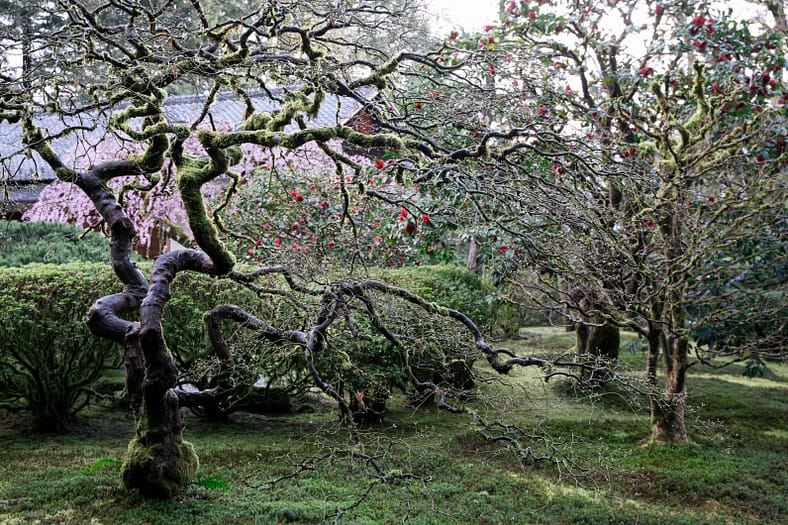
We passed a camellia that Hugo noted had, in his opinion, been pruned a little harshly. Besides looking good, he also wants these flowering evergreens to be open enough for birds to fly into them while at the same time offering the birds some protective cover. It’s a consideration that blurs the line between aesthetics and environmental care and another example of the thoughtful, holistic approach to gardening that is promoted here.
The large cherry tree in the courtyard had bloomed in a delicate, ethereal shade of pale pink, but in the shadow of the Pavilion Gallery the smaller weeping cherry was stopping visitors in their tracks with a more sensuous display of pink blossom bursting from rich pink buds. Up close, it crowded my senses and when I looked away for a moment and turned back to it delivered an almost visceral shock. No wonder Professor Tono instructed that there should only ever be a single weeping cherry in the garden: any more and the effect might not be so pronounced.
Related: Tana’s Tree, The History of the Weeping Cherry of Portland Japanese Garden
Unsurprisingly this tree was drawing quite a crowd, so we escaped through the Pavilion Gallery to the terrace, which offers a clear view east across the city toward the snowcapped peak of Mount Hood, 50 miles or so in the distance. Mount Hood is considered an active volcano, although its last eruption is thought to have occurred shortly before Lewis and Clark made their way along the Columbia River to the Pacific Ocean in 1805. The city is no stranger to the threat posed by volcanos: on the 18 May 1980, the garden hosted a dedication ceremony for the newly-built Pavilion Gallery. Simultaneously, Mount St. Helens showered the guests, the garden and the city in a fine layer of ash as it erupted 75 miles away to the north-east.
Hugo suggested there is something special about mountain towns and cities: the mountain influences the population, since those who grow up in a mountain town have an ever-present, ever-watchful, but inaccessible site on which to project the supernatural.
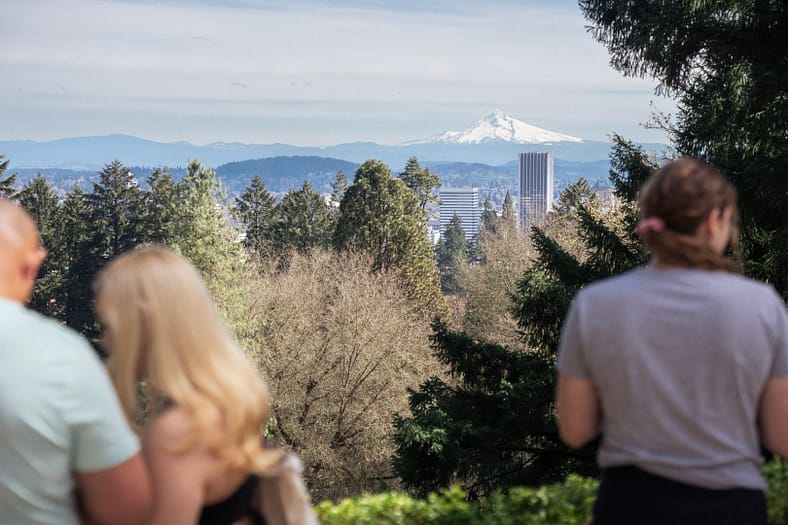
Perhaps it’s why so many gardens in Japan include a symbolic representation of Mount Fuji, or even better, a view of the mountain itself – to evoke its status as a sacred peak and the spiritual presence of the kami (supernatural nature spirit)associated with it. Mountains remind us of geological timescales which contrast with the rhythms of a garden, or even of a life. When they’re volcanic, mountains remind us of the whims of fate and the forces outside our control that influence our lives. It seems auspicious that Portland should have its own Fuji to provoke these feelings, and it adds to the case for the suitability of this garden in this place.
Reluctantly I said my goodbyes, filled with gratitude for the generosity and openness that has helped me to begin to understand the extraordinary achievements of this garden and the people who tend it. Treating myself to one last tour of the grounds, I noticed the Haiku Stone, a gift from poet Dr. Yutaka Mizuhara when he visited in the late 1960s, which has been placed by the overlook to the Sand and Gravel Garden (from where the cover photograph was taken). It reads:
Here, far from Japan
I stand as if warmed by the
spring sunshine of home
As I lingered in the spring sunshine, I had to give it to Dr. Mizuhara: he’d got to the crux of it. This garden is so much more than a Japanese fantasy transplanted to Oregon. To my mind, it’s an honest, ongoing conversation between two places shaped by similar rhythms, earnestly undertaken in the shared, unfinished language of nature that has the capacity to touch – and perhaps connect – anyone who experiences it.
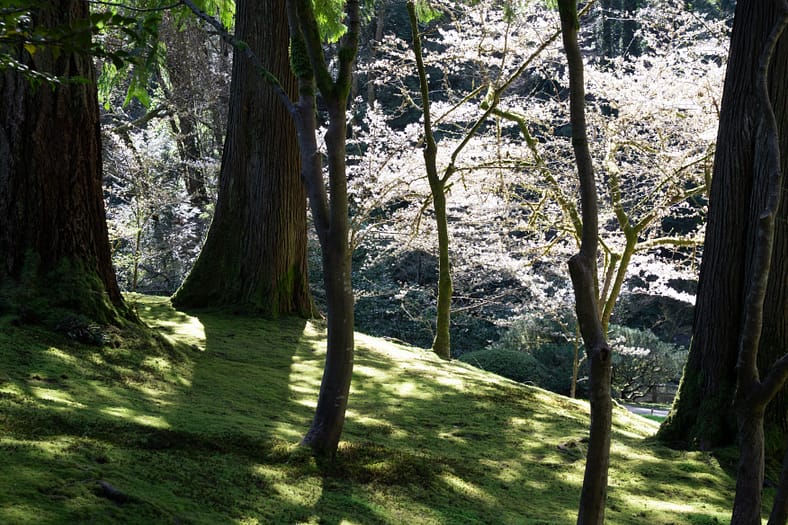
This poem also reminded me of a thought I’d had since my first morning in Portland. Was I imagining it or was the quality of light here similar to Japan? Of the many contributing factors that determine colour and intensity of light, latitude and proximity to an ocean are amongst the most important, so it wasn’t entirely impossible. Earlier, Jacob had shown me around the garden team’s workshop. Scribbled on the whiteboard, above a list of tasks and reminders, was their word for the day: komorebi – the phenomenon of sunlight filtering through trees and plants, creating a pleasing interplay of light and shade. There’s no direct translation into English, but I felt sure that any visitor to Portland Japanese Garden would understand the meaning it communicates intuitively.
About the Author
Alex Edouard edits the Niwaki Field Report, and is also in charge of Niwaki’s day to day creative output, leading a small team at Niwaki HQ in South West England. Following a varied career path from art historian and picture researcher to photography assistant and eventually one man creative studio, he says stumbling into horticulture is the best thing that’s ever happened to him. Alex lives in Salisbury, Wiltshire with his wife, Miranda, sons Wilf and Sam, and a very scruffy dachshund who (sometimes) answers to ‘Beetle’.
About The “Niwaki Field Report”
The Niwaki Field Report is an annual publication featuring horticultural explorations from around the world, with a strong but not exclusive focus on Japanese gardening. The journal is published by Niwaki, a Japanese garden tools and accessories company based in the U.K. founded by Jake and Keiko Hobson. A fascination with Japanese tree pruning (Niwaki means “garden tree” in Japanese) led to Jake working in tree nurseries in Japan and the UK before realizing there was a hunger for the finely crafted Japanese tools he had come to rely on. Today Niwaki sells a wide range of great stuff from Japan, including Japanese Tripod Ladders, the best-selling Hori Hori (a multi-purpose digging and weeding tool), carbon steel pruners, workwear, chef’s knives, saws, and much more. Visit their flagship store in London, drop into Niwaki HQ in Semley on the Wiltshire/Dorset border or shop online at niwaki.com.”