By Will Lerner, Communications Manager for Portland Japanese Garden & Japan Institute
In September, the Japanese Garden Training Center, one of Japan Institute’s programming centers, saw the return of Waza to Kokoro. This flagship program helps Japanese gardens outside of Japan find authentic, locally-appropriate solutions in design, construction, maintenance, and preservation. It is designed for professionals working in Japanese gardens, but is also open to landscape design and construction professionals as well as students of landscape-related disciplines.
“Waza translates to ‘technique’ or ‘skill,’ and kokoro can be translated to ‘heart,’” shares Hugo Torii, Garden Curator of Portland Japanese Garden and the Director of the Training Center. “By naming the seminar Waza to Kokoro, we mean to emphasize that to create or foster a Japanese garden, one needs to know more than just step-by-step instructions or how to use traditional equipment. One must engage with their mind and spirit if they’re going to distill the essence of nature in their landscape.”
“Historically, if one was to learn how to build or foster a Japanese garden, they would have to commit themselves to at least a decade of apprenticeship in Japan,” Torii continues. “We understand that this is limiting and might prevent many people from learning how to best foster these essential landscapes. Rather than be overly stringent, Waza is a modernized approach influenced by Western education techniques, including lectures and homework. Ultimately, becoming a niwashi, or garden master, is still a life-long pursuit, but we hope that our program will help make the initial learning more accessible in modern society.”
In 2025, Torii built upon a foundation initially set up by his predecessor, Sadafumi Uchiyama. Uchiyama, now Curator Emeritus for the Garden, worked alongside Diane Durston, Curator Emerita and former CEO Steve Bloom (2005-24) to establish the Training Center in 2017, one year prior to the very first Waza in 2016. “I am grateful for the work that has been done to establish the Training Center, and am excited to see how we might continue its evolution,” Torii notes.
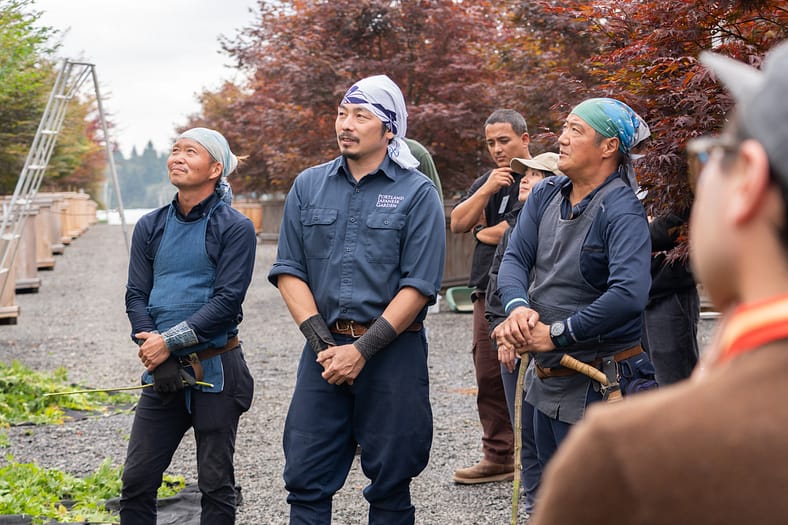
Torii and Yuki Wallen, Training Center Program Manager, assembled a group of experts to help guide a group of learners who flew in from places across North America and the United Kingdom. They included, in alphabetical order:
- Mark Bourne, a Japanese-trained master garden creator and a scholar of Japanese garden history.
- Diane Durston, Curator Emerita of Portland Japanese Garden, and acclaimed expert and author on Japanese culture.
- Koukai Kirishima, President of Niwashou-Kirishima co. Ltd., Councilor and Vice-Chairman of the International Activities Committee of the Garden Society of Japan.
- Toshiaki Seki, Owner of Niwa Ya no Seki.
- Jan Waldmann, President of the Urasenke Wakai Tankokai Association.
Continue reading to see a snapshot of what was covered each day of Waza.
Day One – Orientation
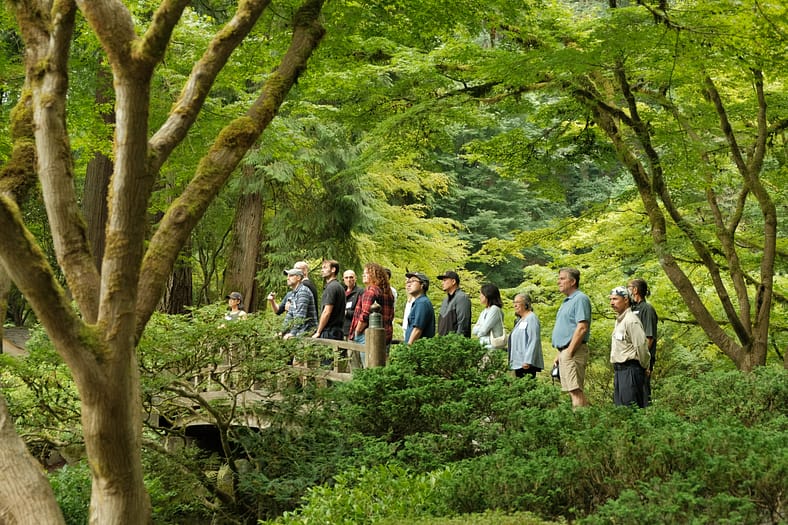
Naturally, the first day of Waza to Kokoro started with introductions, both staff that would be assisting Torii, as well as a general overview of Japanese gardens themselves. After going over some general housekeeping, Torii gave a presentation that covered the history of the landscapes he’s devoted his life to building and fostering. Pointing back to their origins as outputs inspired by faith and agricultural needs, Torii noted how different garden styles arose over the course of centuries, such as a how a space like Portland Japanese Garden’s Strolling Pond Garden is inspired by aesthetic approaches that begun as early as Japan’s Nara Period (710-794).
Following Torii was a presentation by Diane Durston. Prior to her retirement and title as Curator Emerita, Durston served as the Arlene Schnitzer Curator of Culture, Art, and Education for the organization from 2007 to 2018. Durston explored the Japanese sense of beauty, covering terms such as miyabi (refined elegance) and iki (chic, understated stylishness). She concluded on the four characteristics of Japanese aesthetics as described by Donald Keene, the late and highly respected Western scholar: suggestion, irregularity, simplicity, and perishability. The learners were then asked to see where they might find these four characteristics within the landscape of Portland Japanese Garden.

“Having been involved in the very beginnings of Waza to Kokoro, I am so happy to see how it has evolved and progressed!” Durston shares. “This is a one-of-a-kind program that has influenced others around the country and beyond—even among garden professionals in Japan!”
Day Two – Tea
The Way of Tea and its teachings has had great influence on the structure of Waza to Kokoro with the thought that its four principles help guide the gardener. Those four principles are:
- Wa: Harmony
- Kei: Respect
- Sei: Purity
- Jaku: Tranquility
Tea gardens, such as the one at Portland Japanese Garden, are obviously deeply linked to Tea Ceremony and its teachings but the Training Center hopes that learners understand the value that these teachings have in all garden styles. The gardener: 1) strives to find harmony in the composition of the space they are working in; 2) should demonstrate respect for the people who are using the garden, perform with respect for nature; 3) cleans and maintains the garden carefully through pruning, sweeping, and raking; 4) helps establish feelings of tranquility by fully realizing the first three principles.
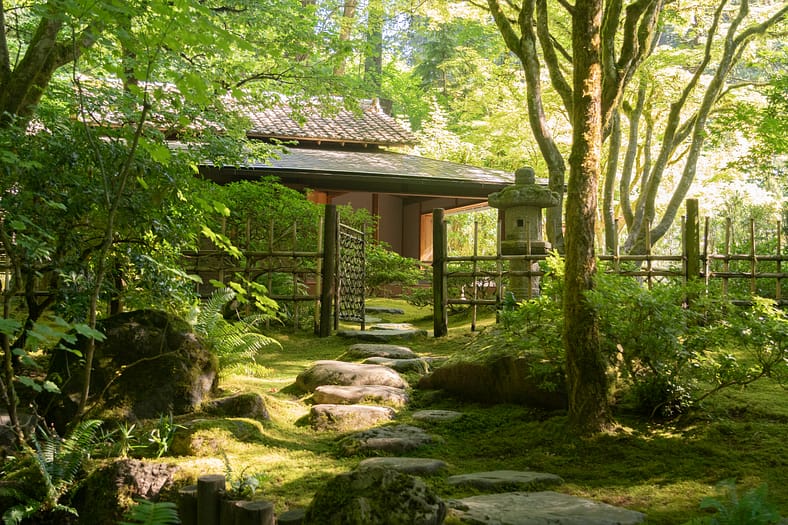
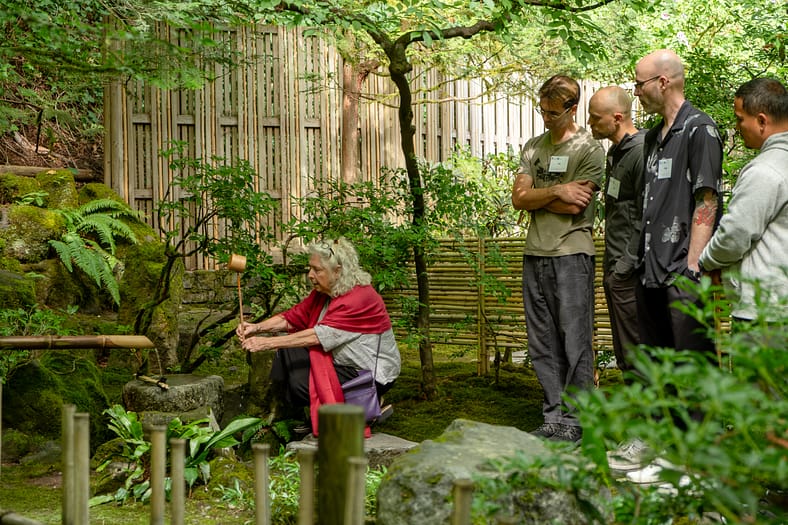
Jan Waldmann, a longtime cultural partner of the Garden, was on-site this second day to discuss Chado (a Japanese term that can be taken to mean both “Tea Ceremony” and “The Way of Tea”) first through a lecture and then through a stroll in the Tea Garden. Finally, she led the students through the ritual itself.
“There’s a wonderful quote about Tea Ceremony…” Waldmann has previously noted, referring to something once shared by Sen Sōshitsu XV, the fifteenth Grand Master of Urasenke, an important school of Japanese tea. “…I like to look at these words as not only holding a bowl of whisked matcha, but just having something that you are going to consume, that you’re going to sit down and just relax, taking time for tea. The quote is, ‘In my own hands I hold a bowl of tea, I see all of nature represented in its deep green color. Closing my eyes, I find green mountains, pure water within my own heart. Silently sitting alone drinking tea, I feel these become part of me. Sharing this bowl of tea with others, they too become one with the tea and with nature, that we can find an everlasting tranquility in our own lives in the company of others is the paradox that is the way of tea.’”
“Waza to Kokoro is a valuable program allowing participants the opportunity for hands-on experience of various principles of gardening as practiced in Japan for generations,” Waldmann shares, reflecting back on this year’s seminar. “Participants leave with a new mindset of expanding their own horizons with a new sense of respect for nature.”
Day Three – Japanese Garden Design
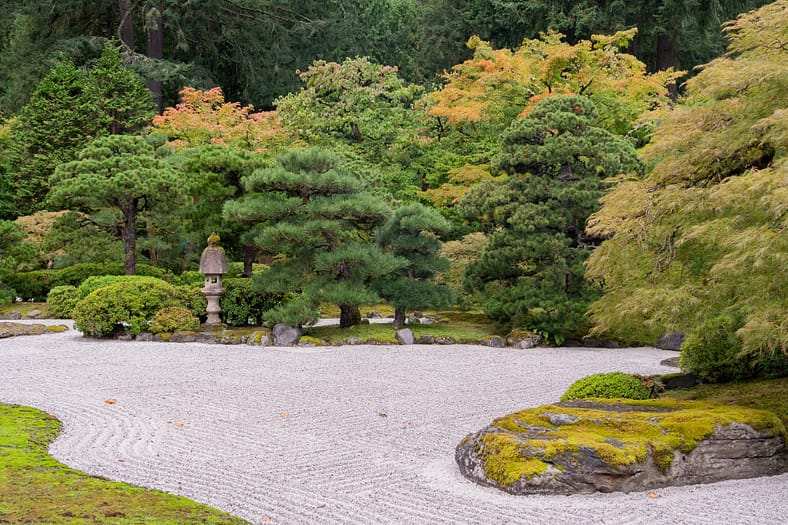
With much already shared about the history of Japanese gardens and the relevancy of Tea Ceremony on the work, the third day of Waza to Kokoro focused primarily on garden design itself. Torii began the day by discussing the five basic materials found in most Japanese gardens: stone, plants, water, bamboo, and wood. For however simple these materials may appear, there is a world of complexity behind them that must be considered by the gardener.
Since Japanese gardens strive to represent the experience of being in nature, this means the gardener should pick the materials that match the landscape that is being represented. “If one were creating a mountainous atmosphere, it wouldn’t make sense to pick smaller and rounder stones one might find in a stream at sea level,” Torii shares. “Instead, we would want to use large stones with edges. This is just one example of the many considerations that must be weighed when sourcing materials, and those considerations will always shift depending on the purpose of the garden and the wild nature it is trying to evoke.”
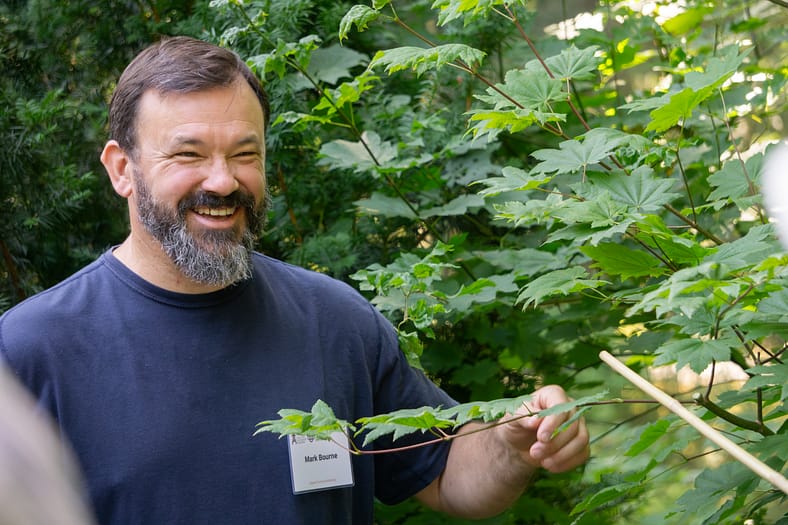
Joining Torii on this day was Mark Bourne. In addition to his master’s degree in architectural history, Bourne had taken a four-year-long apprenticeship under renowned garden creator Yasuo Kitayama. His training included maintenance, restoration, and new work in many famous and historically significant gardens, including the Kyoto Imperial Palace.
Among the things Bourne covered were key concepts in Japanese garden design, such as centering the human-eye view of a garden, composing scenes that consider every inch of the space (including how it interplays with what’s beyond its boundaries), and other concepts that harkened back to Durston’s lecture on day one, such as irregularity, asymmetry, and layering.
“Thank you [to Hugo Torii and his colleagues] for inviting me to be part of the team for this seminar,” Bourne shared afterwards. “It is an amazing program, and the huge effort of putting it together and having the whole event run so smoothly must be quite something. What a chance to study without having to arrange a stay in Japan.”
Days Four and Five – Stone Workshop
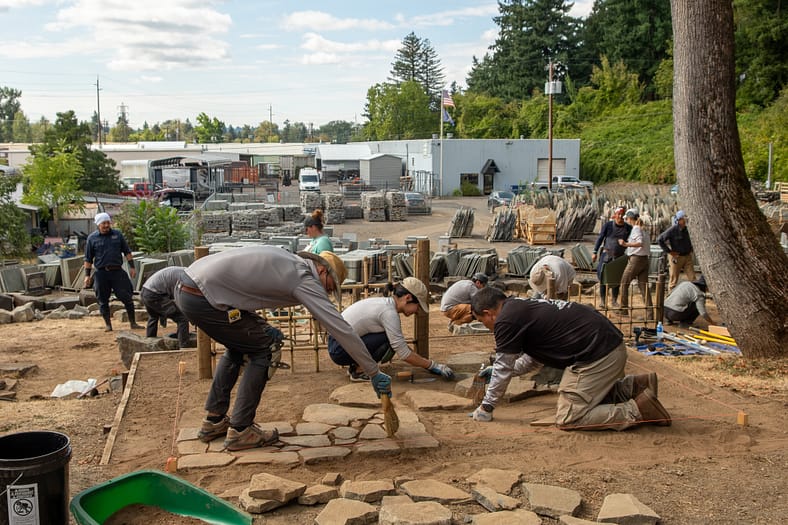
After spending the first few days of Waza at the Garden, the learners then spend the next two days at Smith Rock, Inc. in the neighboring community of Milwaukie. Smith Rock, not to be confused with the state park in central Oregon, has been a longtime time friend and partner of the Japanese Garden Training Center and is a highly regarded provider of natural stones for masonry and landscaping.
Both days began with a tea session and talk by Waldmann, a fitting start as the focus here would be on tea gardens. Whereas so far the discussions had mostly focused on the theoretical and philosophical, the bulk of the time at Smith Rock was focused on the logistical. Joining the group this day and for the rest of the seminar were two expert gardeners from Japan: Koukai Kirishima and Toshiaki Seki.
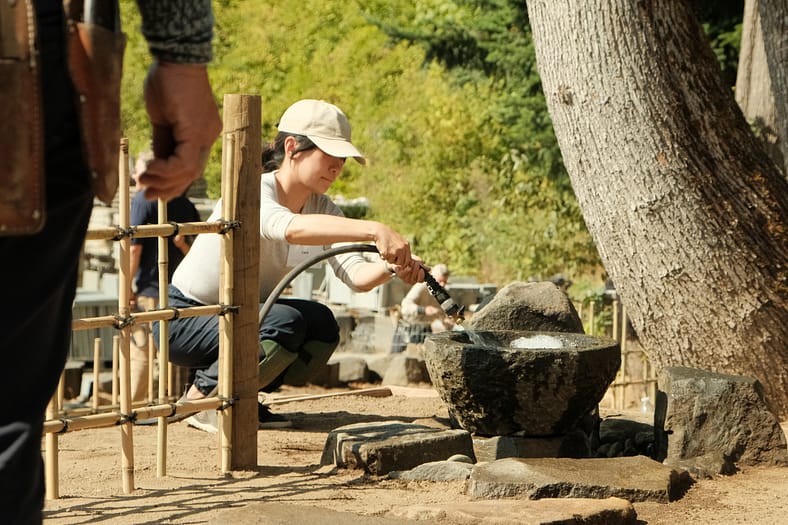
Kirishima is the President of Niwashou-Kirishima co. Ltd., Councilor and Vice-Chairman of the International Activities Committee of the Garden Society of Japan, Honorary Advisor of the Association Française du Jardin Japonais (France), Special lecturer at the Japanese Garden Training Course in Scuola Agraria del Parco di Monza (Italy) and Master of the Sogetsu School of Ikebana. Seki is owner of Niwa Ya no Seki, a landscape design firm and a member of The Garden Society of Japan.
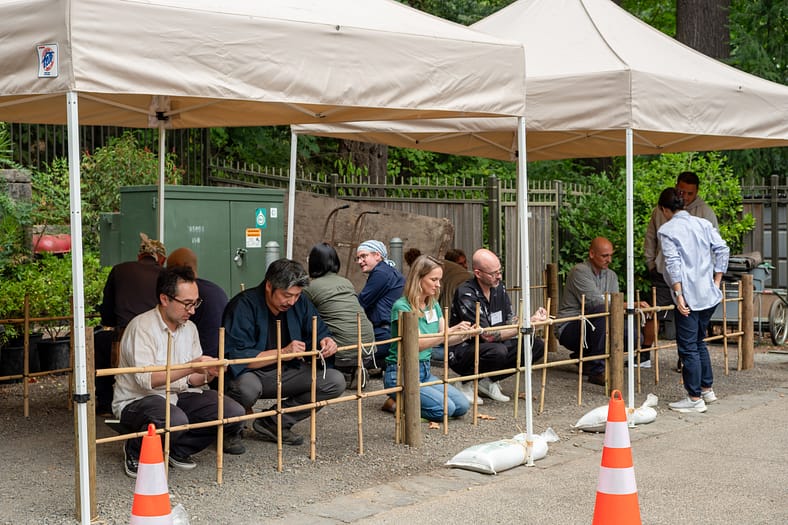
Separated into smaller groups, the learners were tasked with building nobedan, or stone pathways. On leveled ground, stakes were planted with string lines to help give a boundary. After digging the soil to help give appropriate depth, three types of different stones were used to construct the pathway: large corner stones, stones with a flat top and at least one straight edge, and then other stones consisting of anything from pebbles to river rocks to slate. Kirishima and Seki were joined by Torii in helping the participants navigate the many different considerations that go into creating harmonious arrangements of the stone. Another element of this experience was building tsukubai stone arrangements including a mizubachi water basin. In a tea garden, the tsukubai is where the guest participating in a Tea Ceremony rinses their hands and mouth, removing the dirt or grime of the world behind.
Day Six – Pruning
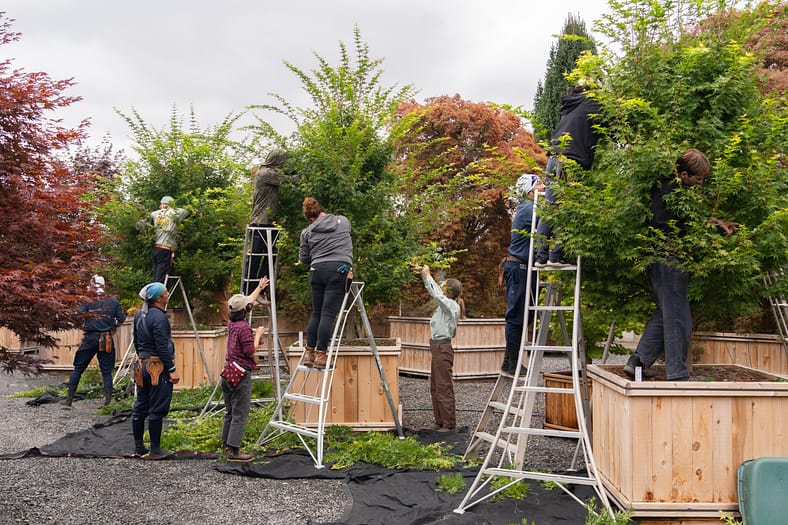
A maple tree in a Japanese garden can appear like a map of a river and its tributaries, with limbs extending out in a manner simultaneously gnarled and elegant. Stunning in all seasons, but especially in fall when they come alight in radiant crimson, Japanese maples seem as though they were placed by divine intervention. It is no wonder that some in Japan consider visiting them a form of communion with nature. However, the specific quality of their shape in Portland Japanese Garden is the result of 整姿 (seishi), the grooming and training of flora. With careful consideration of each tree’s location and how it contributes to a space’s composition, gardeners transform it into a more idealized form through 剪定 (sentei), the pruning of branches and roots.
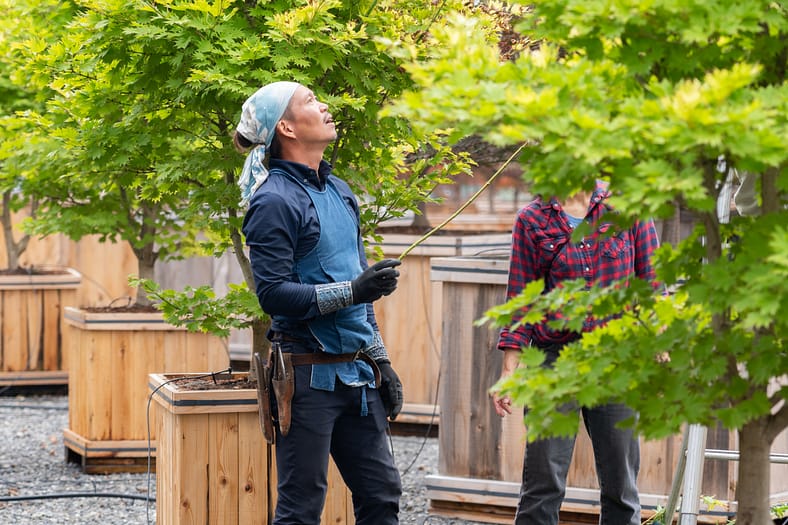
To learn more about how to combine horticultural practice with artistic expression, the learners spent their second day at Iseli Nursery, a renowned organization in nearby Boring, Oregon. While the idea of pruning may appear simple on face value there is a robust amount of research and science behind the removal of limbs, leaves, and buds. A poorly timed cut or unfocused approach can result in a spectrum of poor results beyond aesthetics, including the list of “undesirable branches” or rot that leads to the tree’s death.
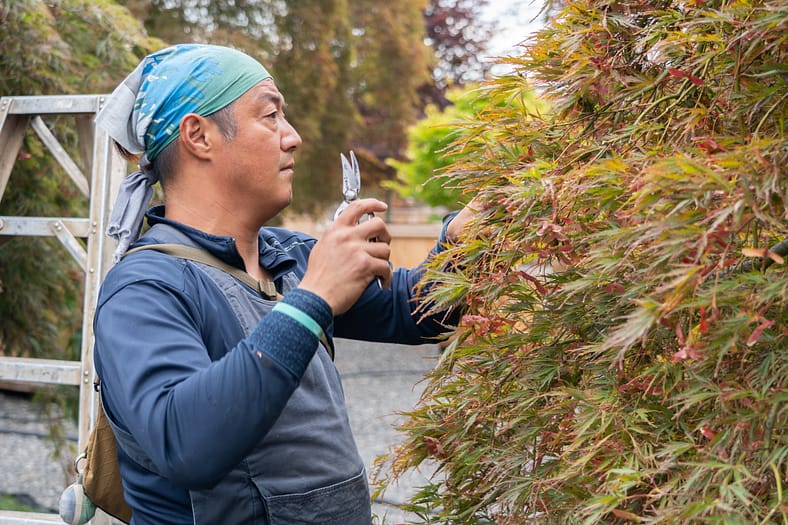
With all those considerations in mind, much of the instruction for the Waza learners was that which encouraged deep thought and intentionality. Thanks to the group setting, these participants were not only able to get feedback from Torii, Kirishima, Seki, and Jacob Knapp, formerly Senior Gardener for Portland Japanese Garden, but also each other. The ability to communicate with peers in a controlled setting was a valuable experience as the practical work of a gardener, especially in large landscapes such as Portland Japanese Garden, can often be a solitary pursuit.
Day Seven – Wrapping Things Up
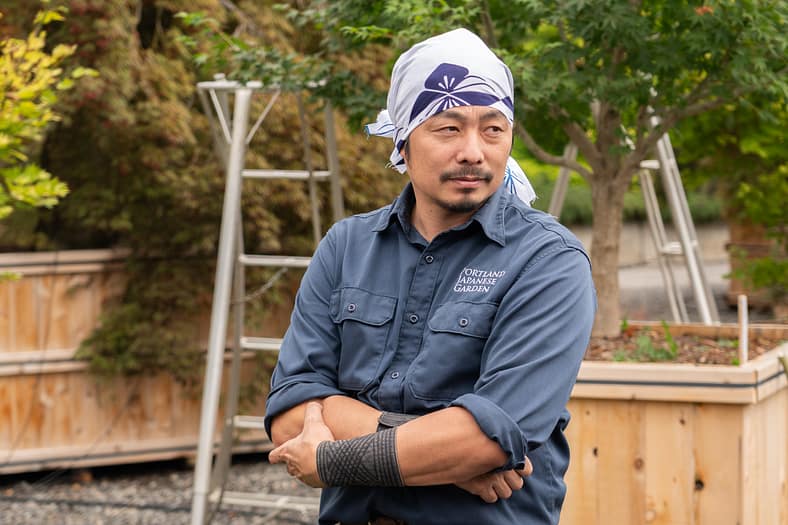
On the final day of Waza to Kokoro, the learners and instructors returned to Portland Japanese Garden to recap a busy week and go over some final lessons. The day began with oral presentations from the participants, who were all tasked with addressing a seemingly simple yet very complex question: “What is the essence of your Japanese garden?” Following this, they enjoyed lunch and a final lecture from Jan Waldmann on Japanese food. The day ended with further remarks from Koukai Kirishima and Toshiaki Seki, a final question-and-answer session with Hugo Torii, and then, finally, a farewell dinner in Northwest Portland.
“I am very pleased with how Waza to Kokoro turned out this year,” concludes Torii. “Our participants demonstrated an eagerness to learn and share what they’ve learned with one another. One of the best parts of this seminar is that I and the other instructors present are able to learn as well from the students, making this a reciprocal process that benefits everyone. We’re already beginning to plan next year’s seminar, this time earlier in the summer. I encourage anyone who is interested to sign up for our newsletter so they can be informed when registration opens in 2026.”
Feedback from the Participants of “Waza to Kokoro” in 2025
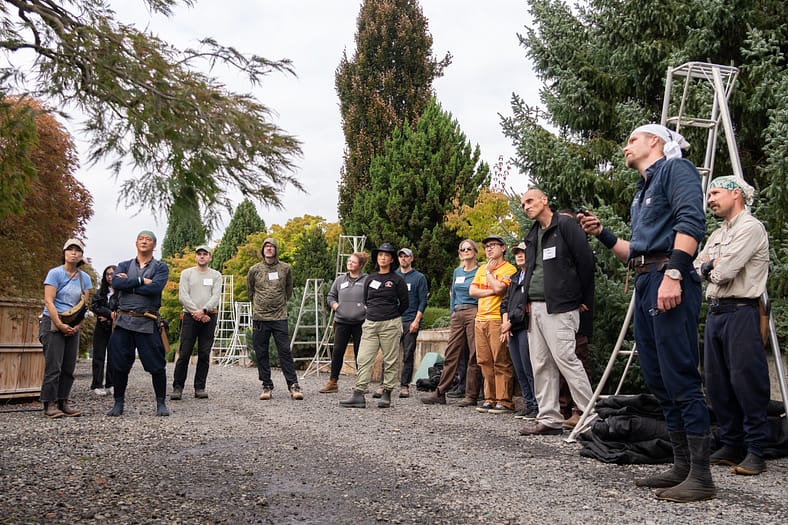
Portland Japanese Garden and Japan Institute are grateful for all of its participants who traveled to Portland to participate in Waza to Kokoro, led by the Japanese Garden Training Center’s Director, Hugo Torii. Below are some of the thoughts shared by the learners after the seminar had concluded.
“The course gave me foundational understanding of how history, culture, spirituality, art and handcrafts have shaped Japanese Gardens through time. It gave me a lens with which to look at my own garden and a window into prioritizing various practices to support [its] care.”
“This class was phenomenal and eye opening for me. I am so grateful to have the opportunity to attend and learn from such knowledgeable teachers. This program elevated me as a gardener and designer. The openness of the staff and instructors was wonderful to experience. They were so willing to share their passions and teach others, it was truly a beautiful experience.”
“Very simply, thank you. I feel so lucky to have been selected to participate and it’s amazing how much we learned in such a short time. Just enough to realize how much I don’t know! This was so well-run and inspiring, and I’m grateful for this experience. Arigato gozaimasu!”
“Thank you to everyone that facilitated and run the course. I loved every minute of it and find it incredibly valuable to my own work. I have a few workshops to assist in the teaching of (pine pruning being the most imminent) and I find myself far better equipped to explain the reasoning behind aesthetic decisions and to demonstrate techniques from a place of greater understanding and precision. I have learnt so much from you all, I really feel reinvigorated and optimistic about all I can learn in the future.”