By Will Lerner, Communications Manager for Portland Japanese Garden & Japan Institute
Portland Japanese Garden is a “living classroom” that offers tremendous opportunities for experiential learning to all who enter its gates. One signature program that embodies this spirit is the Professional Gardener Work Exchange Program an initiative led by Hugo Torii, Garden Curator and Director of the Japanese Garden Training Center.
“It is a collaborative effort between Portland Japanese Garden and other, similar organizations that align with our philosophy and approach,” Torii shares. “I work with the leaders of other gardens to create a mutual exchange where gardeners spend time working alongside their fellow practitioners in a new setting. It’s an invaluable experience for these individuals—passionate gardeners can deepen their skills by working alongside each other; we certainly learn a lot from the guests we welcome here.”
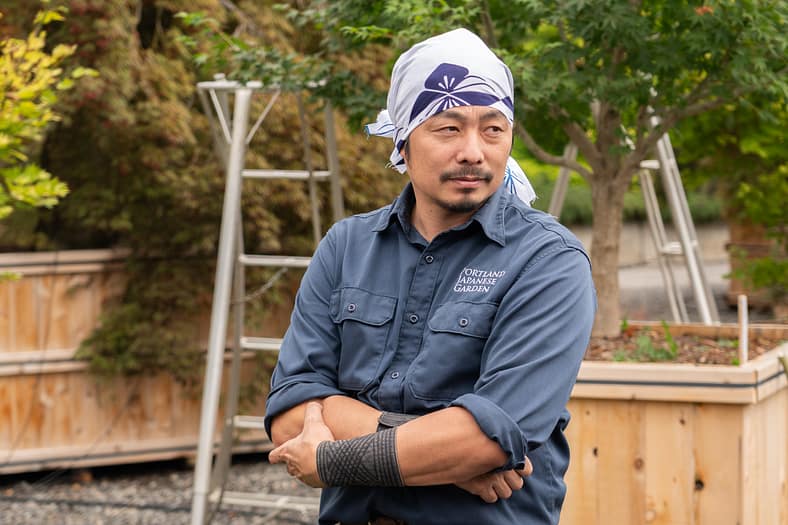
“Looking beyond what this means for the individual practitioner, it is an important initiative for the sustainability of Japanese gardens,” Torii continues. “Portland Japanese Garden has earned its reputation as the most beautiful and authentic Japanese garden outside of Japan because it has been maintained by garden experts for its entire history. As a leader in this field, we have a responsibility to support the wellbeing of other Japanese gardens so that more can experience the harmony and peace they generate.”
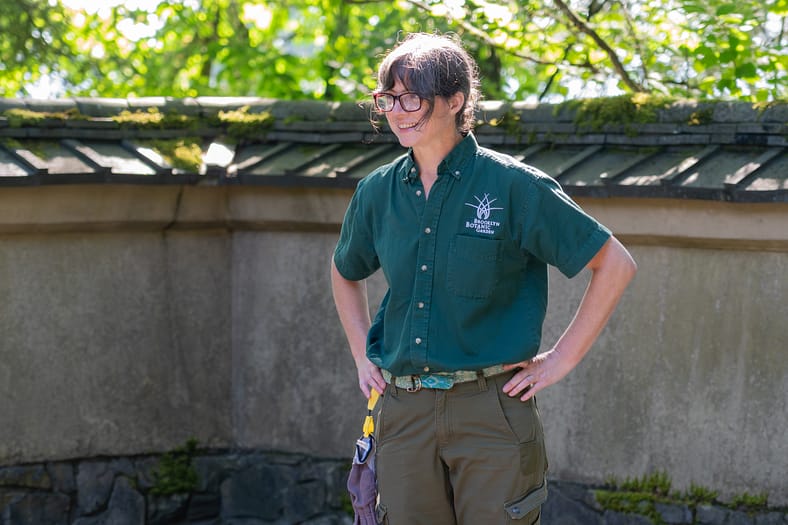
Gardeners from Portland Japanese Garden participate in this reciprocal program as well, with members of the team having worked elsewhere. In July, Portland Japanese Garden welcomed Anne Hunter, gardener and curator for Brooklyn Botanic Garden’s three-acre Japanese Hill-and-Pond Garden and Japanese Tree Peony Collection, to become the latest professional to participate. Hunter sat down to chat about her week in Portland.
Early Days in Nature
Hunter hails from the Washington, D.C. metro area and recalls early moments of meaningful time spent in nature as a kid. “My parents loved gardening at home,” she shares. “I spent time in nature with my family as a child, either hiking or at different gardens around the DC area, the Arboretum and Rock Creek Park, a forested park running through the city.”
An interest in the natural world led Hunter to take a job with the Education Department of the Franklin Park Conservatory and Botanical Gardens in Columbus, Ohio. “From that, I caught the bug of wanting to work for public gardens,” she notes. “When I moved to New York, I worked at the Hudson River Park and High Line in Manhattan and Wave Hill and the New York Botanical Garden in the Bronx. In 2014, I joined Brooklyn Botanic Garden. My first role was running our garden next to our [Diane H. and Joseph S. Steinberg Visitor Center].”
Taking care of a living roof, rain gardens, berm meadows, and a variety of different plantings, Hunter was in close proximity to Brooklyn Botanic Garden’s (BBG) Japanese garden. “I wound up with Brian Funk, the talented gardener and curator working there, sometimes filling in if he was on vacation,” she shares. “After several years and forming a positive relationship with Brian I learned he was retiring after 22 years of service. I said I’d be in interested in taking the space over. He was very generous and taught me here and there and helped me get into a Japanese pruning workshop at Shin-Boku Nursery in New Hampshire, introduced me to [the North American Japanese Garden Association] and hooked me up with some other really great resources to get me started.”
Hunter’s time as a professional in the horticultural arts of Japan may have begun somewhat recently, but her affinity for it can be traced back to her childhood. “Growing up in D.C. and getting to the arboretum I was exposed to bonsai at a young age and I had family in the military who were stationed in Japan,” she says. “I grew up hearing stories of being in Japan and their appreciation for the culture. But working at the Brooklyn Botanic Garden and being near it for many years made me realize this was a really rare, amazing opportunity.”
A Week in Portland
“I think the reputation of Portland Japanese Garden being the finest example of Japanese gardens outside of Japan is well known,” shares Hunter, when asked of her familiarity with us here in Oregon. “And certainly, I had gotten that message and it had been on my list to visit for a long time. I finally had a chance earlier this year and got to make a quick visit before this opportunity. I’m glad that I saw it with the eyes of a visitor first. I was with my family and some friends and got to experience the Garden as it’s meant to be experienced. My daughter and her friend were with us and could not have been more thrilled to do the treasure map hunt.”
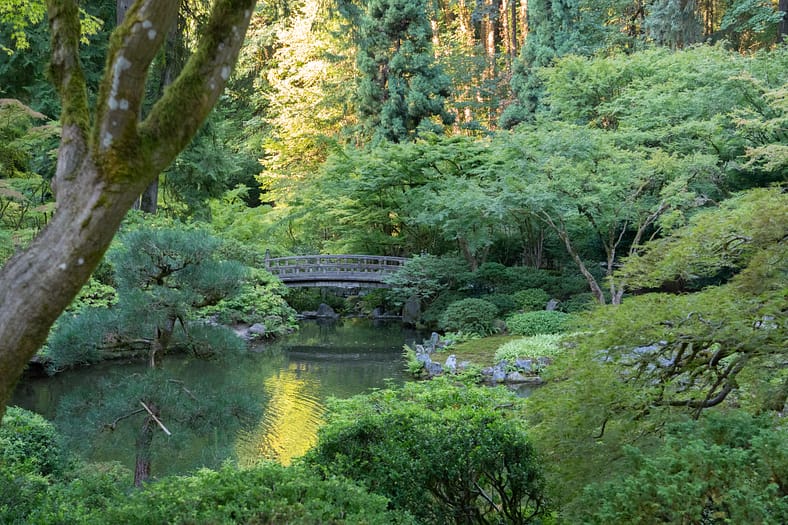
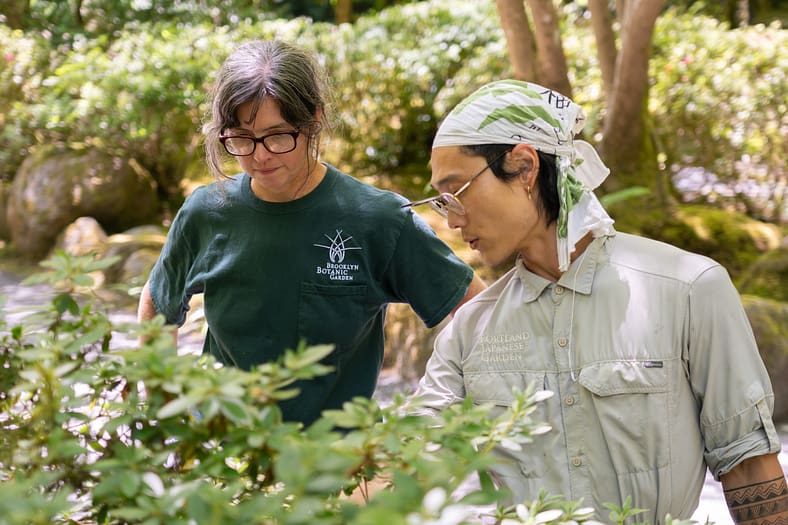
“I have been able to do a nice variety of work projects along with the amazing staff with the Garden Department,” she continues. “I think I’ve gotten to work in almost every area, which is really nice. The mornings have started with a kind of cleaning ritual, where high level cleaning is done for the moss and pathways. I got to feed the koi—it was really interesting to learn about the high level of care that goes into them. I’ve also gotten to do a lot of different pruning, shearing shrubs along the upper pond [of the Strolling Pond Garden], maples, even some bamboo. I also got to rake the Sand and Stone Garden and Flat Garden.”
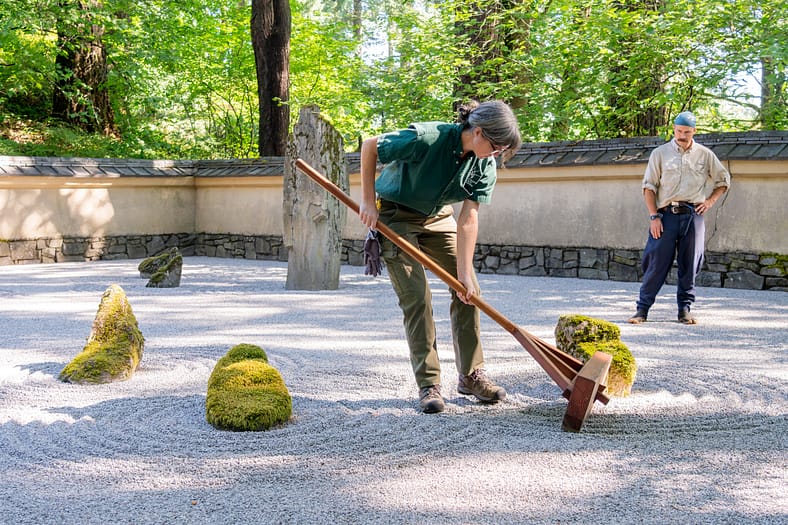
While BBG, because of its scope, employs a larger number of people to tend to its landscape, Hunter is the only full-time staff member dedicated to the three acre Japanese-style garden that she fosters. Among the things she enjoyed was the camaraderie, expertise, and teamwork of the team in Portland.
“The gardeners here are enthusiastic about what they do and work so well as a team,” she shares. “A lot of times they break off to do individual things and then will come back together, and then break apart again. It’s like waxing and waning and from an outsider’s perspective, it’s a fluid way of getting done all the things that need to get done. They truly respect each other and communicate well. They’re the loveliest group of people.”
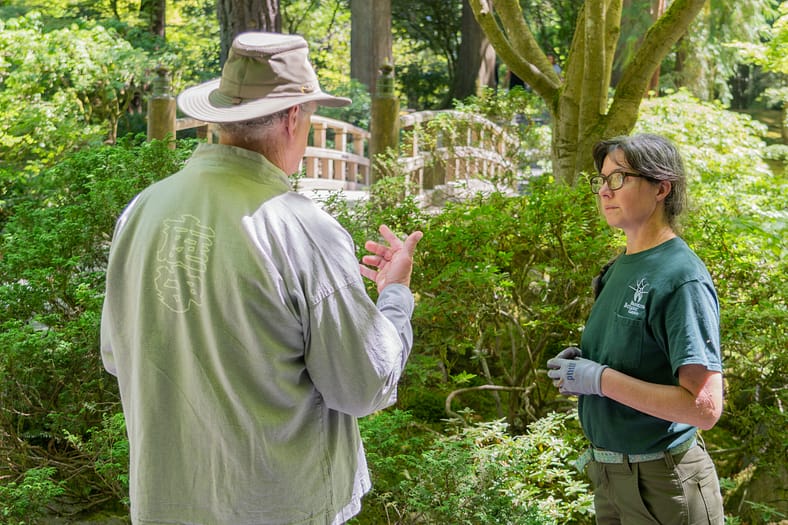
While Hunter demurred at the question when asked what she might have taught them, she was happy to share the lessons she gained, particularly when it came to pruning techniques. “The gardeners showed me how they were trained to do it,” Hunter says. “We were thinning out a lace leaf maple and I was snipping it. Jonathon [VanderSloot] came over and showed me how I could snap with my fingers instead. It’s actually faster. To have somebody standing next to you and doing it together and getting used to the rhythm was helpful. That’s something I’ll apply when I go home and prune my maples.”
The conversation ended with Hunter giving an enthusiastic endorsement of the experience in Portland. “There clearly is a high level of art that is practiced here and it’s an great opportunity to learn from such a wonderful, dedicated team,” she concludes. “And I think it’s important for all of us to get outside of our comfort zone and see how other people do things. Maybe it’ll be better, maybe it’ll just be different. It’s important for humans in any career to do so.”
Extra: The Connection Between Portland and Brooklyn’s Iconic Gardens
Brooklyn Botanic Garden (BBG), an acclaimed garden founded in 1910, encompasses 52 acres and contains multiple, smaller gardens and conservatories within. Aside from its Japanese Hill-and-Pond Garden, it has a significant connection to Portland Japanese Garden through Professor Takuma Tono of the Tokyo University of Agriculture. Tono is the original designer of this space in Portland, but before he began his work in Oregon he had become noted for his creation of a replica of the famed raked gravel garden of Ryōan-ji Temple in Kyoto at BBG.
Tono’s work was featured in a September 1963 issue of The New Yorker. This was an era in which the iconic design of raked gravel gardens was still largely a new concept to many Westerners. In the magazine’s “Talk of the Town” section, it was noted, “In proper Zen fashion, we returned to the office at the end of the day not with an answer but with another question—one that we have not yet answered to our satisfaction, and that we are willing to throw open to discussion: What is a garden?” The article went on to note how the site was created after its director, Dr. George S. Avery, had made a visit to the original in Kyoto.
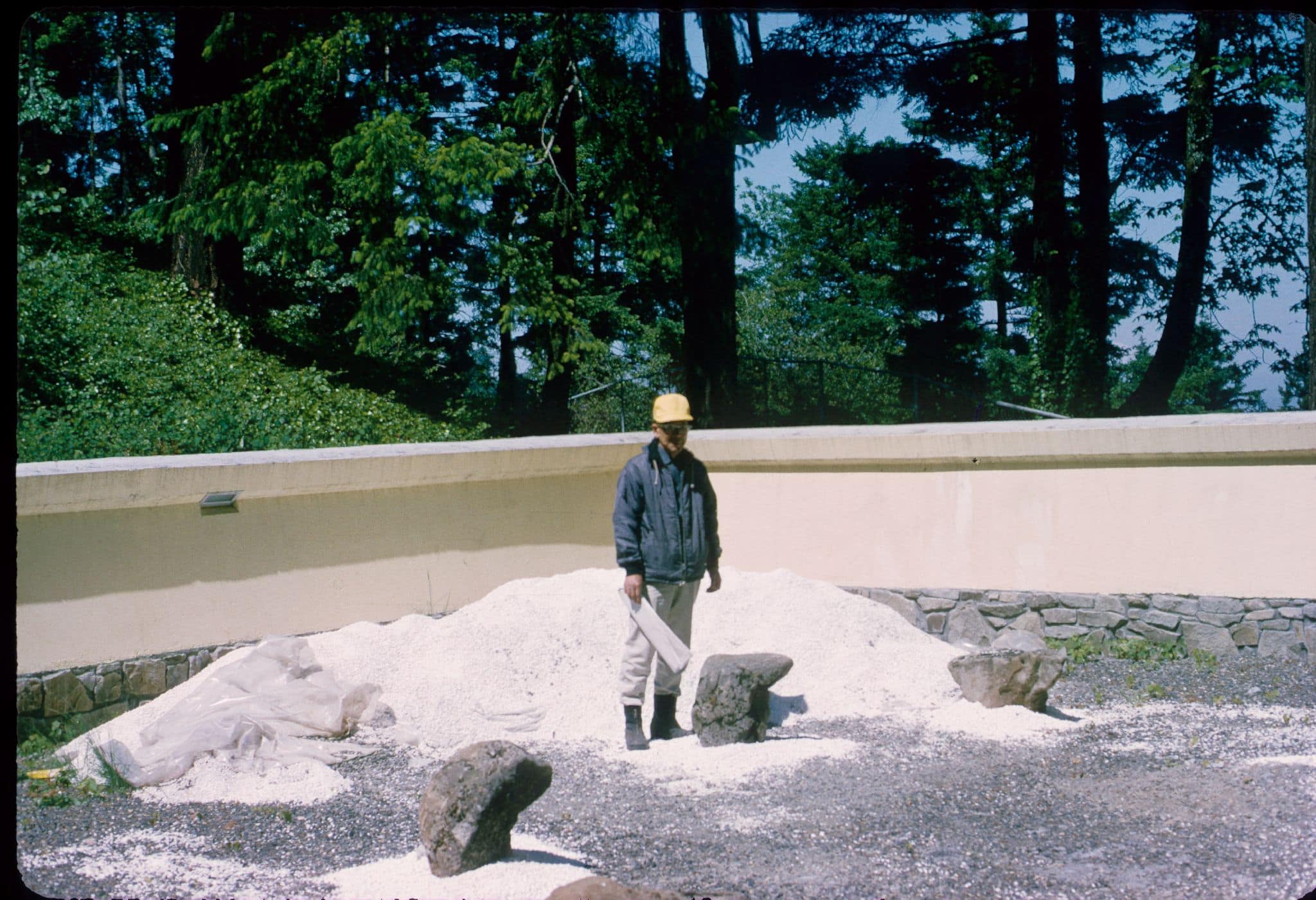
While this tribute no longer exists at BBG, its Japanese Hill-and-Pond Garden has remained a staple of the institution for more than a century. “It’s a three acre space that was designed 110 years ago by a young Japanese American man named Takeo Shiota and it’s been an enduring heart of the garden ever since,” Hunter notes. “The three acres I oversee is a mixture of the ancient hill and pond style integrated with a stroll garden style. Mr. Shiota added some elements from Shinto. We have a large torii gate near a shrine on a nearby hillside. The shrine dedicated to Inari, a deity of rice prosperity and the harvest.”
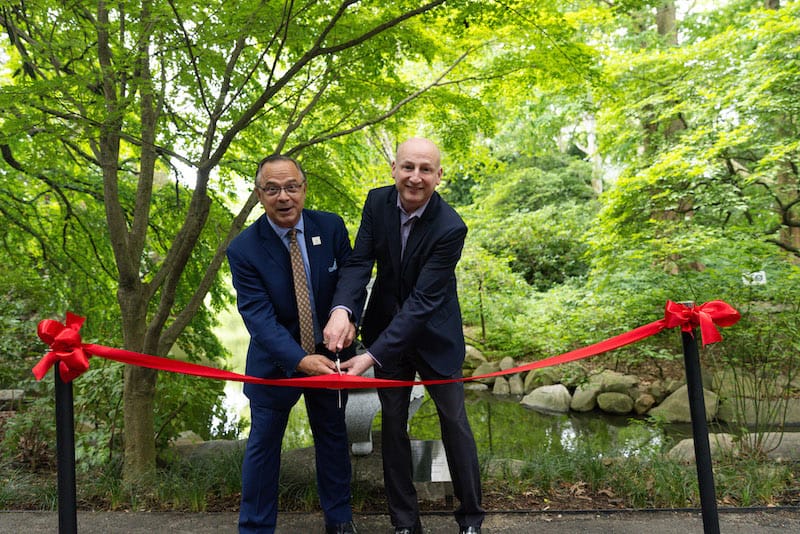
In 2024, Portland Japanese Garden and Brooklyn Botanic Garden solidified their relationship with one another beyond a shared connection to a famed landscape designer when the Oregon-based organization donated a handcrafted replica of its famed Peace Lantern. Ahead of the ceremony commemorating its placement, Hugo Torii flew out to help the New York landmark determine where it would be placed.
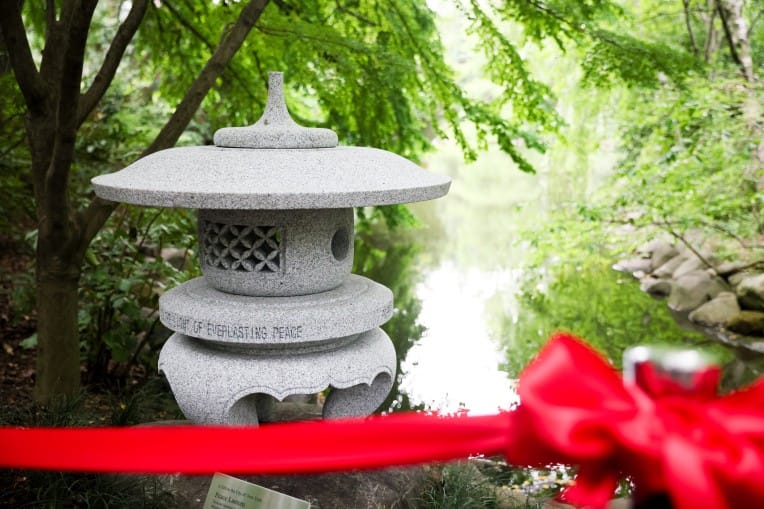
“Hugo scouted the perfect location, and then came back later to help get the footing stone in place and get the lantern perfectly placed,” Hunter recalls. “And then later on there was a ribbon cutting ceremony. I think that has really strengthened and sealed our relationship as institutions. The Peace Lantern is a part of us now—it’s situated just outside of the Japanese garden. It’s a real beacon for visitors, a bit of way find that has become a destination itself for people to stop, take photos, and just reflect in a place that where most people just walked by before.”
Related: Learn more about the Peace Lantern of Portland Japanese Garden
“Brooklyn Botanic Garden is honored to receive this symbol of peace for our Japanese Hill-and-Pond Garden,” Adrian Benepe, President and CEO of Brooklyn Botanic Garden remarked during the ribbon cutting ceremony. “Generations of New Yorkers and visitors from around the world have come to Brooklyn Botanic Garden’s Japanese Hill-and-Pond Garden to find tranquility and restoration, and generations more will encounter and be inspired by this new symbol of peace.”
More Guest Gardener Articles
- Ethan Cote, Richard & Helen DeVos Japanese Garden at the Frederik Meijer Gardens & Sculpture Park
- Jose Gonzales, Seattle Japanese Garden
- Pete Putnicki, Seattle Japanese Garden