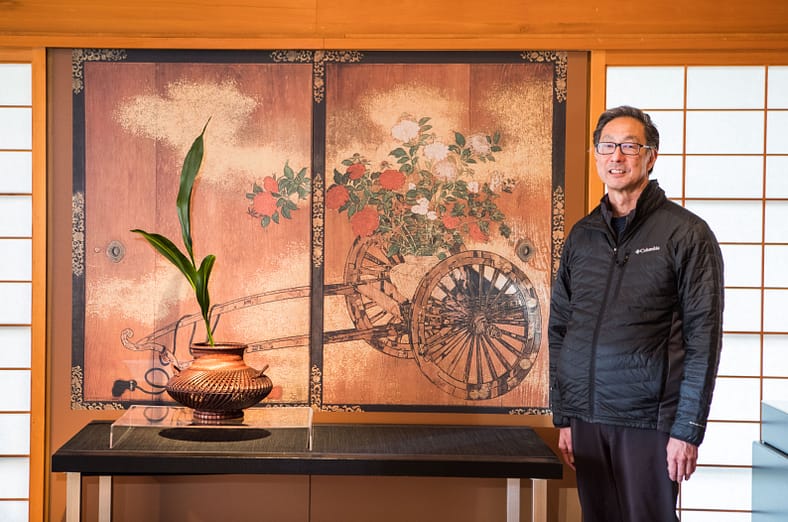
By Will Lerner, Communications Manager for Portland Japanese Garden & Japan Institute
Portland Japanese Garden is honored to have the dedicated support of local artists, musicians, and practitioners who share their expertise and talents with our guests at cultural demonstrations and performances. They help us pursue our mission of Inspiring Harmony and Peace by shining light on Japanese culture as a form of cultural diplomacy. One such individual is David Komeiji.
Komeiji’s partnership with the Garden has largely been through, though not limited to, his work as the leader of the Saga Goryu North America Chapter. Saga Goryu is a centuries-old Japanese school of ikebana, the Japanese art of flower arranging, which has been translated as “living flowers” or “giving life to flowers.”
In ikebana, consideration is given to not just the placement of the plant material, but how it interacts with ma. Ma, like so many Japanese concepts, defies precise translation, but can be thought of as an awareness of space, an element that works in concert with what we can plainly see to create a whole composition. Several words have been used to try and capture its meaning: meaningful space, negative space, meaningful void, interval, the space between two things, and so on.
Japanese culture doesn’t view ma as literal nothingness. It’s something that exists. It can be dangerous, or just flat out wrong, to misunderstand something as devoid of content or character merely because it isn’t visible. The greatest scientific minds have suggested we can only identify as much as five percent of what the universe is comprised of—our senses are too unrefined to see what truly constitutes the space between and around us. Furthermore, the rapid pace of technological achievement, for all its bestowed gains, has also caused ills where increased extravagance and isolation marginalizes many to the point they are essentially thumbed into nothingness—a societal void.
Komeiji, with an artist’s eye and an egalitarian’s heart, likely has no answers that might satisfy the astrophysicist who longs to know precisely what their hand touches when it’s extended out into air, but in conversation with The Garden Path, it is evident he can plainly see what others can’t or won’t, that everyone is an essential element in what constitutes our universe.
Growing Up in Hawai’i
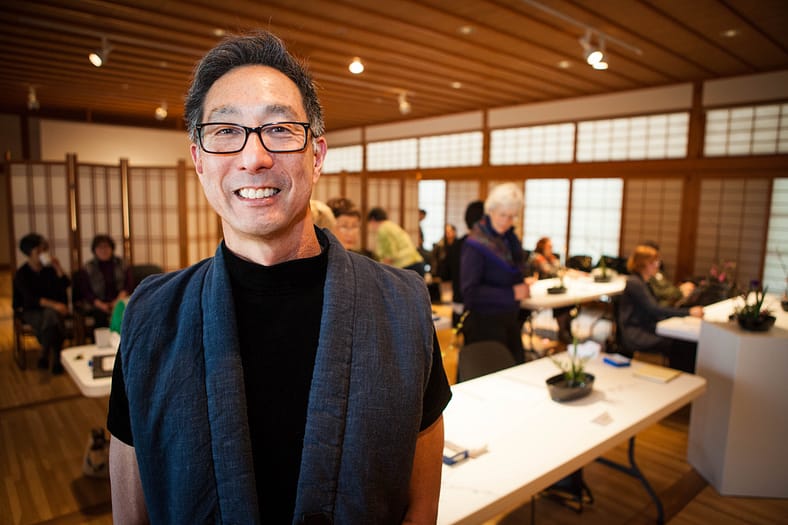
Komeiji was raised alongside his two brothers in Honolulu by his father, the owner of a family furniture store, and his mother, a writer and educator who worked with students both in elementary school and then, later, at the University of Hawai’i. A Sansei, or third generation Japanese American, Komeiji’s grandparents had left Hiroshima, Yamaguchi and Yamanashi prefectures to move to the islands, which were a U.S. territory at the time, decades before statehood.
The Komeiji home was in tight-knit community in the Valley of Nu’uanu in a space that avoided commercial development. “We had access to jungle, water, and the area had retained most of the trees,” Komeiji shares. “It’s just so beautiful.” As he was raised and grew into adulthood, the time he spent outdoors went beyond recreational pleasure to include benefits one gets from cultural and scientific exploration.
“I had a very interesting middle school in the 1960s,” he notes. “We were able to focus very early on sustainability and microclimates and the things that live there. That [connection of nature and education] then carried over when I started studying ancient hula in college. It has protocol, ceremony, and accoutrement like lei. Our teacher was very selective about who she took to the mountain to collect materials. As she did that, she was teaching us the importance of the land and how we need to care for the land so it can care for us.”
Often the Japanese American experience has been that the generations that survived state-sponsored bigotry, such as forced incarceration into concentration camps during World War II or the numerous racist laws passed beforehand, encouraged their children to assimilate into American culture in hopes that they might be not seen as the “other.” Komeiji’s parents went to college in New York in the early 1950s, where they experienced the richness of life beyond Hawai‘i and the value of learning from many cultures. They carried that perspective home, encouraging their children not only to embrace their Japanese heritage but also to explore and appreciate the diversity of traditions around them.
“The 1800s saw the first immigrant laborers from mostly China and some from Japan arriving to Hawai’i, and then there was a big migration in the early 1900s from Japan,” Komeiji shares. “And as those migrations occurred, the population density of the cultural groups kept shifting. Following the Japanese, the Filipinos, Koreans, and Micronesians arrived. What we’ve seen over the arc of time is a shift in cultural influences. When I was growing up there was a heavy focus on Japanese things but I did experience an interesting hybridization of aligning cultural values. I studied things like hula and Korean court music all while being raised in two different Buddhist traditions, Soto Zen and Jodo as well as two Christian communities, Congregational and Methodist. I learned that you can hold space for everything and that everything has value.”
A Ceaseless Pursuit of Understanding
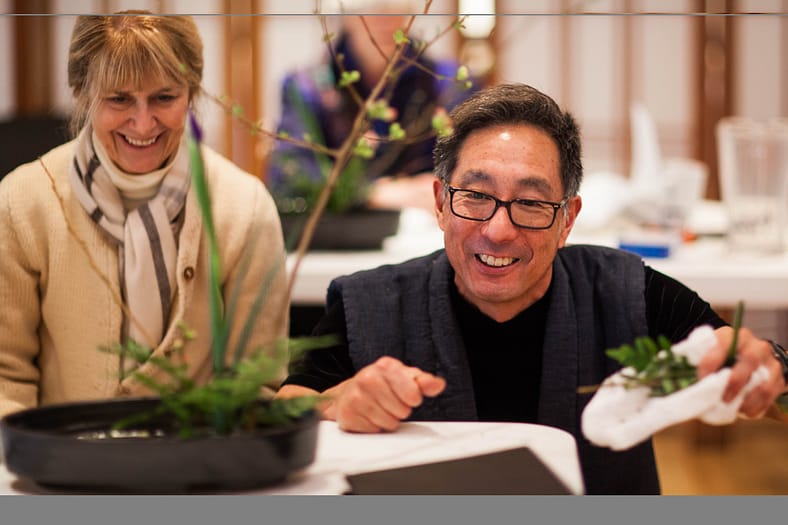
Komeiji refers to himself as a “life-long learner.” This is best illustrated by the eight years he spent studying as an undergraduate at the University of Hawai’i, Mānoa. “The dean called my parents and said, ‘David has done very well in school. Can we help him focus a little bit?’ So I asked her, ‘What is the point of going to school? To get a degree or to learn?’ And she said, ‘Good point, sure.’ I finally ended up with one degree in zoology.”
Eventually, Komeiji’s desire to help others would define his professional career. He would get accepted in Emory University, where he would get more degrees, including a master’s in maternal and child health, with a focus on groups many shy away from: drug-affected babies and dual-diagnosis adolescent males. He would then move into a director role after developing rehabilitation programs before the distance from home began to weigh on him.
“My grandmother was aging and the ten-hour flight from Atlanta to Honolulu was wearing me out,” he remembers. “Growing up I had visited the West Coast so I began to look into moving to Seattle or Portland when OHSU [Oregon Health & Science University] recruited me to develop their cardiac rehab program. I arrived on May 25, 1989 at 5:30pm and have been here ever since.”
When asked how he knows his arrival to exact minute Komeiji shares, “I had a dinner at six.”
Komeiji’s role at OHSU transformed over time, his final stretch of timing putting him in the care of professional and collegiate athletes and professional dancers. While he enjoyed the work he did, he eventually felt compelled to try something different. He landed a role with the Portland Public Schools District. “I worked with 1.5% of the most impacted physically and cognitively impaired children in North Wasco, Multnomah, Hood River, and Clackamas Counties,” he noted.
With a resume that ranged from the immediate and tangible care of lives to the overarching strategic decisions that influence that kind of care, Komeiji was among 120 individuals tapped by the State of Oregon’s Health Authority to help it craft the Coordinated Care Plans requirements for Coordinate Care Organizations (Medicaid insurance providers) and related administrative rules following the 2010 enactment of the Affordable Care Act. When that concluded, his final full-time posting before retirement was helping the Estacada School District establish a medical, dental, and mental health facility for their students and community.
Mrs. Henjyoji and the Garden
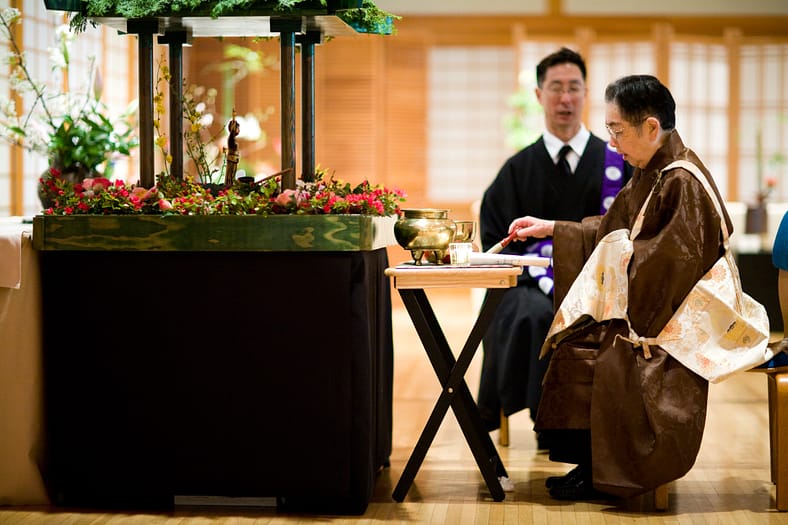
In the early 1990s, Komeiji’s pursuit of knowledge and understanding saw him take on learning two significant subjects more deeply: ikebana and Buddhism. It began with the passing of his grandmother. Komeiji entered into the cycle of early Buddhist memorial observances in Hawai‘i—services such as the seventh day (shonanoka) and the forty-ninth day (shijūkunichi)—but had to pause his participation when he returned to work back home in Portland. His search for a temple that would allow him to continue this in Oregon was largely unsuccessful until he connected with the Henjyoji Shingon Buddhist Temple, a congregation founded by the married pair of Bishop Daiyu Y. Henjyoji and Reverend Kazuko Wako Henjyoji.
Under the Reverend Henjyoji, who Komeiji lovingly refers to as “Mrs. Henjyoji,” he continued honoring his grandmother’s memory and eventually wound up becoming a priest himself. “I had become highly engaged with the temple,” Komeiji shares. “The Henjyojis had been looking for successors and even found a couple candidates, but it didn’t work out. I was approached and I declined, saying I was too selfish because I wanted to do other things. But I also believe in universal messaging, so by the third time I was asked, I said, ‘Alright, alright.’ I was a transitional leader, not a permanent one.”
While in his role leading the temple, Komeiji guided community-centric programming, such as providing meals once a week to older Japanese congregants who were dealing with health concerns including loss of memory. His service to others in this role wouldn’t be confined to the walls of the temple, however.
“When the earthquake and tsunami struck Japan in 2011, I invited David in his capacity as an ordained priest of the Shingon sect of Buddhism and a representative of one of three religious traditions to offer prayers at a memorial vigil we held at the Garden,” shares Diane Durston, Curator Emerita and formerly the Arlene Schnitzer Curator of Culture, Art, and Education (2007-18). “He was the last to pray that day at a small altar we set up behind the Pavilion. I watched as he chanted alone on the veranda, his voice becoming more and more impassioned as he prayed, until suddenly the clouds opened with a huge downpour of rain. I was moved to tears in that moment, as I felt the power and sincerity of his compassion for all those lost and all who survived to try to rebuild their ruined lives. I think David’s life brings together Hawaiian aloha and Japanese-American omoiyari [compassion] in the most meaningful possible way.”
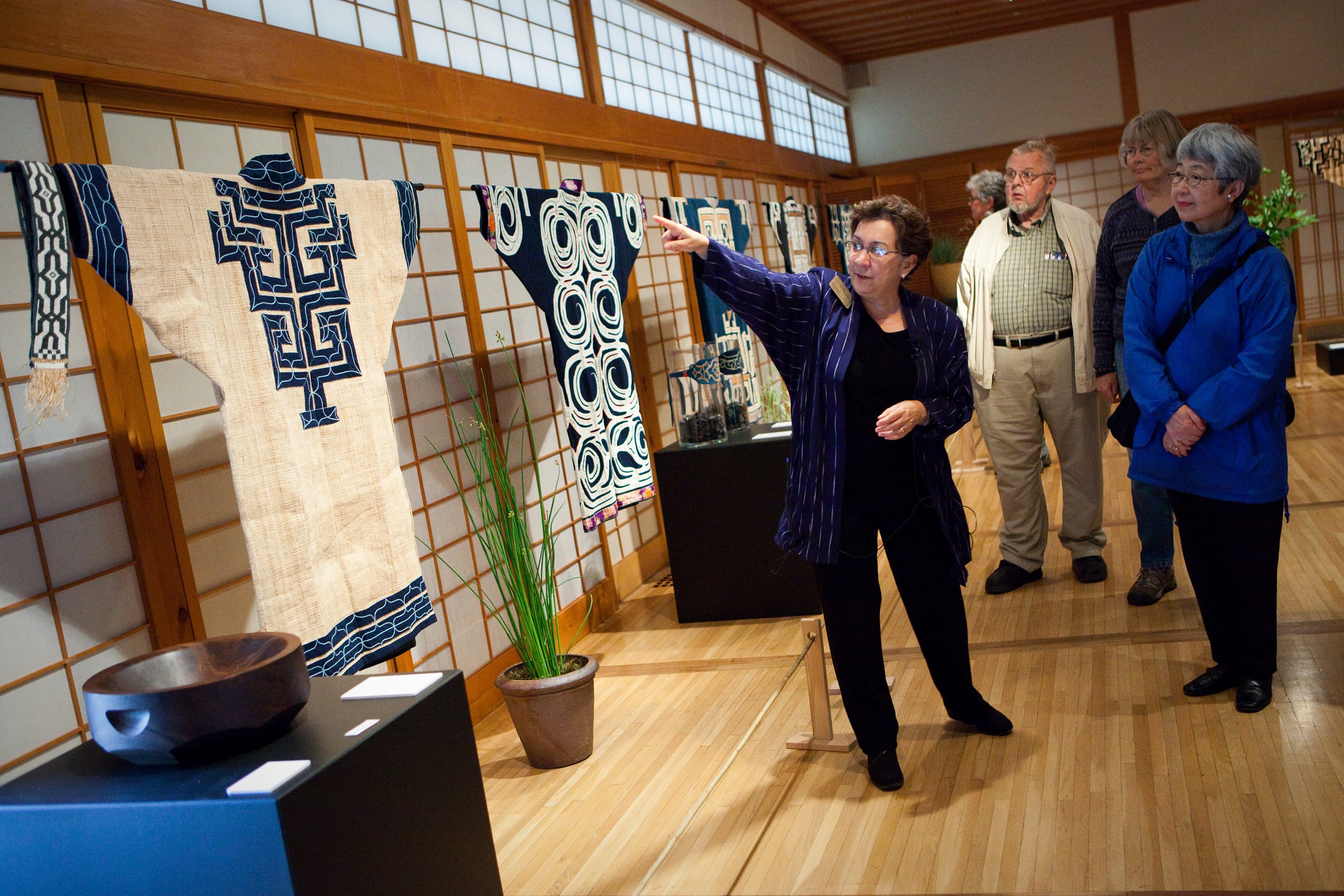
The friendship he developed with Mrs. Henjyoji would lead to another meaningful field of study for Komeiji. Growing up, he had interacted with ikebana—his grandmother had studied it through Ikenobo, the oldest school in the artform. He also had helped a high school friend’s mother when she was hired to craft arrangements for weddings. However, his more intentional approach to learning the artform began in 1992. Mrs. Henjyoji was a student of ikebana who eventually taught the subject herself in addition to helping Mildred Schnitzer, one of the first founders and Board Members of Portland Japanese Garden, establish Portland Chapter No. 47 of Ikebana International.
She taught Komeiji the approach to ikebana as delineated by the teachings of a different school: Saga-Goryu, which according to Ikebana International, “practices a ceremony of floral tribute to Buddha, studies truth, goodness, and beauty through ikebana.” It was through this tutelage and friendship that Komeiji got acquainted with Portland Japanese Garden.
“Mrs. Henjyoji would take me up to the Garden to help her with her ikebana and to provide translation,” Komeiji recalls. “I really appreciated the intimacy that the Garden provided. I thought the [Iyo Stone near the Pavilion in the Flat Garden] was stunning.” Komeiji would eventually be introduced to Diane Durston.
“Collaborations with David were always a gift,” Durston shares. “As a true master of ikebana, not only were all the arrangements he did for the garden exquisite, but they were executed with a self-contained, professional touch. His flowers and his teachings were always as much about the spirit of the discipline as they were about the beauty of form and color. He never asked for compensation or public acknowledgement of his work. Often, he was in and out of the Garden before I knew he had arrived, taking a huge burden off my shoulders, and providing us with masterful displays of the living art of ikebana.”
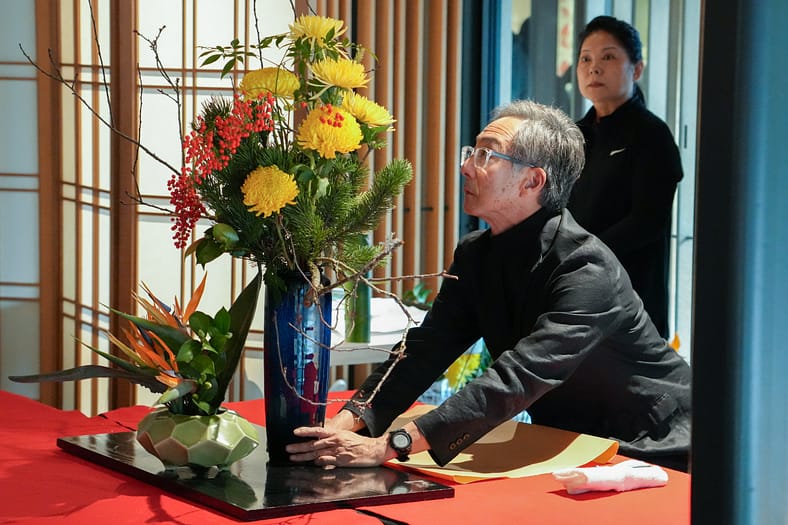
In addition to the vigil and ikebana demonstrations in the Cathy Rudd Cultural Corner, he has overseen the placement of large mukaebana (welcome arrangements) in the Cultural Village. “One of the things I quickly learned about working with David and his Saga Goryu students is that ikebana is an artform imbued with symbolism and meaning,” shares Kelsey Cleveland, Cultural Programs Manager. “The ikebana displays and arrangements are beautiful to behold but are so much more than that. This is exemplified in our partnership celebrating Hana Matsuri, the commemoration of Shakamuni Buddha’s birthday, each April. David works collaboratively with his students on creating a display inspired by the annual theme (Odai) of,waka (31-syllable short poems) from the Imperial New Year Poetry Reading (Utakai Hajime), in which the Imperial family and others compose waka. Everything from the flower selection to the container heightens the theme and adds layers of additional meaning. While David works with his students to create the display at the Garden after months of thought at practice, he is like an orchestra conductor bringing out each student’s unique ‘voice’ into the work. I feel honored to witness the process and then to watch the team crack jokes and enjoy each other’s company after the intense focused work is done.”
“David-sensei is a warm and caring person who often checks in on others and enjoys sharing,” adds Mayuko Sasanuma, Director of Cultural Programs. “In association with ‘Healing,’ the mukaebana he created for the Garden after its three-month closure due to COVID served not only to welcome members and guests back, but also to bring them a sense of healing and beauty during the challenging early days of the pandemic. Beyond his contributions with ikebana, many Garden employees have been lucky to receive his homemade Hawai’ian pickles and sweets, and over time he has formed friendships with many of them.”
When asked why he loves ikebana, Komeiji noted how it can teach universal truths to the student who is willing to hear them and not impose their own context upon it. “It’s also just beautiful!” he shares. “It evokes an emotional response. I can feel someone through their ikebana. I can recognize through my students who did what, even if they’re doing the same arrangement with the same materials. I can tell if they’re having a bad day.”
Oregon State Penitentiary and the Asian Pacific Family Club
After retiring from the Estacada School District, Komeiji couldn’t shake the images he had seen of unhoused people in the community and the lack of services provided to them. He joined a loosely organized coalition of people and organizations committed to figuring out goals ranging from urgent to long-term that would help people get into permanent shelter and the services that would keep them there. While sharing meals with people in encampments, he learned that among the various demographics impacted, such as women with children or the chronically mentally ill, there was one group that received less attention: ex-felons.
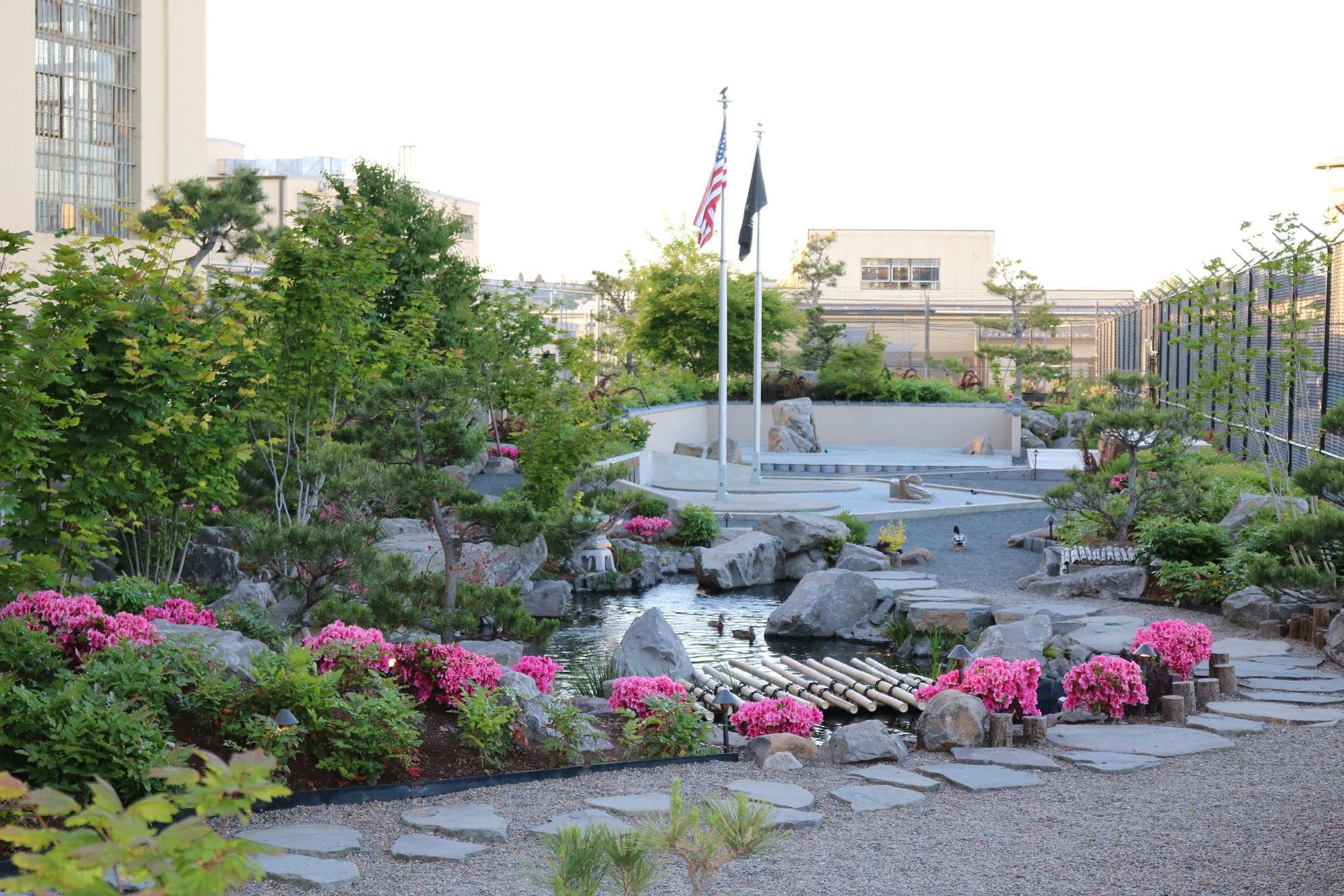
“After telling Diane [Durston] that I wanted to help those who go through corrections, she told me I should go see Hoichi Kurisu, who was in the area to give a presentation,” Komeiji remembers, referring to the second Garden Director of Portland Japanese Garden (1968-73). Kurisu, who upon leaving the Garden developed a highly successful design-build firm that has built landscapes around the world. Among his projects was the Memorial Healing Garden, a 13,000-square-foot landscape at Oregon State Penitentiary (OSP) in Salem. It is tended to by the adults in custody who have joined OSP’s Asian Pacific Family Club (APFC), a group that provides “opportunities for members to learn, educate, and celebrate diverse Asian and Pacific Islander heritages, and to foster programs that will help individuals gain skills and tools to effectively reintegrate into society.”
“After his lecture, I asked him how he would feel if I taught ikebana in the prison,” Komeiji shares. And he said, ‘Why not?’ When I first visited the APFC, they had bottled water and cookies for the guests. I was blown away by that. They have nothing and they took the time to get something for each of us. I could tell these guys get it, they understand what it is to give until it hurts. I thought that I’ve got to help these guys. I did an ikebana demonstration for them after months of preparation to learn what materials I could bring in.”
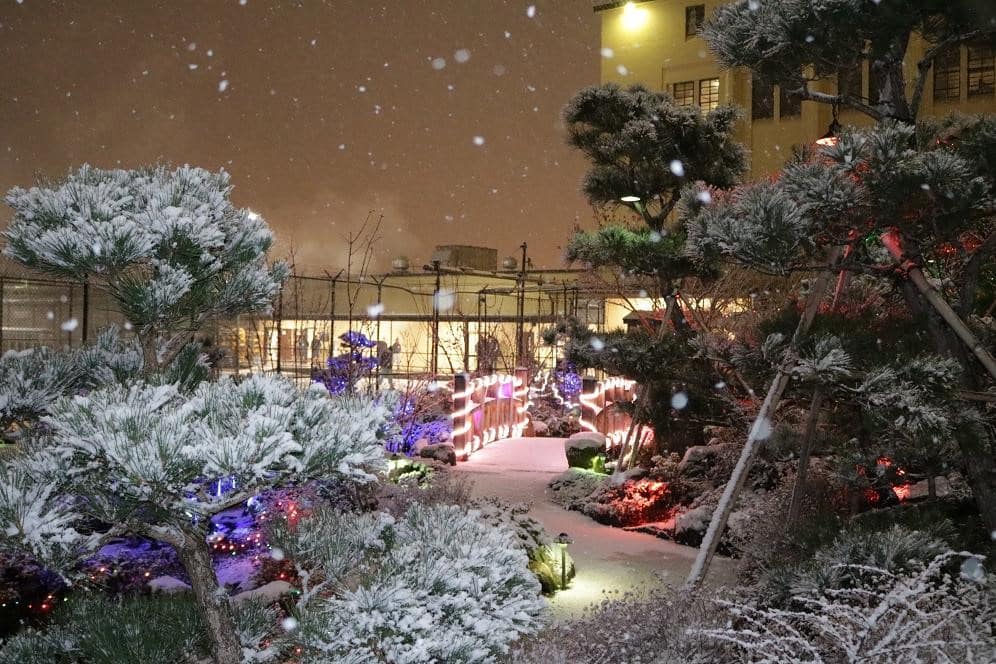
Since then, Komeiji has continued to be active with the APFC, helping them plan programming focused on the many different cultures and customs that fit within the vast scope of what it means to be Asian and Pacific Islander. “My main role is to help provide classes or content for their meetings,” Komeiji shares. “It’s such a huge geographic area that we had to talk really long and hard about the common values that unite these different experiences.”
Related: Learn More About the Memorial Healing Garden at Oregon State Penitentiary
Motivated by his experience at OSP, Komeiji successfully pitched and then with Michiko Kurisu curated Shin Ka: Inner Gardens of Reflection, an exhibition held at the Japan Information & Culture Center in the Embassy of Japan in Washington, D.C. Featuring photographs, audio recordings of the adults in custody, an interactive element that invited guests to rake a gravel garden, and audio/visual displays of water and greenery, the exhibition explored “the history and retention of Japanese gardens over time in North America leading to contemporary expressions of healing, focusing on the Memorial Healing Garden,” according to Komeiji. “We’re now in the process of making it a traveling exhibition. I want to bring it here so that the families of the guys at OSP can see it.”
We All Need Each Other
In 2019, Komeiji established Ho’oulu: Fostering Growth, a small nonprofit. “I lead a mission-driven organization dedicated to promoting poly-cultural awareness, education, and healing,” he writes. “We support marginalized communities—including youth, incarcerated individuals, and cultural learners—through programs rooted in Japanese and Hawaiian traditions, ikebana, and restorative practices.”
Though he is too bound to others to fully disengage, Komeiji is now approaching a second sort of retirement. Much of his time is spent trying to set up subsequent generations to help take on the work he’s done to serve marginalized populations. As deeply compassionate as any person could ever hope to be, it’s certain that he will hold no judgment on where these successors and students are from, or their lot in life, or their ancestry.
“David doesn’t preach the ideals and values of his extensive background in Japanese culture and Hawaiian aloha—he lives them every day,” Durston concludes. “He teaches by example—caring for the poor and disenfranchised, feeding elderly parishioners, reaching out to the homeless wherever he finds them, showing penitentiary inmates from the Asian and Pacific Island community that their lives have value and encouraging them to find true their identities and learn how to return to society as productive members of the community.”
This desire to bridge divides and move into a better and more harmonious future together is a fundamental aspiration of Portland Japanese Garden and was coded in its establishment. The Garden is meant to be a space for anyone with an open mind and willing heart and was never intended to be wholly Japanese nor wholly American, but rather a synthesis of diverse ideas and concepts that create a new and better whole.
“Jan Waldmann [Cultural Partner and Tea Ceremony Teacher] and Diane Durston show that it’s possible that you can be born outside of the culture and still feel it, understand it, and act on it to help drive harmony,” he shares. “Every culture evolves. Japan’s going to change. Who’s going to hold onto the culture? Who’s going to help it evolve? It has to go out and then come back. We all need each other. You’ve got to look at it that way.”