By Kelsey Cleveland
Portland Japanese Garden is honored to have the dedicated support of local artists, musicians, and practitioners who share their expertise and talents with our guests at cultural demonstrations and performances. They help us pursue our mission of Inspiring Harmony and Peace by shining light on Japanese culture as a form of cultural diplomacy. One such individual is Pete McDonnell, kumihino artist.
Kumihimo, translated literally as gathered threads, is the Japanese art of silk braiding to create strong and decorative ropes or cords. The traditional technique was originally used to tie kimono obis (wide decorative sash) and to lace samurai armor. Today, there is a revival of interest in traditional methods and applications of kumihimo around the world, with workshops, social media groups, and societies such The American Kumihimo Society.
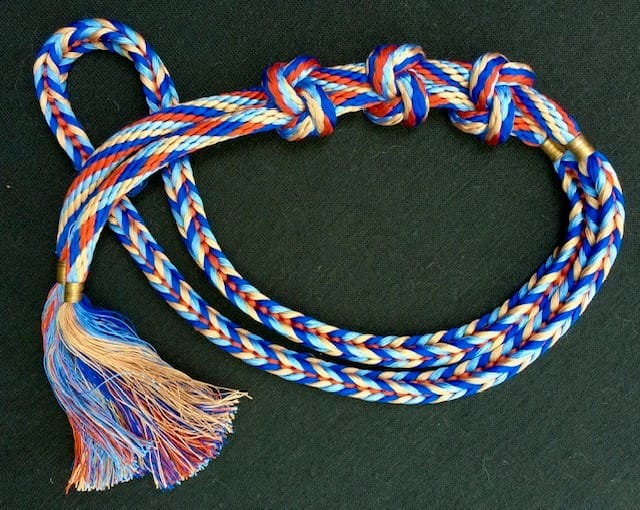
During my time working as Cultural Programs Manager at Portland Japanese Garden, I have repeatedly learned how one Japanese art form, like tea ceremony, requires the skills of many specialized artisans and craftspeople. The art forms are interwoven. For example, in tea ceremony there are artisans who create the chawan (bowls), chasen (whisks), and other tea utensils. Students and tea teachers also wear kimono. Artisans create silk kimonos and the obi sashes wrapped around the waist. An obi-shime is a cord knotted tied around the obi to secure it and keep it closed. Kumihimo, silk braided cords, are often used as obi-shime. This art form can also be enjoyed independently on its own.
In 2024, Kristen Siemon, a volunteer at Portland Japanese Garden, met Pete McDonnell at Hoffman Center for the Arts in Manzanita. She complimented one of his kumihimo accessories he was wearing. By the end of the conversation, she promised to introduce him to the culture team at the Garden.
True to her word, she sent an introduction and forward information about his workshop titled, “Kumihimo on the Marudai: Braiding Fundamentals” at the Hoffman Center for the Arts in Manzanita. The culture team reached out to him, met in person, and invited him to present his first demonstration later that year.
According to McDonell, “After visiting the Garden several times, it became the obvious venue to present this craft to a wider audience of folks attuned to Japanese culture. I remain honored and grateful to be able to share what I do at this amazingly beautiful place.”
McDonnell is a native of southeastern Washington State, a 40-year resident of Seattle, and a full-time retiree in Manzanita since 2020. Before his retirement, McDonnell had a career as a clinical trials data manager at Fred Hutchinson Cancer Research Center and Seattle Children’s Research Institute and performed as a singer in a wide variety of musical and theatrical projects.
I asked him how he got interested in the craft. “I bumped into it,” McDonnell said. He is a lifelong fiber arts enthusiast, having explored macrame, needlepoint, knitting, crochet, horsehair hitching, and loom and tablet weaving. In 1995, “he thought he might get back into weaving” so he did a web search for weaving equipment. He stumbled across a weaving supply store in Vader, WA. On the site, he “saw this thing,” a photo of a kumihimo marudai, and was intrigued. He reached out to the store who told him about an upcoming workshop on kumihimo. Six weeks later, he attended a three-day workshop with Rodrick Owen, part of the Coupeville Arts residential series at Camp Casey on Whidbey Island. He has been practicing the art form since then. He has presented lecture-demonstrations of kumihimo at the Hoffman Center for the Arts in Manzanita, where he is also a volunteer in the Hoffman Arts Center gallery, and at Portland Japanese Garden.
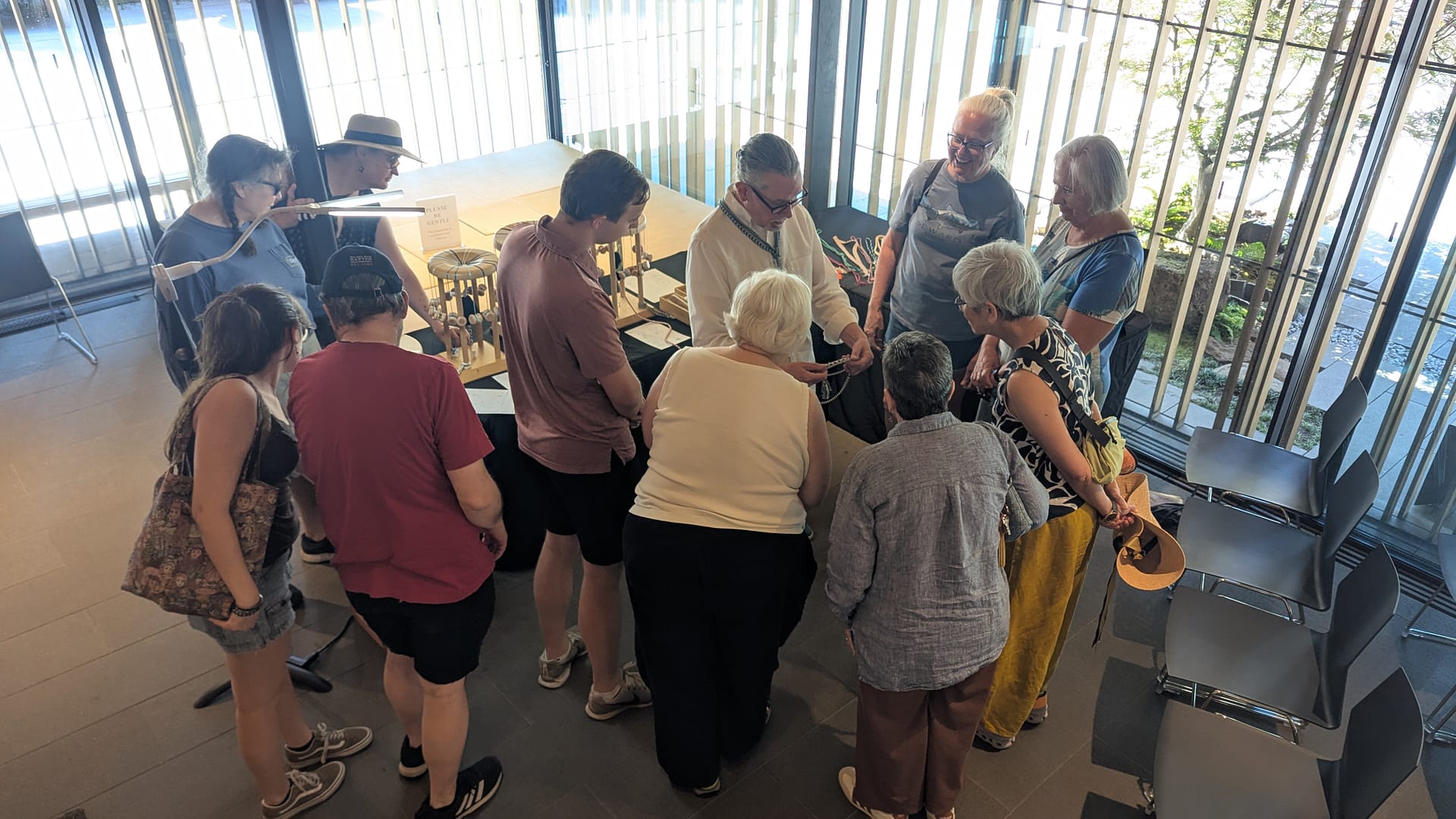
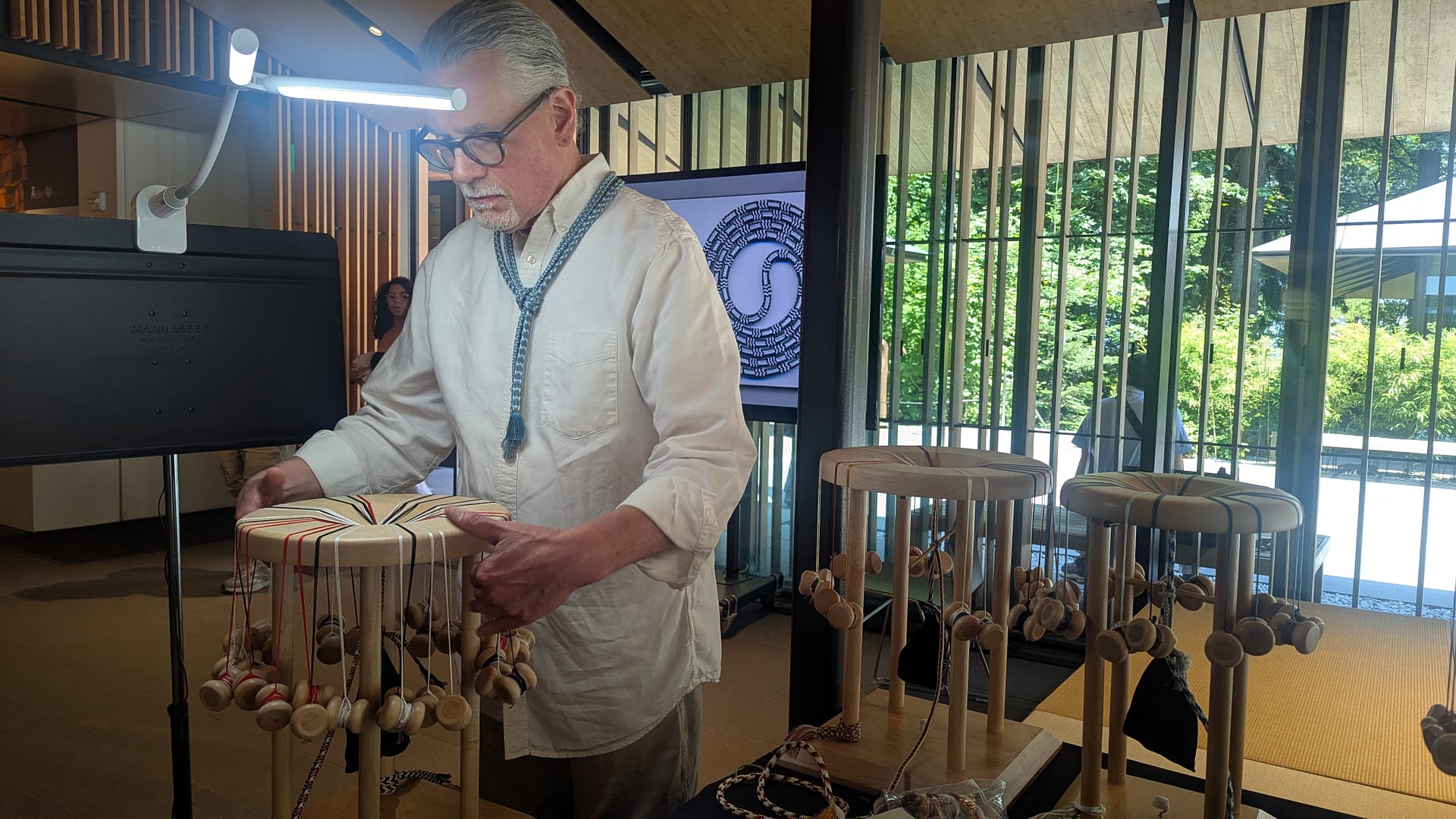
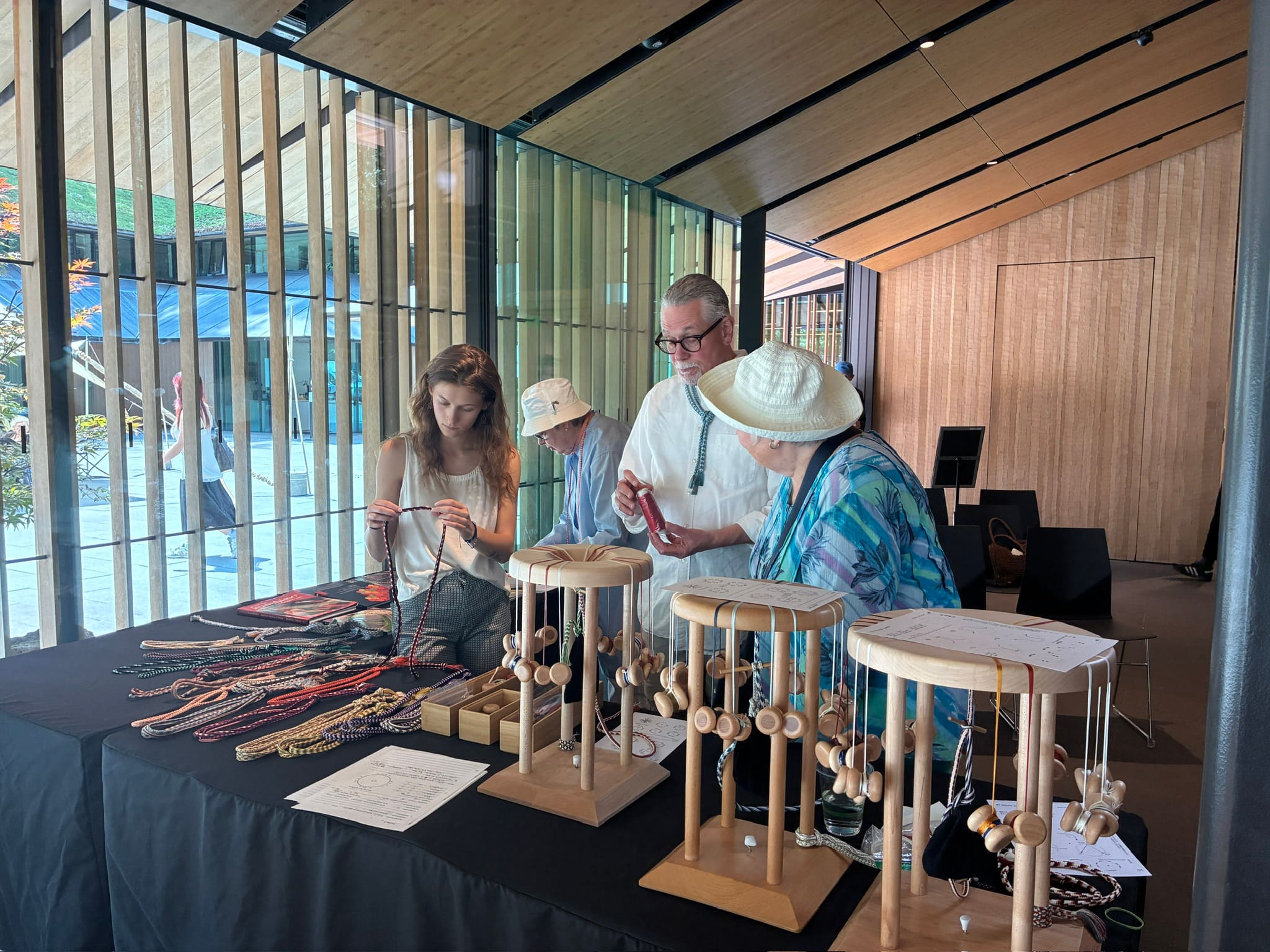
On July 15, McDonnell returned to Portland Japanese Garden for his third cultural corner demonstration. This time, instead of presenting a lecture, he provided a conversational “drop-in” style of demonstration. He practiced his craft and invited guests to walk up, ask questions, and take a close-up look at three different kumihimo set-ups, completed works, and relevant literature. While working, a presentation played in the background touching on the crafts origins and history, traditional and contemporary applications, equipment and materials, and demonstrations of basic braiding techniques on a marudai, a traditional wooden braiding stand featuring a round wooden disk with a center hole with four legs. He passed a tama, weighted bobbin, back and forth across the top of the marudai to weave intricate patterns and cords. Traditionally, silk thread was used.
McDonnell didn’t have time to visit the Garden after his demonstration but planned on visiting soon during his next stay in Portland. “Every time I visit the Garden I notice some detail or perspective I hadn’t taken in before. Lately I have enjoyed just standing in any one spot and slowly turning around to see the lovely, subtle, intentional vistas in every direction.”
Portland Japanese Garden is honored to have the incredible support of local artists who share their talents with our guests at Cultural Demonstrations and Performances. To learn more about our slate of upcoming programs, visit our events page here.
Kelsey Cleveland serves as Cultural Programs Manager for Portland Japanese Garden. After studying Japanese at Smith College and Nanzan University, she worked for eight years in the nonprofit sector in Osaka and Kobe, Japan.