By Will Lerner
One of the most beloved elements of Portland Japanese Garden is its Zig-Zag Bridge in the Strolling Pond Garden. Near our Heavenly Falls and situated above the waters koi call home, this structure is representative of centuries-old Japanese landscape design. In this article we look at its cultural heritage as well as its history in the Garden.
An Easel on Which the Scene is Painted
Rare is the straight line in nature—“straight” is a term that humanity has imposed upon itself, an abstraction stirred up in the minds of mapmakers and geometry professors. We’ve created the concept of a straight line but our planet, a lump of rock and water swirling an elliptical pattern in the cosmos, is unaware of our opinions on the order of things. And from here, the lump sets the tone. In this world, nature varies beyond measure. It’s so much so that we are forced to wonder if there could be such a thing as an “anomaly” because it would mean that there is a “norm” to depart from.
Maybe that’s why, with asymmetries, obscured views, and intentionally left signs of age, Japanese gardens are so capable in making us feel at home. We are still products of the land, nature itself. With Portland Japanese Garden’s warps and bends and crags and scuffs, there is an intentional evocation of nature that reassures. Even that which is supposedly “straight” is placed in a way as to feel nearly random and thus, calming. Take the wooden plank bridge in the Strolling Pond Garden, for instance.
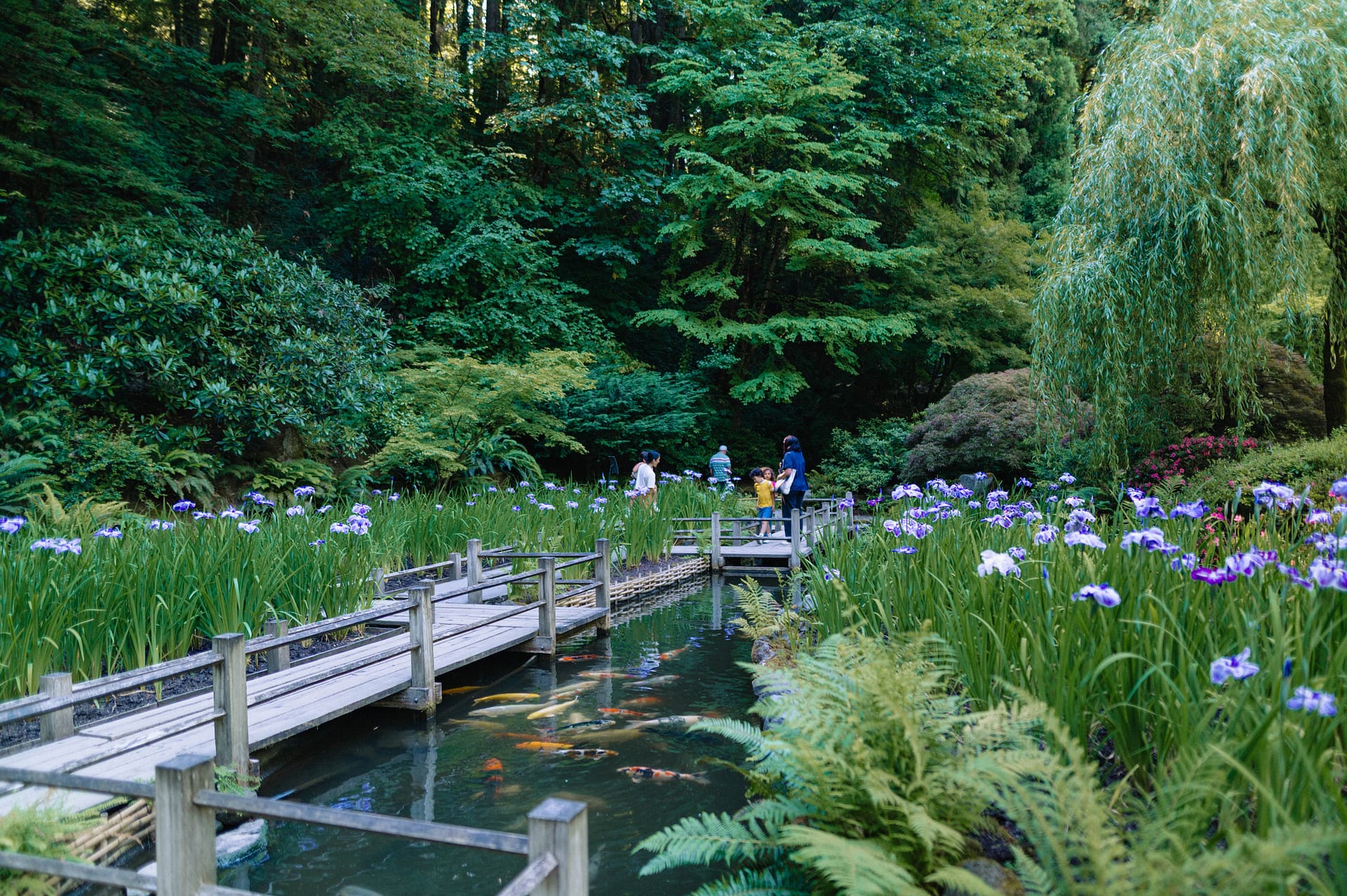
Down past the graceful Koto-ji Lantern, near a hillside of cherry trees, and aside the Heavenly Falls drumming a pond is the Zig-Zag Bridge. The structure has rails that rise up to the shin and consists of seven lightly colored wooden plank paths and one of stone to give it eight parts. It is a wharf in a sea of iris leaves and ferns, a loosely knit green bedazzled with purple flowers that allows glimpses into water below. We see “straight” lines here, but the bridge’s titular zigs and zags seen altogether introduce a sense of charming disorder.
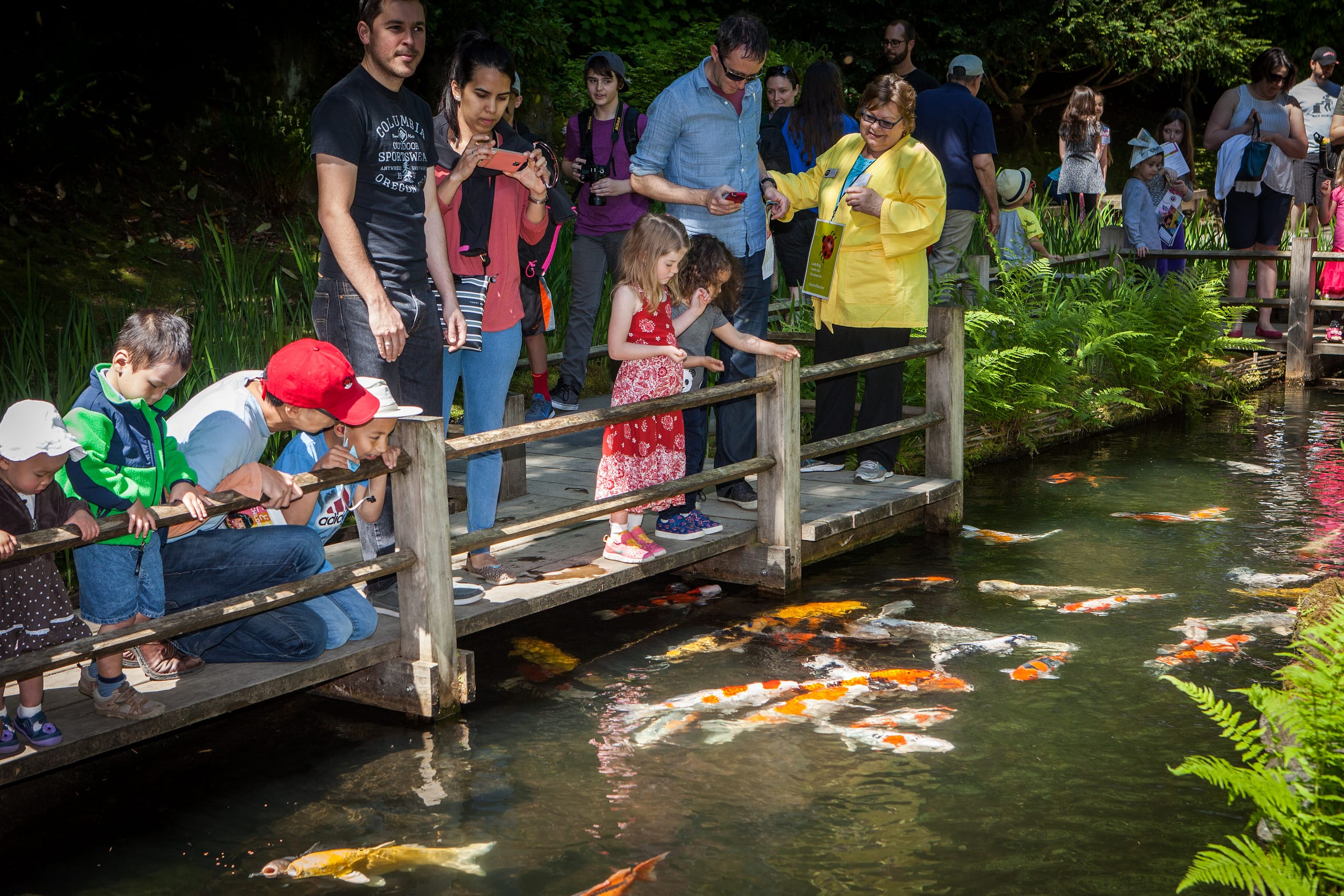
Because of its inconsistent lengths and tight corners, guests to the Garden can’t take a brisk trot over it. But they wouldn’t want to. Here eyes are trained down and steps are taken patiently because the Bridge is perched above where the koi swim. On warmer days, the dazzling fish look like flames dancing in water and crowds throng to see them. The diversity of the people here, from so many nations and states, only makes the scene more delightful and memorable. It’s a painting constantly reimagined with different shapes and colors and the Zig-Zag Bridge is the easel on which it’s placed. It’s hard to believe that it hasn’t been here since the first days of Portland Japanese Garden.
The History of Portland Japanese Garden’s Zig-Zag Bridge
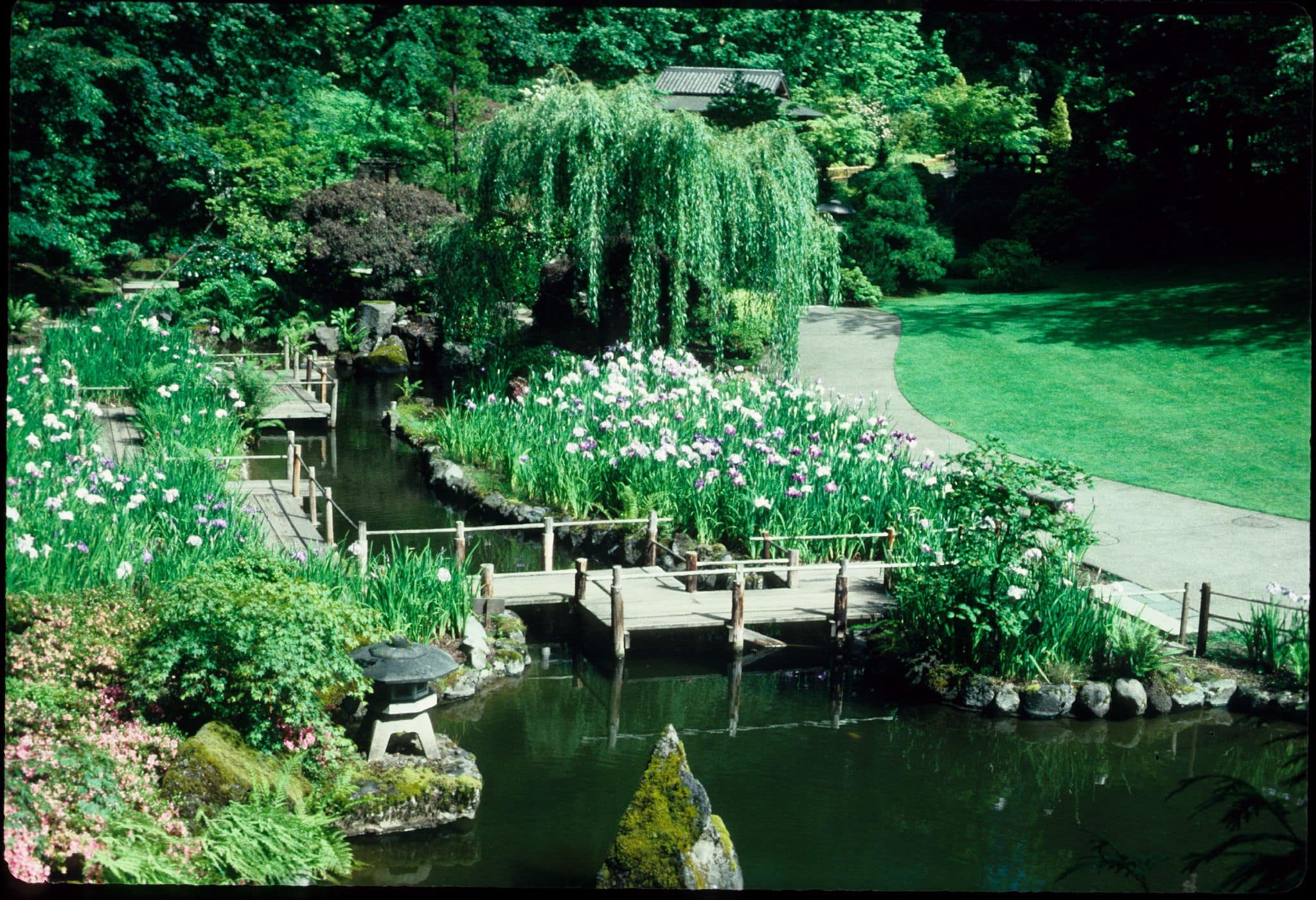
The earliest form of the Zig-Zag Bridge was just one short portion that spanned across the Strolling Pond Garden’s iris beds. This would be the final element added to the landscape by the Garden’s original designer, Professor Takuma Tono of the Tokyo University of Agriculture (1891-1987). In fact, the final known image of Tono at the Garden is of him sitting on the short bridge’s railings, back turned to the viewer, taking in the rushing waters of the Heavenly Falls.
This bridge would be lengthened and given its zigs and zags later during the tenure of the organization’s third Garden Director, Hachiro Sakakibara (1972-74). In 2010, Sakakibara sat down with Ed McVicker, then President of the Board of Trustees (2009-11), and discussed why he transformed it into the shape it takes today. “We built the Zig-Zag Bridge because the stream went straight into the [lower pond of the Strolling Pond Garden],” he recounted. “We were always taught not to design anything like that, so in order to break the straight flow of the stream, we built the Zig-Zag Bridge to run through the iris beds.”
“In terms of design balance, Japanese gardens have a symmetrical and an asymmetrical balance,” he continued. “A symmetric balance is 100% artificial. … A straight line in a garden would be considered artificial or man-made. Therefore, if an artificial element is put into a natural garden, it creates risks for the balance of a design. Also, gardens in Japan are very small so they need to make a near distance view, a middle view, and a far view to create the depth. By using the zigzag pattern instead of a straight line it gives the garden depth, which is a technique used in Japanese design.”
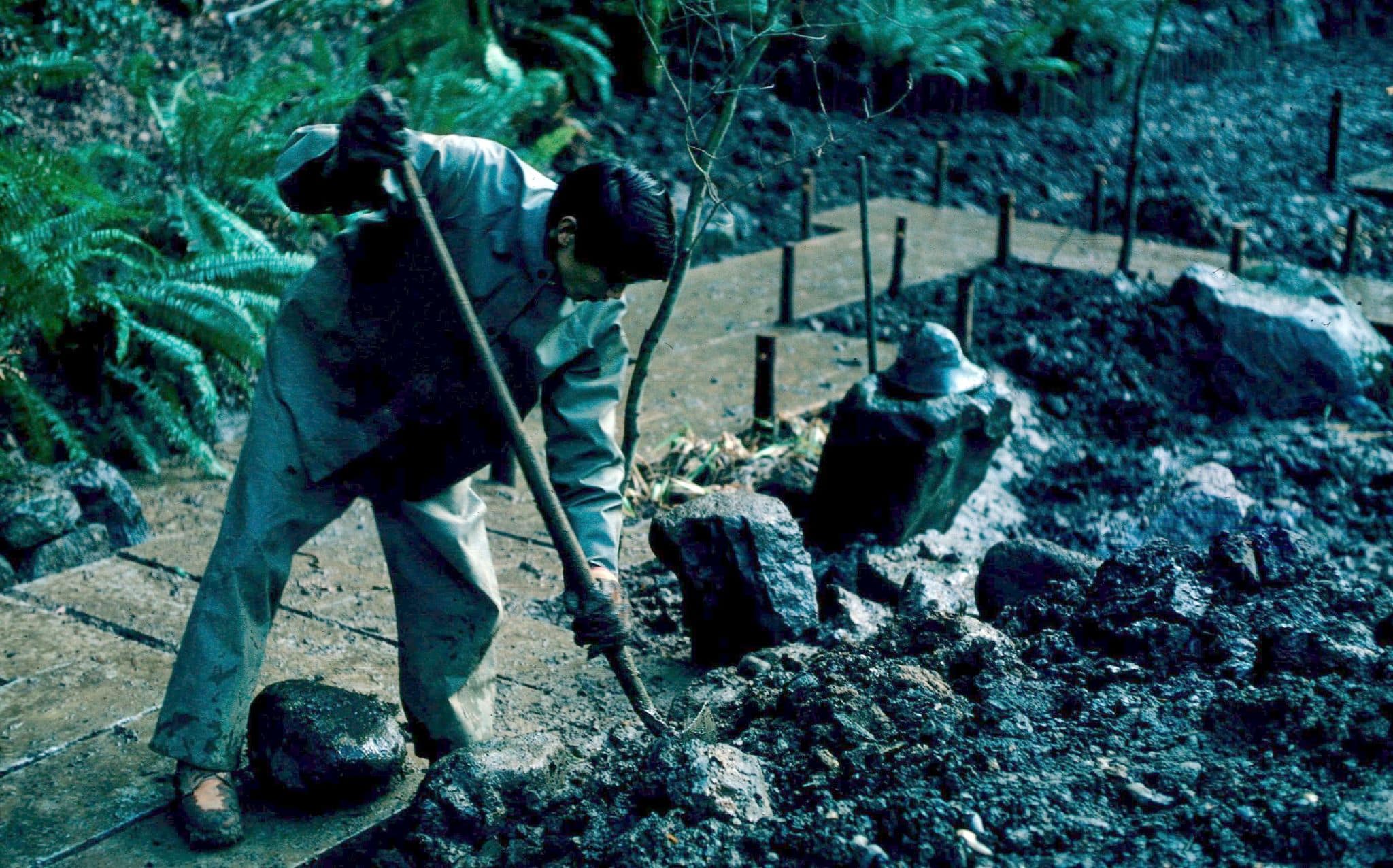
Sakakibara noted that expanding it provided “no challenges.” “At my previous company, we never hired anyone to do carpentry or construction; we did everything ourselves,” he shared. “This gave me the experience and knowledge in building the Zig-Zag Bridge, and allowed it to be a rather easy task.”
As has been the case with many of the Garden’s wooden structures, the Zig-Zag Bridge has been refreshed and rehabilitated since its construction. A 1982 edition of The Garden Path noted that repairs were among the “large projects” in store that winter for Kichiro Sano, Garden Director from 1982 to 1984. The following year, members were informed that the repairs had been completed. In the next decade, The Garden Path shared in a May 1998 issue that the bridge had gotten “a facelift in April when approximately one-third of its planks were replaced due to water damage and wear-and-tear.”
Extra: Origins in Japanese Literature
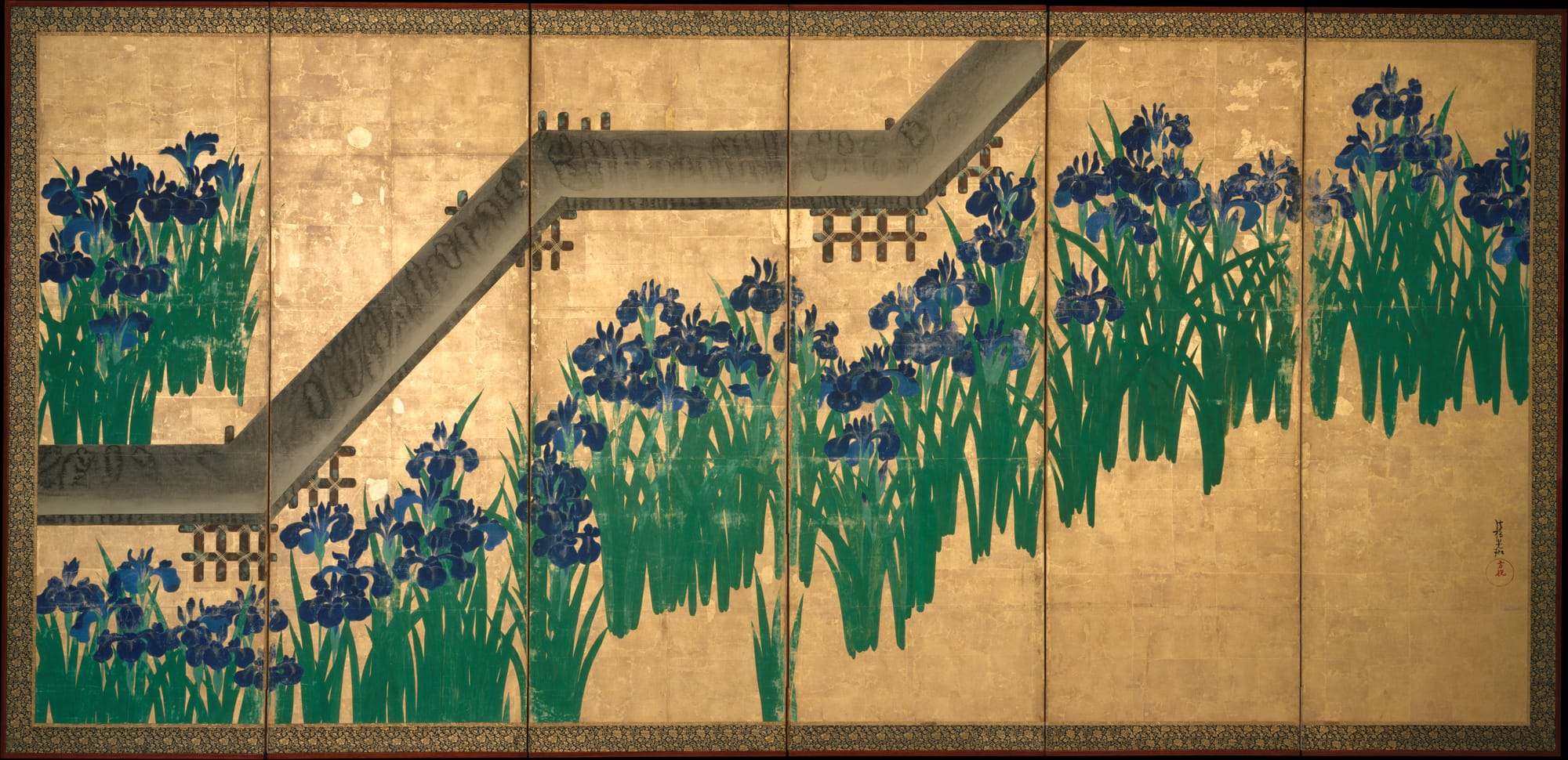
As is told in The Tales of Ise, a Heian period (794-1185) Japanese tome of waka poems, it was on a summer day that a poet named Ariwara no Narihira found himself in Mikawa Province alongside some friends. Besotted with a doomed infatuation for Fujiwara no Takaiko, a future Empress, Narihara and his party paused among irises in full bloom alongside the Sumida River at “Eight Bridges,” a location named thus “because the river there fanned out into eight channels like the legs of a spider, with a bridge across each one.”
While much of the Tales, both its characters and its provenance, have been a centuries-old matter of debate and speculation, what is undeniable is the tremendous influence this interlude has had, including on classic Noh plays and even James Joyce’s Finnegan’s Wake. Among those inspired were visual artists who would often depict the scene with zig-zagging wooden bridges flanked by irises on either side. Among the most famous versions of this was rendered onto folding screens by artist Ogata Kōrin (1658–1716) in the 18th century. From here, the concept of yatsuhashi (八橋 ), or “eight plank bridges” arose and they have been seen in Japanese-inspired landscapes ever since.
Will Lerner serves as Marketing and Communications Manager for Portland Japanese Garden.