By Will Lerner
“When visiting some of the best moss gardens in Japan, expectations of the equivalent elsewhere are high, to say the least. Are there any gardens in other countries that can match these wonders? Portland Japanese Garden can do just that. When we visit the garden in late October, it is almost unbelievably beautiful with the maple-red cherry blossoms that flare up like flames from the green carpets of moss.” – Ulrica Nordström, Moss: From Forest to Garden (2019)
Whether it’s the swaths of green that appear in its Tea Garden and Natural Garden, the incidental growth seen in the Sand and Stone Garden, or the artful arrangement into cup and gourd in its Flat Garden, moss is a unifying and reassuring element of Portland Japanese Garden. Described as “the essence of the Japanese garden” by Josho Toga, formerly Head Priest of Tenryu-ji Temple in Kyoto, the Garden’s tranquility is, in part, expressed by this cherished plant. As we join Lewis & Clark in the beloved annual tradition they started, Moss Appreciation Week, we’re taking a closer look at the quiet magic of this often overlooked bryophyte (a group of nonvascular land plants including moss, hornworts, and liverworts).
Keeping Us to a Beat
A little over a decade ago, a team from the McMaster Institute for Music and the Mind in Canada placed electrical sensors on the heads of some volunteers and then played two streams of piano tones, each in a different pitch: lower and higher. Occasionally, an error was introduced, where either the higher or lower tone would go off beat. Brain activity suggested that the volunteers responded more strongly to changes in the lower tone. Another experiment led by this same group of researchers had volunteers tap in time to the piano streams. Again, the lower tones dominated—the volunteers were more likely to change their timing as the bass notes changed. What does this mean? People, almost all people, are inclined to follow the rhythm of the more subtle bass instruments than their higher pitched friends in the band.
When talking about the composition of Portland Japanese Garden’s landscape, it has often been remarked that it is best to think of it as an orchestra, where all of the elements, be they plant, stone, or water, contribute to the whole. If we can agree an orchestra is an apt metaphor for understanding the Garden, then perhaps no plant better represents its beat than moss. These bryophytes don’t have the flash nor brilliance of cherry blossoms or leaves stirred in autumn colors, they don’t arrest your attention like the thunder of waterfall or tempo of a babbling stream. And yet, much like a bass guitar or cello, they provide body. Without Portland Japanese Garden’s mosses, what we would see might still be beautiful, but the vision would be tinnier and hollow. This landscape has a calming influence because it subscribes to the steady and uninterrupted rhythms of these tiny and ancient plants.
When did moss start growing at Portland Japanese Garden? Since time immemorial. However, the intentional fostering of moss here began as the Garden was being constructed in the early 1960s. Now lush and green, it can be challenging to imagine these grounds as they were after the old Portland Zoo moved out in the late 1950s. It was essentially a brownfield, a smack of squalor compared to the rich verdancy enveloping it. In addition to the donations of trees from community members, plants purchased from nurseries, and contributions from the Portland Parks & Recreation Bureau, the gathering of moss has been essential to the maintenance of this urban oasis. However, it wasn’t quite so easy to get it to thrive at first.
The Moss Garden
“Behind the flat garden is a small pond and the moss garden—one of the most beautiful forms of Japanese garden, rare in America. The many varieties of mosses and ferns catching the sunlight make this another spot of great tranquility.” – Dorothea Loa McFadden, Oriental Gardens in America (1976)
On June 16, 1967, F. Warren Munro, then Board President of Portland Japanese Garden, wrote a letter to the landscape’s original designer, Professor Takuma Tono of the Tokyo University of Agriculture. “We have had a suggestion regarding the creation of a Moss Garden within the Garden proper from a member of the Japanese Garden Society who is thinking of making a donation to the Garden,” Munro wrote. “Are Moss Gardens native to or compatible in the Japanese Garden? Is our climate satisfactory and do you feel we have an appropriate area for a Moss Garden?”
A few days later, Tono wrote back. “A Moss Garden would be very interesting and unique in the States,” the landscape architecture expert offered in response.* “Surely, it would be possible, especially around Portland.”
Tono offered a few locations within the Garden’s acreage, including sites near where the Sapporo Pagoda Lantern stands in the Strolling Pond Garden and another in what is known today as the Entry Garden. A quick sketch he included ultimately showed where the Moss Garden would grow, alongside Kingston Drive on the southernmost boundary of the grounds.
In 1968, the Garden’s second year of being open to the public, Tono would receive a letter from Rubye Hiltenbrand, Executive Secretary. “The Moss Garden is struggling along,” she wrote. “Some of them die, and a few seem to be taking hold and living.”
“This is very natural and one can not expect such a garden to be successful from the beginning,” Tono cautioned. “Even in Japan there is just only one in Kyoto, nobody has dared to create a new one yet. This means any moss garden is not so easy to start. I am sure that Mrs. Mackaness will get better results in two or three years, then it would draw worldwide interest to Portland.”
The Mrs. Mackaness he refers to was Faith Mackaness, a well-known gardener and bryologist who was based in nearby Corbett, a town resting on the Columbia River. Her efforts to help establish the Moss Garden would be featured in an October 1969 article in The Oregon Journal. Noting she had become known around Portland Japanese Garden as the “moss lady,” journalist Molly Grothaus wrote, “She has driven hundreds of miles collecting mosses. It is she who knows where the pipe cleaner moss grows in the Columbia Gorge, where to find broom moss, hair caps, and many other mosses. Since June of 1968 Faith Mackaness has donated hundreds of hours working the moss garden, which began as a south slope of ivy, bracken, and horsetail rush.”
Professor Tono’s call for patience was prescient. Eventually the moss would thrive in this space. However, it would only truly thrive after it was reimagined and rebranded as the Natural Garden, a display of the style known as zoki no niwa, where a more rustic and natural appearance is paradoxically cultivated through intense care and maintenance. The decision to change it was carried out by Hachiro Sakakibara, Garden Director from 1972-74. His friend and predecessor, Hoichi Kurisu (Garden Director, 1968-73), told Ed McVicker (Board President, 2009-11) about this change, a change that had the blessing of Professor Tono.
Related | The Zoki no Niwa of Portland Japanese Garden: A Uniquely Natural Feeling
“When Sakakibara san arrived, he also thought that there had to be something done to the Moss Garden and we talked about what we could do,” Kurisu recalled. “The Board finally decided to approve this project, and it still looks like a Moss Garden, but it is a natural style garden that we implemented.”
Moss Care at Portland Japanese Garden
“On the West Coast of North America during the mid-twentieth century and more recently, ground-covering mosses were planted or appeared (more the latter) in Japanese-style public gardens located in Portland’s Washington Park; in Seattle, Washington’s Washington Park Arboretum; and at the University of British Columbia in Vancouver. Something of the spirit that inhabits the temple gardens of Japan has actually been captured in these immigrant landscapes, a soulful ghost that utterly eludes most of our would-be Japanese gardens, public or private.” – George Schenk, Moss Gardening (1999)
Moss today is a cared for plant across all the Garden’s landscape. Because of its need for moisture and because it lacks roots to draw from the soil, sprinklers are stationed throughout to help wet the moss. Occasionally, it will be removed from roofs, particularly those with cedar shingles, which lose structural integrity if moss grows too much upon them. It is also artfully and carefully removed from lanterns and stones so they are not completely overtaken by the plant. This will be done either by brushing or picking the moss off by hand.
At Portland Japanese Garden, among the most painstaking and yet cathartic actions gardeners and horticultural support volunteers do is brush the moss. While the plant tends to do well in the company of evergreens, which also prefer acidic soil, it means that they are a magnet for the pine needles that fall from them. To help maintain the beauty of the landscape, folks here use teboki (whisk brooms) to gently clean the moss of debris. This also helps the bryophytes catch some sunlight, per Hugo Torii, Garden Curator.
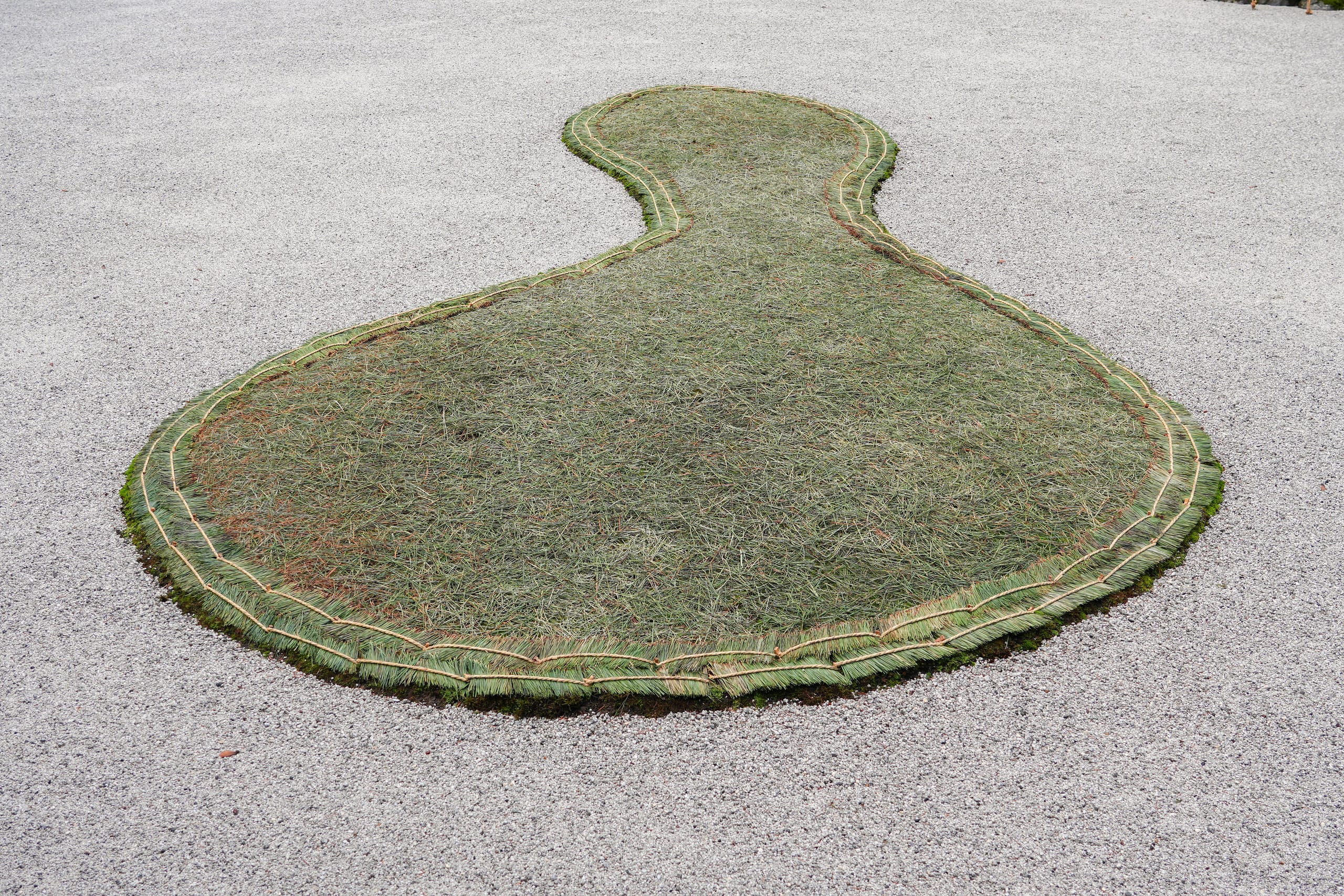
In winter, the Garden Department has begun the practice of crafting shiki-matsuba, coverings of dried pine needles placed on moss to help protect it from frost. These decorations fit within the idea of tei-en no fuyu-jitaku (庭園の冬支度), which translates to “garden’s winter preparation,” or as Torii puts it, caring for the plants by keeping them “cozy” in winter.
Beyond that, moss is remarkably self-sufficient. It doesn’t require fertilizers, pesticides, or herbicides. You don’t need to dig holes to plant it or have to worry about heavy rain washing it away. As long as it’s not engulfed in bright hot sunlight or repeatedly trodden over, moss can and will grow in places like Portland and the mountainous areas of Japan.
A Profound Love of Moss
“Japanese culture also values age and history. Because moss doesn’t grow dramatically overnight – and instead takes years and years to cover the surface of a stone – the Japanese see something inherently virtuous about the plant.” – Mako Nozu & Brian Thompson
While moss, or koke, is found throughout the world, there may be no nation that realizes and recognizes its beauty more than Japan. Thanks to its rainy climate and moisture-rich air, moss thrives there—nearly one-fifth of all known species of moss can be found across the archipelago. It is so abundant and integral to Japan’s makeup that it’s even mentioned in the nation’s national anthem, “Kimi Ga Yo”:
君が代は
千代に八千代に
さざれ石の
いわおとなりて
こけのむすまで
Kimi ga Yo wa
Chiyo ni Yachiyo ni
Sazare-ishi no
Iwao to narite
Koke no musu made
May your reign
Continue for a thousand, eight thousand generations,
Until the tiny pebbles Grow into massive boulders
Until lush with moss
Moss has also served as muse for those with literary ambitions. Yoshitaka Oishi, a preeminent scientist and researcher who teaches at Fukui Prefectural University has noted that it has played a part in coining phrases like, “kokemusu (to become moss-covered) to convey the slow passage of time and the idiomatic koke no koromo (moss garments) to describe the rough, unadorned robes of a Buddhist priest. Japan’s warrior class found a powerful metaphor for the transience of life in the short-lived blossoms of the cherry tree, but moss also provided a somber reminder of the unavoidable fate of all living things, as expressed in the saying koke no shita (beneath the moss), indicating that a person has gone to his grave.”
Oishi has also shared how moss is often associated with wabi sabi. “Wabi has been defined variously in English as tranquil simplicity; austere elegance; unpolished, imperfect, or irregular beauty; rusticity; things in their simplest, most austere, and natural state, a serene, transcendental state of mind,” Diane Durston, Curator Emerita of Portland Japanese Garden has written in her book, Wabi Sabi: The Art of Everyday Life. “Likewise, sabi has been interpreted as the beauty that treasures the passage of time, and with it the lonely sense of impermanence it evokes. It has also been defined as the patina that age bestows, or as that which is true to the natural cycle of birth and death.”
Because its beauty is subtle, earthy, and wizened, moss lends itself well to places and things that evoke thoughts of wabi sabi. As we have shared before, the Tea Garden is a space within Portland Japanese Garden that strongly evokes this essential Japanese aesthetic. This is in no small part due to the lush carpets of moss that soften its grounds, as well as that which is delicately sported by stones and lanterns.
Related | Tranquil Simplicity: Exploring the Meaning of Wabi Sabi in Portland Japanese Garden
Moss is still a vibrant part of Japanese society today. Case in point is a highly popular book published in 2011: Mosses, My Dear Friends by Hisako Fujii. Its popularity was reported to have inspired moss viewing parties among those who called themselves “moss girls.” Japanese resorts, such as Oirase Keiryu Hotel in Aomori Prefecture, offer special moss-themed packages like a “Spring Moss Viewing,” where guests will “learn about the ecology of moss using a giant model approximately 50 times its actual size” and “enjoy the unique appearance of moss flowers during a stroll, followed by tasting moss flower-themed sweets.”
Moss in Japanese Gardens
“’Mosses in themselves are not holy plants. But when I look at them in a garden, I can experience the feeling of something holy. For us Japanese, mosses are special. They express silence, peace and time,’ says Yoshitaka Oishi, professor at Fukui Prefectural University.” – as told to Ulrica Nordström in Moss: From Forest to Garden (2019)
As Sadafumi Uchiyama, Curator Emeritus for Portland Japanese Garden has noted, Japanese gardens aren’t intended to be carbon copies of nature, but rather capture the experience of being in nature. This, plus the reverence the Japanese have for moss makes it only natural that it would be a celebrated feature of the nation’s gardens.
Related | The Distinction of Japanese Gardens as Told by The Experts Who Create and Maintain Them
Oishi, the professor quoted above, has written that mosses were used as ground covered in gardens dating back to the 11th century, and then more intentionally used as selected plantings in gardens next to Zen temples and Roji (tea gardens) in the 15th century. “These concepts in Zen and Roji gardens are associated with bryophyte-covered landscapes,” Oishi has written. “This is because these landscapes suggest a mountain-like ambiance, the passage of time, and tranquility in Japan. These associations suggest that the importance of bryophyte cover in gardens might have increased with the development of Zen and Roji gardens—specifically, mosses came to be used as major ground cover after the establishment of Roji.”
However, it is difficult to pinpoint exactly when moss went from something that was incidental to the development of a Japanese garden to a deliberate element to include. As George Schenk has shared in his 1999 classic, Moss Gardening, “Moss invited themselves into the gardens of Japan and thereby invented moss gardening.”
Other experts appear to agree with this framing. Tomoki Kato, President of Ueyakato Landscape Co. and someone who has honored Portland Japanese Garden by serving as a guest instructor for the Japanese Garden Training Center, told author Ulrica Nordström that “[Mosses] decide which ways in the garden they want to go. That’s what’s fascinating. Mosses have something beyond beauty, which we simply cannot name and which I, as a gardener, cannot influence.”
In other words, mosses, born to this planet many hundreds of millions of years before humanity took its first steps, have long set a rhythm. It’s for us to stay true to their beat.
Will Lerner serves as Marketing and Communications Manager for Portland Japanese Garden.
* While Professor Tono did speak and write in English, his busy schedule often prevented him from editing his letters for grammar and spelling. He once wrote, “…you may find some trouble with my words. Please use your nice imagination.” In that spirit, we have edited his writing for clarity.
References
Choi, C.Q. (2014, June 30). Why that bass beat moves us. LiveScience.com. https://www.livescience.com/46600-why-bass-music-moves-us.html
Grothaus, M. (1969, October 3). Moss garden creates its own environment. The Oregon Journal. https://infoweb-newsbank-com.proxy.multcolib.org/apps/news/document-view?p=AMNEWS&docref=image/v2%3A130FB78394A04B53%40EANX-NB-16EF65DD0C0C76E6%402440504-16EEDA4CCBF35E1A%4037-16EEDA4CCBF35E1A%40.
Heeger, S, (2011, April.) A world apart: Moss in Japan’s gardens. Garden Design. https://www.gardendesign.com/japanese/moss.html
Kimmerer, R.W. (2003). Gathering moss: A natural and cultural history of mosses. OSU Press.
Lueth, V. M., & Reski, R. (2023). Mosses. Current Biology, 33(22), R1175-R1181. https://doi.org/10.1016/j.cub.2023.09.042
Martin, A. (2015). The magical world of moss gardening. Timber Press.
McFadden, D.L. (1976). Oriental gardens in America. Douglas-West Publishers, Inc.
Nordström, U. (2019). Moss: From Garden to Garden: A Guide to the Hidden World of Moss. Countryman Press.
Nozu, M. & Thompson, B. (2015). What’s behind Japan’s moss obsession? The Conversation. https://theconversation.com/whats-behind-japans-moss-obsession-50500
Oishi, Y. (2019). Urban heat island effects on moss gardens in Kyoto, Japan. Landscape and Ecological Engineering, 15(2), 177-184. https://doi.org/10.1007/s11355-018-0356-z
Oishi, Y. (2020, January 2). Japan’s emerald carpets: The cultural importance and environmental promise of moss. Nippon.com. https://www.nippon.com/en/japan-topics/b02350/japan%e2%80%99s-emerald-carpets-the-cultural-importance-and-environmental-promise-of-moss.html?cx_recs_click=true
Oishi, Y. (2022). Why are the aesthetics of modest mosses highly valued in Japanese gardens? The Bryologist, 125(1), 61-69. https://doi.org/10.1639/0007-2745-125.1.061
Parry, R.L. (2008, September 1). Climate change threat to Japanese Zen gardens. The Times. https://www.thetimes.com/travel/destinations/asia-travel/japan/climate-change-threat-to-japanese-zen-gardens-5btfwzwzkfc
Pfanner, E. (2015, November 3). In Japan, moss gathers new fans The Wall Street Journal. https://www.wsj.com/articles/in-japan-moss-gathers-new-fans-1446513218
Schenk, G. (1999). Moss gardening: Including lichens, liverworts, and other miniatures. Timber Press.
Seivert, D. (2016). A tour of moss gardens in Japan and North America. The Journal of the North American Japanese Garden Association, 3, pp. 23-29. https://najga.org/a-tour-of-moss-gardens-in-japan-and-north-america/